
A user tenant corresponds to a database management system that you are familiar with and can be considered as a database instance. It is created by the system tenant based on business requirements. A user tenant has all the characteristics that an instance should have, mainly including:
- The ability to create its own users.
- The ability to create all types of objects, such as databases and tables.
- Its own system tables and system views.
- Its own system variables.
- Other characteristics of a database instance.
The metadata of all user data is stored in the user tenant. Therefore, each tenant has its own namespace, which is isolated from other tenants and inaccessible. The system tenant manages all user tenants. The hierarchical relationship between the system tenant and user tenants is shown in the following figure.
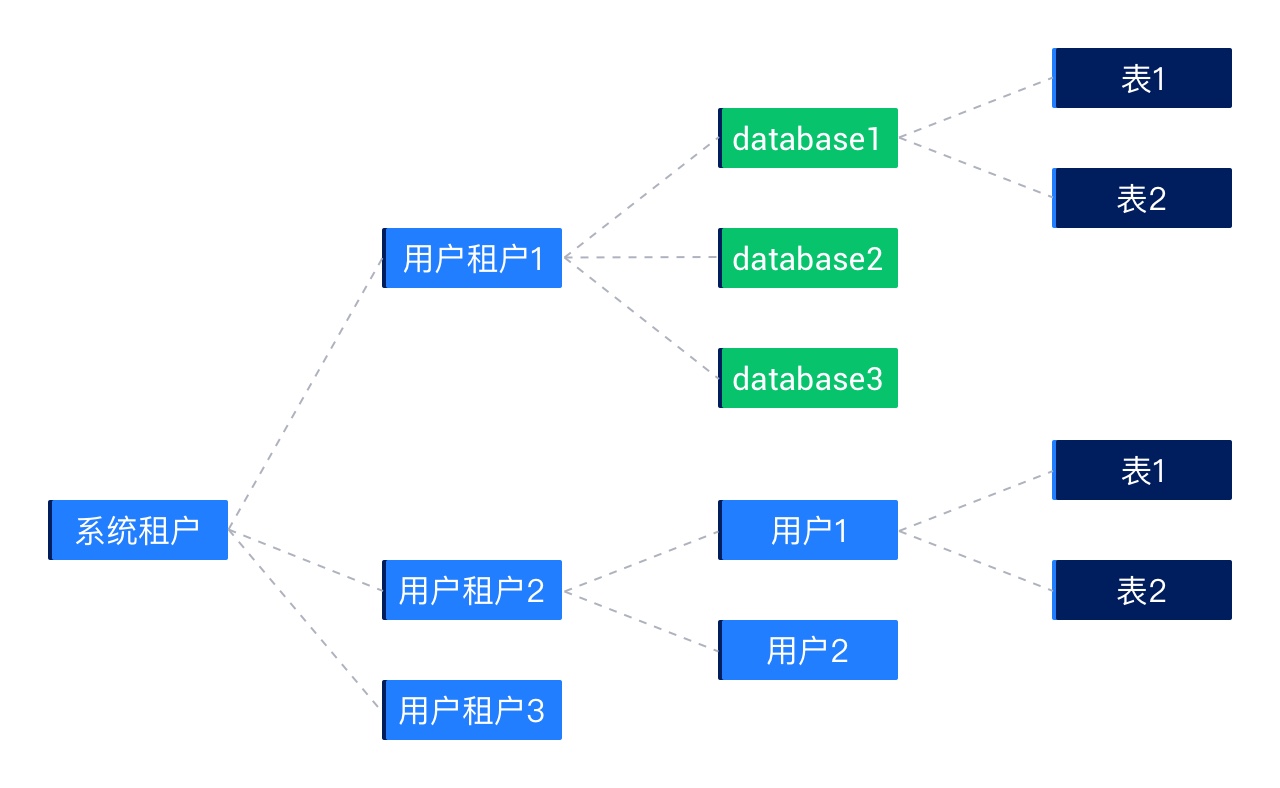
Users created in a user tenant can log in only to that tenant and are invisible to other tenants. You can query user information from the mysql.user view.
You can create tables in a user tenant. After a table is created, it is invisible to other tenants. You can query information about all user tables in the current tenant from the information_schema.tables view.
A user tenant can modify only the system variables of the tenant. You can query system variable information from the information_schema.global_variables and information_schema.session_variables views. You can also use the SHOW VARIABLES statement to query system variables.