
OceanBase AI Database adopts a storage-compute separated shared-storage architecture. The three core capabilities of a traditional database—compute, log, and storage—are decoupled into three independent layers. Each layer has a clear responsibility and evolves independently, together providing high performance, high availability, low cost, and elastic scalability.
Compute layer (OBServer):
The Compute Layer consists of OBServer nodes and serves as the SQL entry point of the database. It provides SQL execution and transaction processing capabilities.
Compute nodes cache hot data on local disks to accelerate data reads. They are designed to be stateless, do not rely on local log disks, support efficient elastic scaling, and can be deployed in single-replica mode, significantly reducing computing costs.
Log layer (LogService):
The log layer is an independent distributed log storage system responsible for log persistence, availability, and log I/O.
By default, the logging layer uses a Paxos three-replica deployment. Replicas are automatically distributed across different zones, ensuring no data loss or service interruption if a failure occurs in any zone. Log writes are directly persisted to local high-performance storage, resulting in extremely low latency.
Storage layer (Object Storage):
The storage layer is the system's data foundation, providing massive, persistent data storage and shared access capabilities based on object storage.
The storage layer unifies the storage of log files, baseline data, and minor compaction data, and supports object storage compatible with the S3 protocol. Multiple replicas of the same log stream share the same underlying data file, avoiding duplicate storage and minimizing storage costs. Object storage inherently possesses cross-zone disaster recovery capabilities, ensuring long-term reliable data preservation.
Concepts
Zone: An OceanBase AI Database cluster consists of multiple nodes across one or more zones. Each node belongs to only one zone, while each zone may contain multiple nodes. A zone is the basic unit for high availability and disaster recovery in a cluster, and cross-zone deployment is supported for fault isolation.
Tenant: OceanBase AI Database supports creating multiple isolated database instances within a single cluster, known as tenants. Each tenant has independent resource quotas, permission systems, and data spaces, with no interference between them. The cluster supports creating tenants in MySQL-compatible mode. After connecting to a tenant, applications can create users, databases, and database objects within that tenant, with a MySQL-like experience.
Partition: A partition is a logical horizontal split of a table, created according to user-defined partitioning rules. Each row belongs to exactly one partition. Supported partition types include Hash, Range, and List.Multiple partitions of the same table can be distributed across multiple nodes within an AZ to enable distributed storage and parallel processing.
Tablet: A Tablet is the basic physical storage unit in OceanBase AI Database. Each table partition corresponds to one Tablet, which stores the ordered records of that partition. A Tablet is the minimum unit for data read/write, migration, and replica management.
Log Stream (LS): A Log Stream is the logical unit that provides persistence and consistency guarantees for data. When a Tablet is modified, Redo logs are written to the Log Stream that owns that Tablet. A Log Stream can serve multiple Tablets on the same node, enabling efficient log aggregation and management.
Leader: The Leader is the write replica of a Log Stream. It handles transactional writes and strongly consistent reads. A Log Stream has exactly one Leader at any time.
Follower: A Follower is a read-only replica of a Log Stream. It supports weak-consistency reads. It does not accept write requests. Instead, it fetches logs from the LogService and replays them to remain synchronized with the Leader. A Follower can be promoted to Leader when needed.
LogService Replica: A LogService replica is a storage replica of a Log Stream at the log layer. Each LogService replica is uniquely bound to the Log Stream in the compute layer via the
<cluster_id, tenant_id, ls_id>triplet. The compute layer and log layer cooperate through Paxos to provide high-performance log writes, strong consistency, and cross-AZ disaster recovery.ODP (OceanBase Database Proxy): ODP is the database proxy component of OceanBase AI Database. It sits between applications and the OBServer cluster and provides SQL routing, connection pooling, read/write splitting, load balancing, automatic failover, and protocol compatibility. ODP transparently routes application connections to backend OBServer nodes, allowing applications to remain unaware of cluster topology changes.
Single-replica architecture
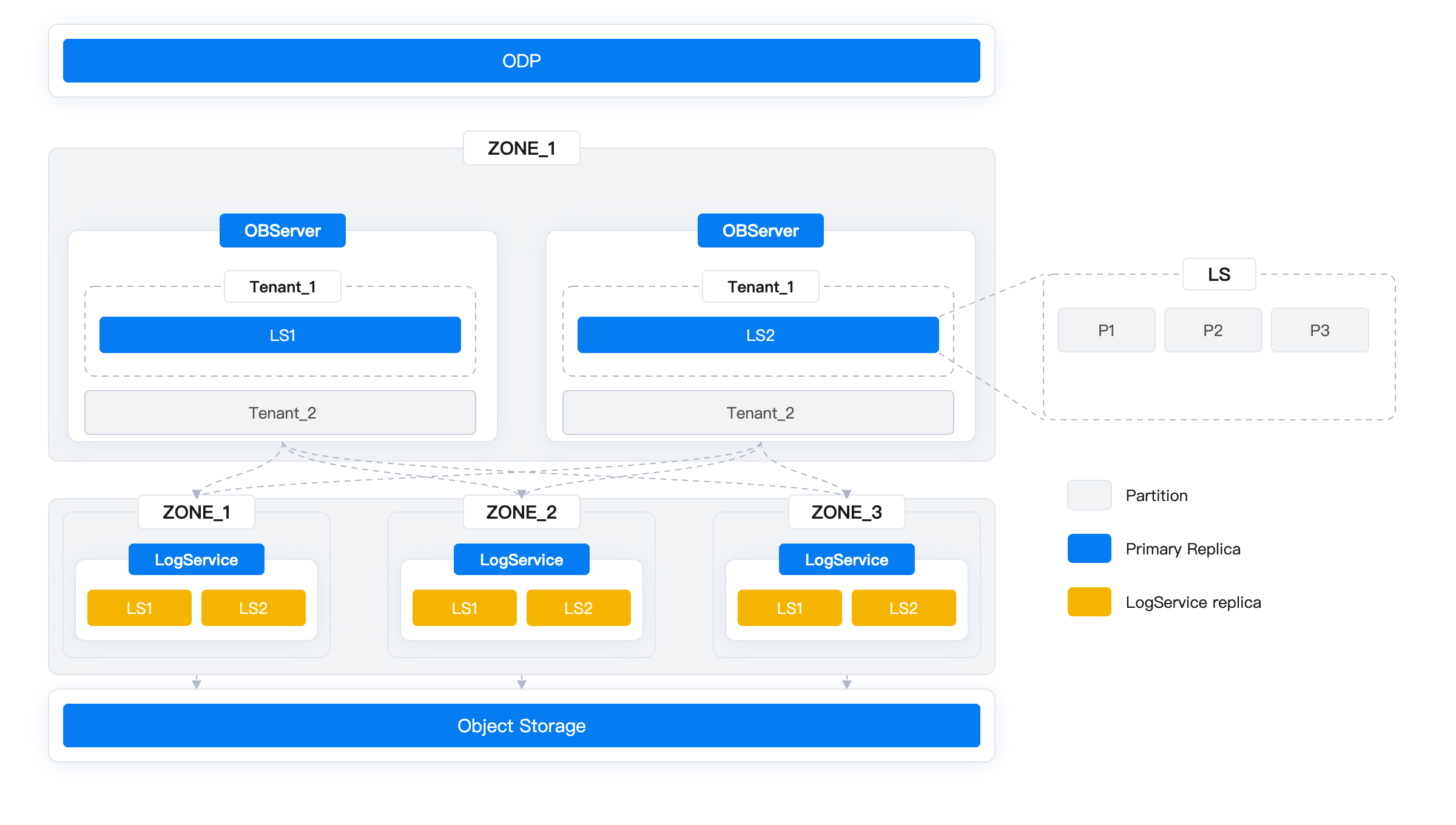
- Compute layer (OBServer): Single replica, single zone, multi-node
- Log service layer (LogService): Three replicas to ensure high availability of logs
- Storage layer: Standard object storage
Advantages
- Ultra-low compute cost: Compared with the traditional three-replica architecture, the compute cost is reduced by 66%.
- Minimal resource consumption: Requires only one replica of compute nodes, resulting in the lowest resource usage.
- Simple operation and maintenance: Deployment and management complexity is minimized.
- Cross-zone disaster recovery: With the 3-replica deployment of the independent LogService, cross-zone disaster recovery is possible even with single-replica compute nodes.
- RPO = 0: Lossless automatic disaster recovery with zero data loss.
- Fast elasticity: Scaling in and out does not require data migration.
Limitations
- Availability risk: In a cluster with multiple compute nodes, failure of a single node will invalidate that node’s cache, causing the response time of some SQL statements to increase for a period of time. In a cluster with single compute node, a node failure will make the service unavailable until a new compute node is brought online.
- Recovery time: Although RPO = 0, RTO is in the order of minutes.
- Performance bottleneck: All read and write requests are concentrated on a single replica.
Application scenarios
- Cost-sensitive workloads: Scenarios with extremely strict cost requirements.
- Non-critical business systems: Scenarios that can tolerate temporary performance fluctuations or service interruptions.
- Backup/Historical databases: Primarily used for data archiving and querying.
- Testing/development environments: Environments with limited resources.
- Highly elastic workloads: Workloads that require rapid scaling in and out.
Two-replica architecture
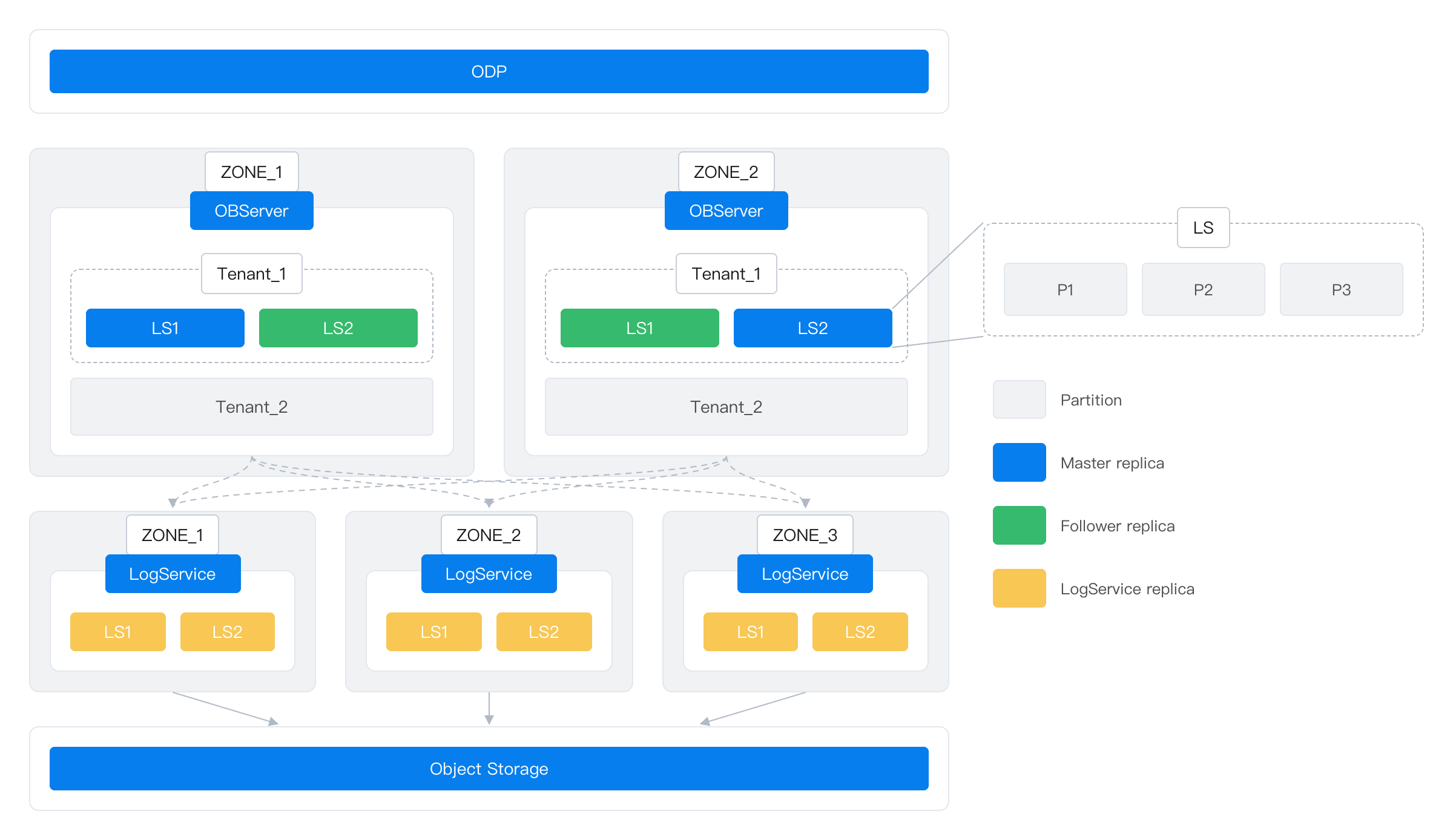
- Compute layer: Two replicas
- Log layer: Three replicas to ensure high availability of logs
- Storage layer: Standard object storage
Advantages
- High availability: The two replicas back each other up, improving service availability.
- Load balancing: Read and write traffic can be distributed.
- Failover: When the primary replica fails, the service can quickly switch to the standby replica, with RTO < 8 seconds.
- Moderate compute cost: Compared with the traditional 3-replica architecture, compute cost is reduced by 33%.
- Better performance: Workload can be shared to avoid a single-node bottleneck.
- Fault tolerance: Can tolerate data center-level failures.
Limitations
- Higher resource consumption: Requires twice the compute resources of single-replica mode.
- Higher cost: Compared with single-replica mode, cost increases by 100%.
- Deployment complexity: Requires maintaining synchronization between the two replicas.
- Fault detection: Requires more complex fault detection and switchover mechanisms.
Application scenarios
- Core business systems: Scenarios with high availability requirements.
- 24/7 services: Services that cannot tolerate long interruptions.
- High-performance workloads: Workloads that require load balancing to reduce pressure.