
Scenario overview
AI applications and agent data management
Core capabilities of the OceanBase AI Database:
- Data isolation: Multi-level isolation at the tenant, database, namespace, table, and row/column levels.
- Logical tables: Supports data isolation for millions to tens of millions of Agent instances.
- Hot/cold data tiering: Enables low-cost retention of 99% dormant instances.
Agent evaluation
Core capabilities of the OceanBase AI Database:
- Fork Table/Database: Provides a data sandbox with Git-like branch management. Millisecond-level copy-on-write forks share baseline data while isolating incremental changes.
Multimodal data processing
Core capabilities of the OceanBase AI Database:
- Multimodal tables (coming soon): Stores articles, images, audio, and video as LOBs in tables, with in-row, out-of-row, and out-of-database reference storage modes available based on scale.
- File processing: Supports model-in-database processing, enabling parsing, chunking, embedding generation, and index construction within the database.
RAG/semantic search/memory recall
Core capabilities of the OceanBase AI Database:
- Hybrid search: Supports vector, full-text, and scalar search across unstructured, semi-structured, and structured data, enabling hybrid search in a single SQL statement.
- Fusion ranking: Provides multiple in-database rank fusion algorithms, including RRF, MINMAX_NORMALIZER, and WEIGHT_SUM, for high-performance, high-accuracy retrieval.
- RAG pipeline in DB: Supports the full RAG workflow through a SQL interface, from file ingestion to answer delivery.
MySQL + ES + VectorDB integration
Core capabilities of the OceanBase AI Database:
- One engine: Eliminates the need for multi-component dual writes, CDC synchronization, or cross-system queries, ensuring data consistency.
- One data set, multiple query types: Supports hybrid search over a single data set, including scalar, JSON, full-text, and vector search.
Real-time data warehouse
Core capabilities of the OceanBase AI Database:
- Streaming-batch unification: Supports both high-frequency real-time writes and large-scale batch ingestion, eliminating the need for a complex Lambda architecture.
- Materialized views: Supports incremental and full refreshes for near-real-time and real-time queries, enabling real-time data processing and flexible data warehouse layering.
- Row-column hybrid storage: Allows flexible row storage, column storage, and row-column hybrid storage definitions, efficiently supporting multiple query types with a single copy of data.
- Vectorized engine: Processes data in batches, delivering an order-of-magnitude performance improvement over non-vectorized execution.
- MPP: Provides a native MPP computation engine with a multi-level parallel execution strategy across nodes, partitions, and tasks, enabling elastic scaling.
- Storage-compute separation: Allows independent scaling of compute, storage, and log service resources on demand while keeping cold data at low cost.
- Single replica: Supports cost reduction through single-replica deployment, with full data storage based on an independent log service and object storage, while still guaranteeing RPO=0.
Data processing
Core capabilities of the OceanBase AI Database:
- Resource isolation: Uses a two-level resource isolation strategy across tenants and resource groups, ensuring that data processing and interactive analytics do not interfere with each other.
- Engine integration: Compatible with the Arrow Flight SQL protocol, natively integrates Spark, Daft, and Ray engines, enabling closed-loop PB-scale batch processing and feature engineering within Lakebase.
Data lake fusion
Core capabilities of the OceanBase AI Database:
- Iceberg/Paimon/Hive integration: Accelerates query and analytics on the data lake while supporting data ingestion into the lake from the database.
- Parquet/ORC/CSV adaption: Optimizes performance with local caching, partition pruning, predicate pushdown, statistics, Bloom filter pruning, and other techniques for efficient computation.
- Unified Catalog management: Synchronizes table metadata from the database to HMS through catalog sync, enabling unified metadata management and sharing.
Massive KV/HBase replacement/historical database/archive database
Core capabilities of the OceanBase AI Database:
- Low-cost storage: Stores massive datasets in object storage to support KV, SQL, and analytics workloads, while still guaranteeing RPO=0 through single-replica deployment.
- Hot/cold data tiering: Uses local caching for hot data and shared storage for full data, reducing archival migration overhead.
Introduction to OceanBase AI Database
Over the past decade, OceanBase has powered millisecond-level responses for core Alipay transactions, achieved world-leading benchmark results with 707 million tpmC on TPC-C and 15.26 million QphH on TPC-H, delivered extreme high availability with RTO < 8 seconds, and supported the stable production launch of core systems for more than 4,000 customers. These achievements reflect OceanBase’s long-standing commitment to solving one fundamental problem: how to help people manage structured data more effectively.
As AI agents increasingly take on real enterprise workloads, unstructured data has become a major enterprise asset. However, existing data management approaches are facing several challenges:
- Unstructured data remains underutilized: Unstructured data accounts for 70%–90% of organizational data, yet unified management and analytics tools are still lacking.
- Data and AI remain disconnected: Data teams and AI engineers often work on separate platforms, making collaboration difficult.
- Data freshness is insufficient: Traditional lakehouse architectures are primarily batch-oriented and struggle to support second-level responsiveness and dynamic queries for streaming data.
- The technology stack is fragmented: Online transactions, massive data storage, real-time analytics, vector search, and full-text retrieval are often handled by multiple systems.
- Data consistency is difficult to maintain: When a single data set flows across multiple systems, it is difficult to guarantee consistency for cross-system queries.
To address these challenges, AI-driven business transformation is reshaping database requirements in the following areas:
- Lake-database convergence: Integrates the open formats and massive storage of data lakes with the transactional, consistent, and real-time capabilities of databases, enabling structured, semi-structured, and unstructured data to be stored, analyzed, and searched within a unified system.
- Multimodal tables: Extends relational tables to support text, images, audio, and video as native data types, managed under the same transaction, permission, versioning, and lifecycle mechanisms.
- Hybrid search: Unifies scalar filtering, vector search, and full-text search in a single query pipeline, enabling multi-path retrieval, relevance ranking, and consistency maintenance within the database.
- Agent-friendly capabilities: Provides native support for long-term memory, session context, business state, action logs, and iterative workflows, helping AI applications move from validation to production.
- Open ecosystem: Supports S3-compatible object storage, open table formats such as Iceberg and Paimon, and integration with Spark and Ray, reducing data duplication, format conversion, and system lock-in.
OceanBase AI Database is a next-generation, multimodal database with hot-cold data tiering and storage-compute separation, built on the production-proven distributed foundation of OceanBase and tailored for AI data scenarios. It is not just an upgrade of OceanBase Database capabilities but also a product innovation in data management for the AI era.
Product architecture
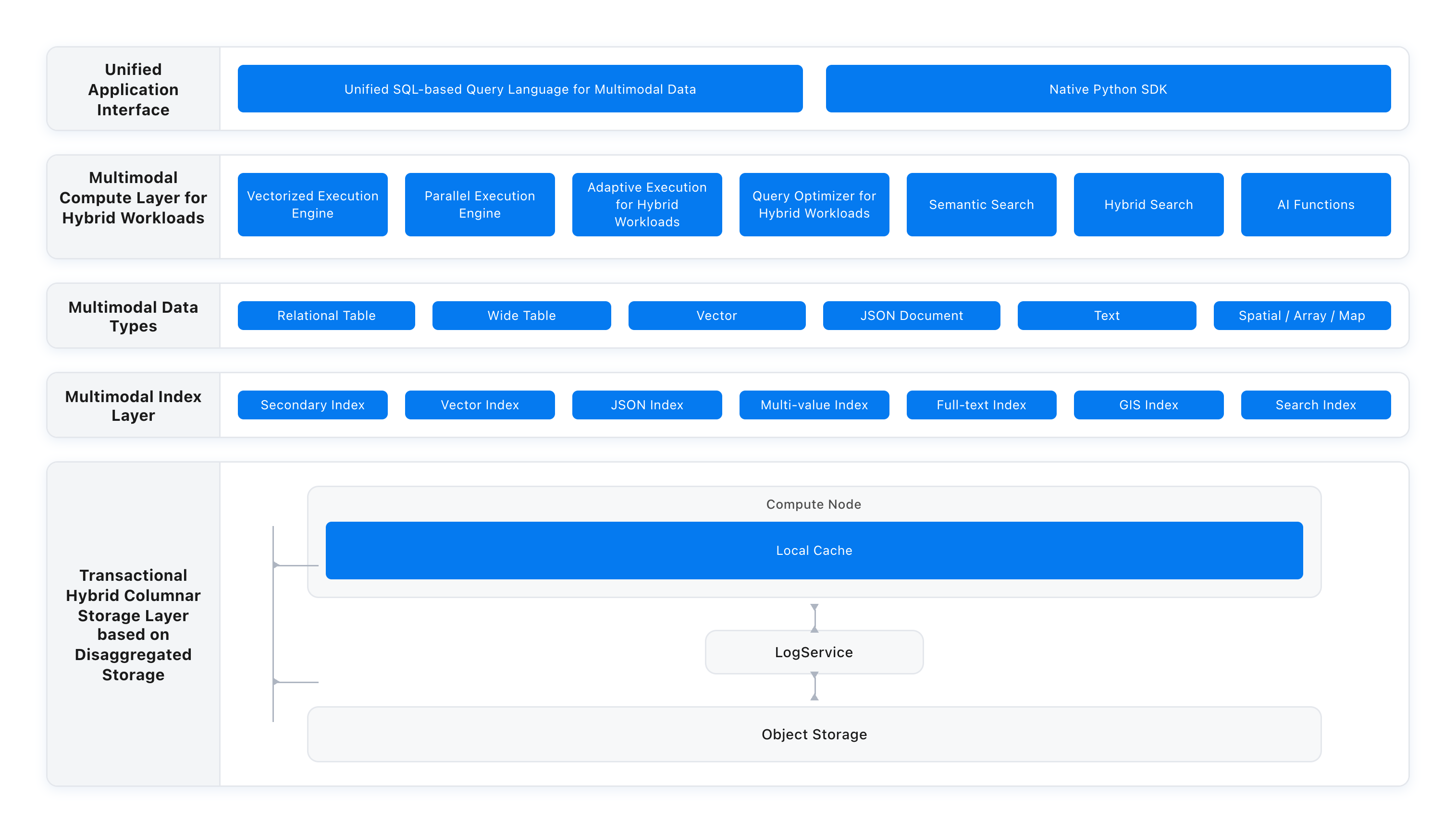
Unified application interface:
- Unified query language: A single SQL syntax allows access to all multimodal data types, eliminating the need to learn separate query languages for vector, full-text, and other multimodal searches.
- Native Python SDK: Provides an easy-to-use Python SDK, that lowers the complexity of Agent access and facilitates integration with AI ecosystem frameworks.
Multimodal computing layer for hybrid workloads:
- Vectorized execution engine: Processes data in columnar batches, improving analytical performance on large data volumes.
- Parallel execution engine: Enables multi-node, multi-core parallelism to support large-scale scans and aggregations.
- Hybrid workload adaptive execution and query optimizer: Supports the coexistence of TP, AP, and AI workloads within the same cluster, with automatic resource scheduling and adaptive plan selection.
- Semantic search: Supports vector-based nearest neighbor search.
- Hybrid search: Supports multi-path retrieval and fusion ranking across structured filtering, vector search, and full-text search.
- AI functions: Enables direct model inference calls within SQL.
Multimodal data types:
- Native support for multiple data models: Eliminates the need for separate external databases, supporting relational tables, wide tables, vectors, JSON documents, text, spatial data, and arrays/maps. A single table can contain structured columns, JSON columns, vector columns, and text columns, with cross-type queries supported at query time.
Multimodal index layer:
- Native support for multiple index types: Eliminates the need for separate external databases, supporting secondary indexes for relational tables, vector indexes for vectors, JSON indexes for JSON documents, multivalue indexes for arrays/multivalue columns, full-text indexes for text, GIS indexes for spatial data, and search indexes for multi-column inverted indexing. Each data type is matched with an appropriate indexing acceleration path.
Row-column hybrid storage layer with transactional semantics based on storage-compute separation:
- Local cache: Hot data is cached on local SSDs on compute nodes to ensure performance.
- Independent log service: A Paxos-based distributed transaction log service persists and replicates transaction logs (clogs), ensuring transactional semantics.
- Object storage: Serves as the final persistence layer and destination for all data, providing low cost and near-unlimited capacity.
- Row-column hybrid storage: The same storage layer supports both row-oriented and column-oriented storage, eliminating the need to synchronize data between separate row and column databases as in traditional solutions.
Core capabilities
Agent database: Native support for isolation, memory, and trial-and-error
As AI drives the cost of building apps close to zero, the real challenge shifts to long-term operation:
- Tens of millions of app/agent instances, 99% of which are dormant but must respond within seconds when awakened.
- Agents cannot start from scratch every time; they need to remember users, contexts, business facts, and historical judgments.
- Agents may automatically alter schemas, write data, and switch strategies, but failed paths must not pollute production data.
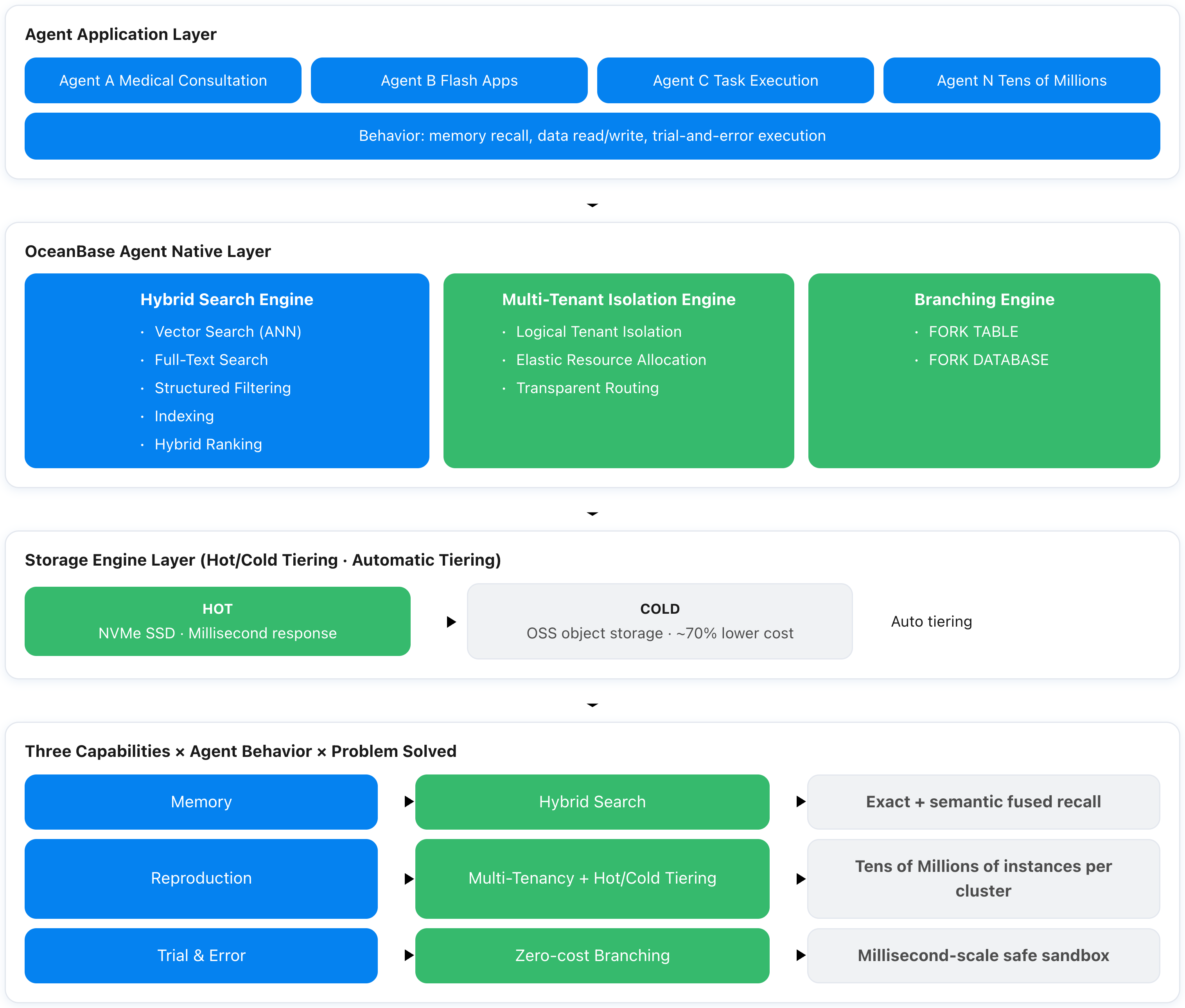
OceanBase AI Database makes the three core Agent behaviors—isolating, remembering, and experimenting—native database capabilities.
- Isolation: Supports five levels of isolation across tenants, databases, namespaces, tables, and rows/columns, meeting isolation requirements across scenarios and supporting tens of millions of application instances.
- Memory: Supports Agent memory retrieval in a single SQL statement, without crossing systems, while data consistency is guaranteed by database transactions.
- Trial-and-error: Generates multiple isolated experiment databases from the same baseline data in milliseconds; experiment databases can be discarded or merged when testing is complete.
For more information, see native capabilities for agent scenarios in Core features.
Multimodel database: Turning unstructured data into a computable asset
Approximately 90% of enterprise data is unstructured (images, videos, documents, audio). This data has long been stored in object storage or file systems in a "store-only, do-not-analyze" manner, consuming costs without being directly understood or used by business systems.
In the AI era, large models have made unstructured data understandable for the first time: images can be interpreted, audio can be transcribed, and documents can be summarized. But the real production challenge is that raw files, model outputs, and business metadata are still scattered across different systems, making unified governance, efficient search, and result write-back difficult to implement as a single integrated solution.
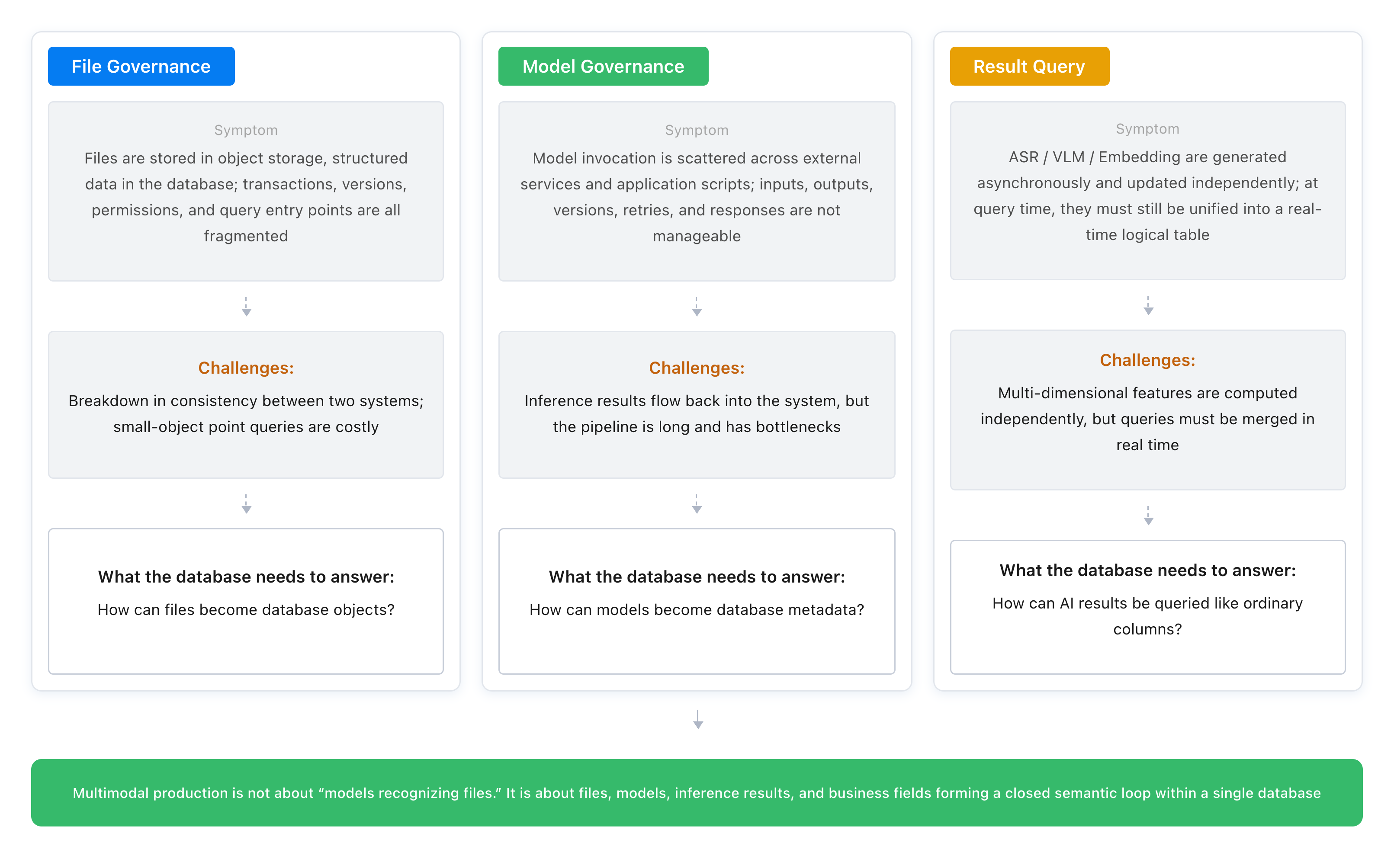
OceanBase AI Database brings LOB files, AI models, inference results, and business fields under one database semantic model:
- Unified LOB governance: Documents, images, audio, and video are automatically stored in InRow, OutRow, or object storage based on size, with unified transaction processing and permission management in the database.
- Model in database: Large models become first-class citizens in the database and can be defined, managed, and referenced. With AI operators, the database supports parsing, summarization, embedding generation, and other multimodal file processing tasks, while also enabling the creation of indexes for efficient querying.
- Hybrid search: Scalar, vector, and full-text search are executed in a single SQL statement, with multi-path retrieval and automatic fusion ranking.
Unstructured data is no longer just stored; it can now be queried by SQL, searched through hybrid search, and directly consumed by business systems, evolving a structured database into a multimodal database.
For more information, see multi-model integration in Core features.
Lake-warehouse-database convergence: One system, one technology stack
"Lake-warehouse-database convergence" is not about simply packaging three systems together. It is about using the same data, the same metadata, and the same SQL semantics to satisfy the low-cost requirements of a data lake, the analytical capabilities of a data warehouse, and the transactional requirements of a database within a single engine.
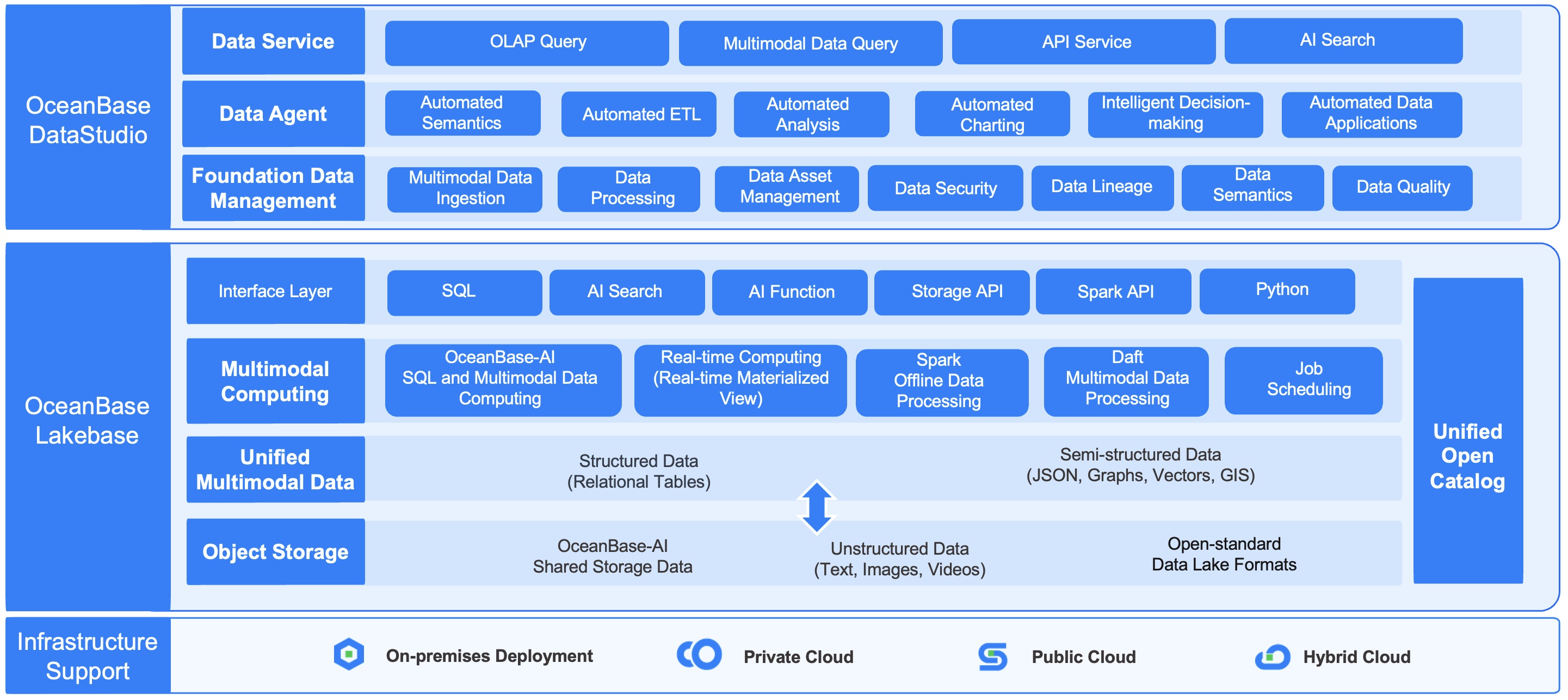
As the core lake-database engine, OceanBase AI Database powers the orange-highlighted part in the diagram, while Lakebase serves as the complete platform, covering the following capabilities with one technology stack:
Traditional Capabilities |
OceanBase AI Database/Lakebase |
|---|---|
| Low-cost data lake storage | Object storage as primary storage |
| Unstructured files | LOB Tiered Storage (InRow/OutRow/Object Storage) |
| Offline/Real-time ETL | Spark, Daft on Ray, real-time/near-real-time materialized views, and elastic scaling |
| Data warehouse analytics | Columnar storage, row-column hybrid storage, vectorized execution, parallel execution, and resource isolation |
| Database transactions | ACID, MVCC, and distributed transactions |
| Vector Search | Native vector type, HNSW/IVF indexes |
| Full-text search | BM25 full-text indexing, multilingual tokenization |
| Data governance | OceanBase DataStudio provides data development, asset management, lineage tracking, and task scheduling. |
For more information, see lake-warehouse-database convergence in Core features.
Storage-compute separation: Single-replica cost, multi-replica reliability
In the AI era, data has two clear characteristics: massive scale and uneven hot-cold distribution. Storage-compute integrated architectures deliver efficient response performance, but they also introduce significant resource costs. Every increase in data volume requires scaling both compute nodes and local SSDs, while cold data still occupies expensive local disks and three-replica or two-replica space.
OceanBase AI Database adopts a storage-compute separated architecture with hot-cold tiering and decoupled log and compute services, balancing resource cost, reliability, and performance.
- Three-layer decoupling: Compute, log, and storage are deployed and scaled independently, without interfering with one another.
- Stateless compute nodes: Compute nodes do not persist full data, so elastic scaling does not require data migration, and single-replica deployment is supported to reduce cost.
- Independent log service: LogService is deployed in a Paxos three-replica configuration. Transaction logs are acknowledged only after confirmation by a majority of replicas, ensuring RPO=0.
- Object storage foundation: All data is ultimately persisted in low-cost object storage, with near-unlimited capacity and shared access across multiple compute nodes.
- Automatic hot/cold data tiering: Hot data is cached in local SSDs to ensure performance, while cold data remains in object storage. The system automatically identifies access popularity and migrates data accordingly.
For more information, see storage-compute separation architecture in Core features.
RAG pipeline in database: Documents In, answers out
RAG applications such as enterprise knowledge bases, intelligent customer service, and document question answering typically rely on multiple systems: document storage, text parsing, embedding services, vector databases, full-text search, reranking models, and large-model inference. Moving data among these systems introduces synchronization latency, consistency maintenance issues, and operational complexity.
OceanBase AI Database brings the entire RAG pipeline into the database, enabling "documents in, answers out" within a single system.
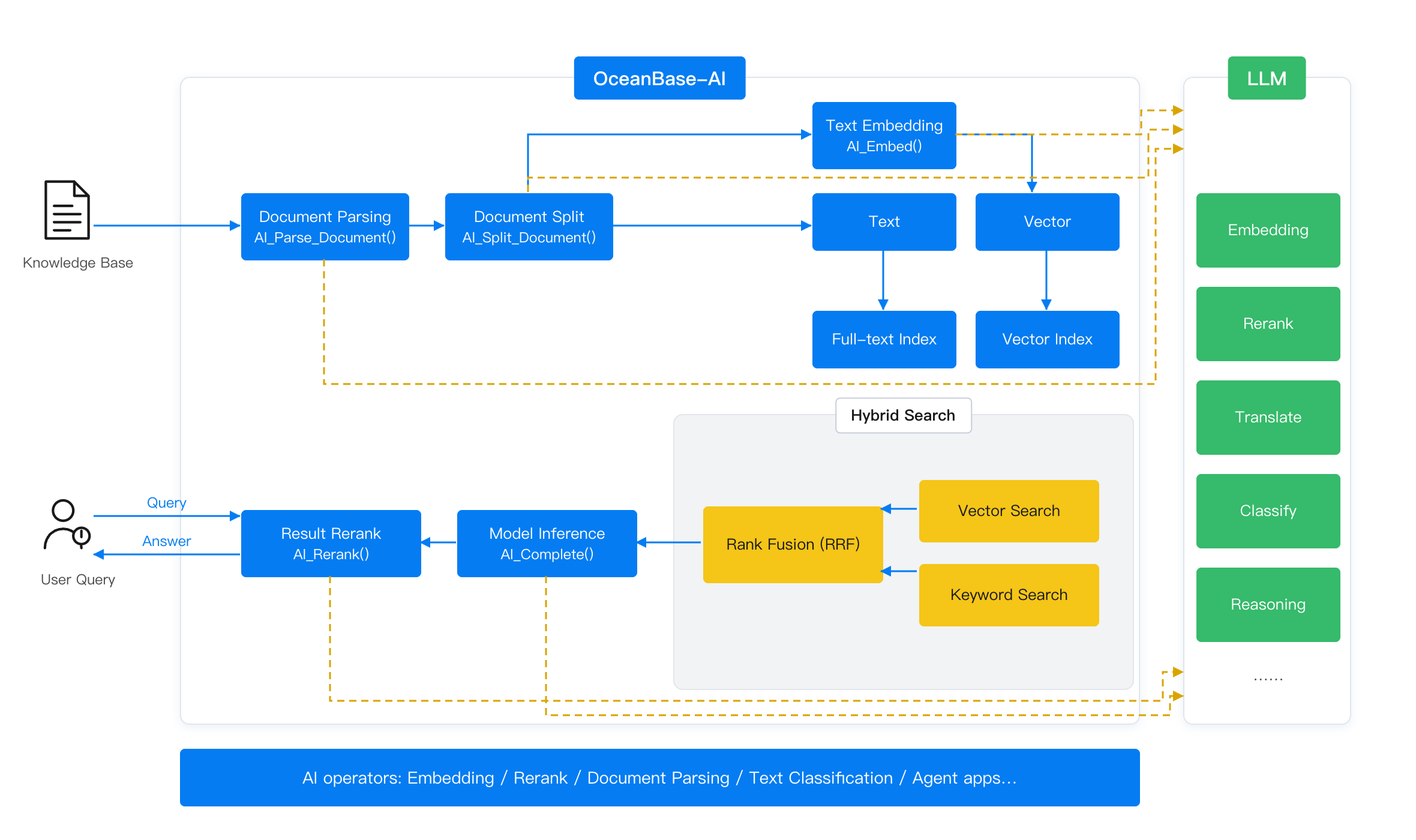
As shown in the diagram, the RAG Pipeline in the Database consists of two main flows:
- Document ingestion: Knowledge base documents → document parsing → document chunking → text embedding → full-text index + vector index construction
- User query: User question → hybrid search → weighted fusion → result reranking → model inference → answer return
The entire pipeline, from document ingestion to user query, is completed in the database:
- AI functions: Document parsing (AI_Parse_Document), document chunking (AI_Split_Document), text embedding (AI_Embed), result reranking (AI_Rerank), and model inference (AI_Complete) can all be directly called in SQL.
- Dual in-database indexes: Full-text indexes for keyword retrieval and BM25 ranking, together with vector indexes for semantic similarity retrieval, are built on the same text chunks in the database, eliminating synchronization to external ES or vector databases.
- Hybrid search: A single SQL statement simultaneously initiates vector search, keyword search, and scalar filtering, with ranking fused by algorithms such as RRF, WEIGHT_SUM, and MINMAX_NORMALIZER.
- Scalable AI operators: AI operators can cover embedding, reranking, document parsing, text classification, and other model types, and new AI operators can also be defined through Python UDFs.
For more information, see Core features.
FAQ
Q: What is the relationship between OceanBase AI Database and OceanBase Database?
They share the same core engine but serve different purposes: OceanBase Database is primarily designed for TP/HTAP scenarios with extremely high requirements for response-time stability, while OceanBase AI Database is primarily designed for AI and lakehouse analytics scenarios.
Q: What disaster recovery capabilities does it provide?
LogService uses strong synchronous replication across three replicas. With a 1F deployment, it provides RPO=0 and RTO on the order of minutes. With a 2F deployment, it provides RPO=0 and RTO < 8 seconds.
Q: What deployment channels are supported?
Both on-premises deployment and OB Cloud are supported. However, OceanBase AI Database is not yet available on OB Cloud. For available regions, specifications, and launch timelines, please refer to OceanBase Cloud product updates or contact OceanBase sales. It supports x86, ARM, and mainstream domestic operating systems.
Q: What compatibility modes are available?
It supports MySQL-compatible mode and KV-compatible mode. The KV-compatible mode includes OBKV-Table and OBKV-HBase.
Q: How does it differ from OceanBase Database in surrounding tools and ecosystem support?
It still supports ODP and MySQL ecosystem drivers, and it also supports the existing toolchain, including OCP, ODC, OMS, OceanBase Loader and Dumper, and DataPilot. In addition, it now supports the DataStudio platform.
Q: Is the compute node scaling flexible?
OceanBase AI Database adopts a storage-and-compute separation architecture, with data persisted in object storage and local disks used only as caches. Compute nodes can be scaled up or down flexibly on demand.
Q: How large should the local cache be?
With hot-cold data tiering, the recommended setting is max(memory × 3, hot data × 2).