
The deployment of OBKV-HBase consists of two parts:
Deploy an OBKV cluster: The OBKV cluster is an OceanBase AI Database cluster for a MySQL tenant. For more information, see Deploy OceanBase AI Database.
Configure the OBKV client: The client configuration differs depending on whether you use a cloud service or deploy OBKV-HBase on-premises.
Deploy an OBKV cluster
You can select an appropriate deployment solution as needed.
Select an appropriate deployment solution
Select an appropriate deployment solution based on your requirements.
OceanBase AI Database uses a shared-nothing multi-replica architecture to eliminate single points of failure and ensure system continuity. OceanBase AI Database supports high availability and disaster recovery at the single-machine (a cluster deployed in a single IDC), IDC (a cluster deployed across multiple IDCs within the same city), and city (a cluster deployed across multiple cities) levels. You can deploy a cluster in single-IDC, dual-IDC, two-region-three-IDC, and three-region-five-IDC configurations, and deploy an arbitration service to reduce costs.
Select an appropriate deployment method
Currently, OceanBase AI Database clusters can be deployed only by using OCP. For more information, see Deploy a three-replica OceanBase AI Database cluster by using OCP.
Plan resources
Before deployment, you need to plan and prepare the resources required.
- For server configuration requirements, see Prepare servers.
Configure the OBKV client
The following figure shows the differences between deploying OBKV-HBase on a public cloud and on-premises.
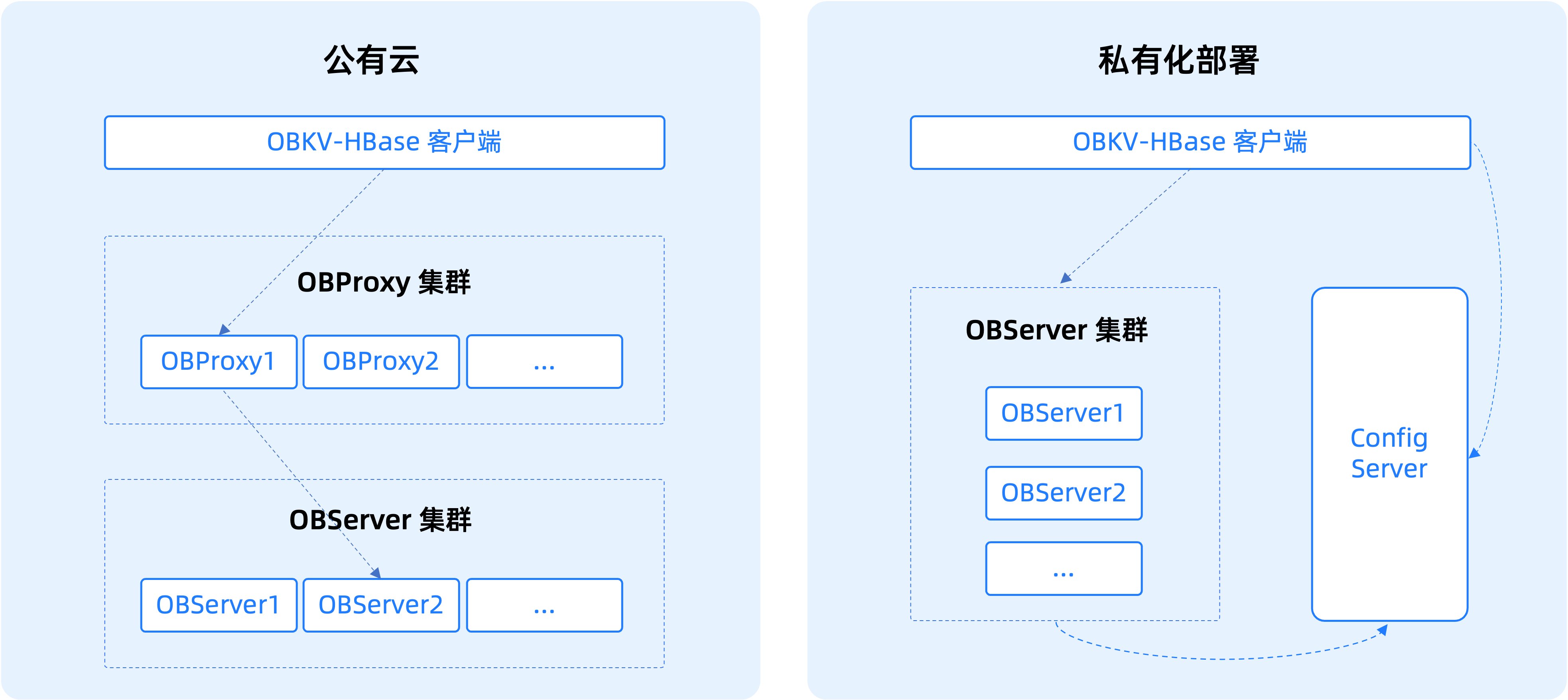
Direct connection mode
You can use the direct connection mode for on-premises deployment.
- The OceanBase Config Server provides metadata registration, storage, and query services.
- The OBKV-HBase client has a built-in data routing feature. In direct connection mode, data is directly delivered to the destination data node.
- When the RegionServer list of the OBServer cluster changes, the change is pushed to the Config Server. OBKV-HBase can obtain the RegionServer list from the Config Server in real time. Generally, OBKV-HBase can detect changes to the RegionServer list by itself. The Config Server is accessed only during client initialization or when the RegionServer list is offline.
Notice
In direct connection mode, there is no need to deploy the OceanBase Database Proxy (ODP).
Public cloud mode
In a public cloud environment, the business cluster and the database cluster are network-isolated, so you must rely on ODP to route messages.
Notice
In some on-premises deployment scenarios, network isolation also exists between the business and database IDCs. In such cases, you can also deploy ODP. Based on IP address mapping and the load balancer, business requests are sent to ODP, which then forwards them to the database.