
This topic describes the basic concepts and physical architecture of an OceanBase AI Database cluster.
OceanBase AI Database is a distributed database that consists of multiple physically scattered database units. These database units are logically unified by the computer network to form an OceanBase AI Database cluster.
An OceanBase AI Database cluster consists of multiple zones. A zone is a logical container for node management. Generally, a group of nodes in the same zone have similar disaster recovery attributes. A zone is usually an independent physical deployment unit, which can be an Internet Data Center (IDC), an availability zone in a cloud, or an independent rack. You can deploy your OceanBase AI Database cluster across different zones to implement fault isolation and quick recovery when a zone fails.
OceanBase AI Database is a single-process software. Its process is named observer. Generally, one physical server or virtual machine (VM) runs one observer process that is uniquely identified by an IP address and a port number. This server is called an OBServer node or simply a node. The observer process is the core component of OceanBase AI Database and provides all database kernel features, such as the SQL engine, storage engine, and transaction engine. The process also provides distributed features such as RPC communication, partition management, and load balancing.
OceanBase AI Database consists of two components: OBServer and LogService. LogService requires a three-replica deployment and at least three nodes, while OBServer can be deployed with one or two replicas.
Taking a two-replica OBServer deployment as an example, the deployment architecture is as follows:
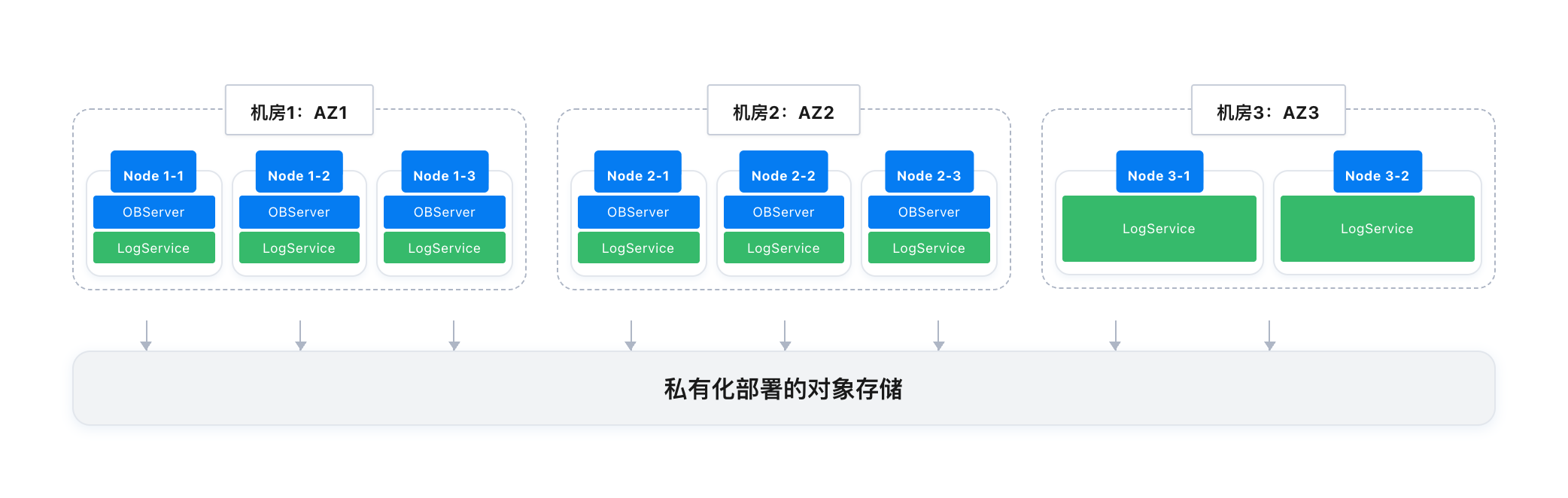
In the preceding figure, the OceanBase AI Database cluster is deployed in three IDCs (corresponding to three zones) in the same city (corresponding to one region). OBServer is deployed in a hybrid manner across two zones, while only LogService is deployed in the third zone.
OceanBase AI Database supports only intra-city deployment. You can adjust the deployment mode of the cluster by flexibly modifying the distribution of IDCs across zones and the replica distribution within the zones, for example, to a single-IDC or three-IDC configuration.