
Compatible with HBase APIs, OBKV-HBase is a wide-table database dedicated to storing massive amounts of structured and semi-structured data and delivering extreme access performance.
Core advantages of OBKV-HBase
Stable P99
Developed in C++, OBKV-HBase uses a self-developed memory management subsystem, eliminating the Java garbage collection (GC) and other memory-related jitter issues in open-source HBase. Drawing on more than a decade of TP refinement by OceanBase AI Database, OBKV-HBase achieves excellent P99 stability through extreme optimization of the storage access path.
Hot replicas
Built on the native high-reliability capabilities of OceanBase AI Database, OBKV-HBase uses the Paxos protocol to ensure strong consistency among multiple replicas. When a node fails, it quickly fails over to a hot replica, ensuring business continuity with a recovery time objective (RTO) of less than 8 seconds. In contrast, open-source HBase is built on a storage-compute separation architecture, where each partition at the RegionServer layer has only one replica. When a failure occurs, partition scheduling and failure recovery typically make the business unavailable for several minutes.
Cross-zone disaster recovery
OBKV-HBase allows you to deploy a cluster instance across multiple zones, enabling typical disaster recovery architectures such as three IDCs across two regions and five IDCs across three regions, which provide higher disaster recovery capabilities. Open-source HBase generally relies on HLogs for primary/standby cluster disaster recovery. To achieve the same disaster recovery level, it requires more replicas and incurs higher costs.
High performance
Both OBKV-HBase and open-source HBase use an LSM-tree-based storage engine and therefore share the same write performance advantages. Based on more than 10 years of continuous development and optimization in TP scenarios by OceanBase AI Database, OBKV-HBase also delivers extreme read performance. In scenarios with large amounts of data, its read performance is more than four times that of open-source HBase.
Easy O&M
OBKV-HBase exposes only OBServer nodes to users, so you do not need to worry about the differences between roles in the distributed implementation. OceanBase AI Database provides a series of easy-to-use development and O&M tools, which lowers the O&M threshold. In addition, OceanBase AI Database is an all-in-one database, and the O&M for OBKV is the same as that for OceanBase AI Database. This unifies the enterprise technology stack and reduces the workload of maintaining multiple databases.
Application scenarios of OBKV-HBase
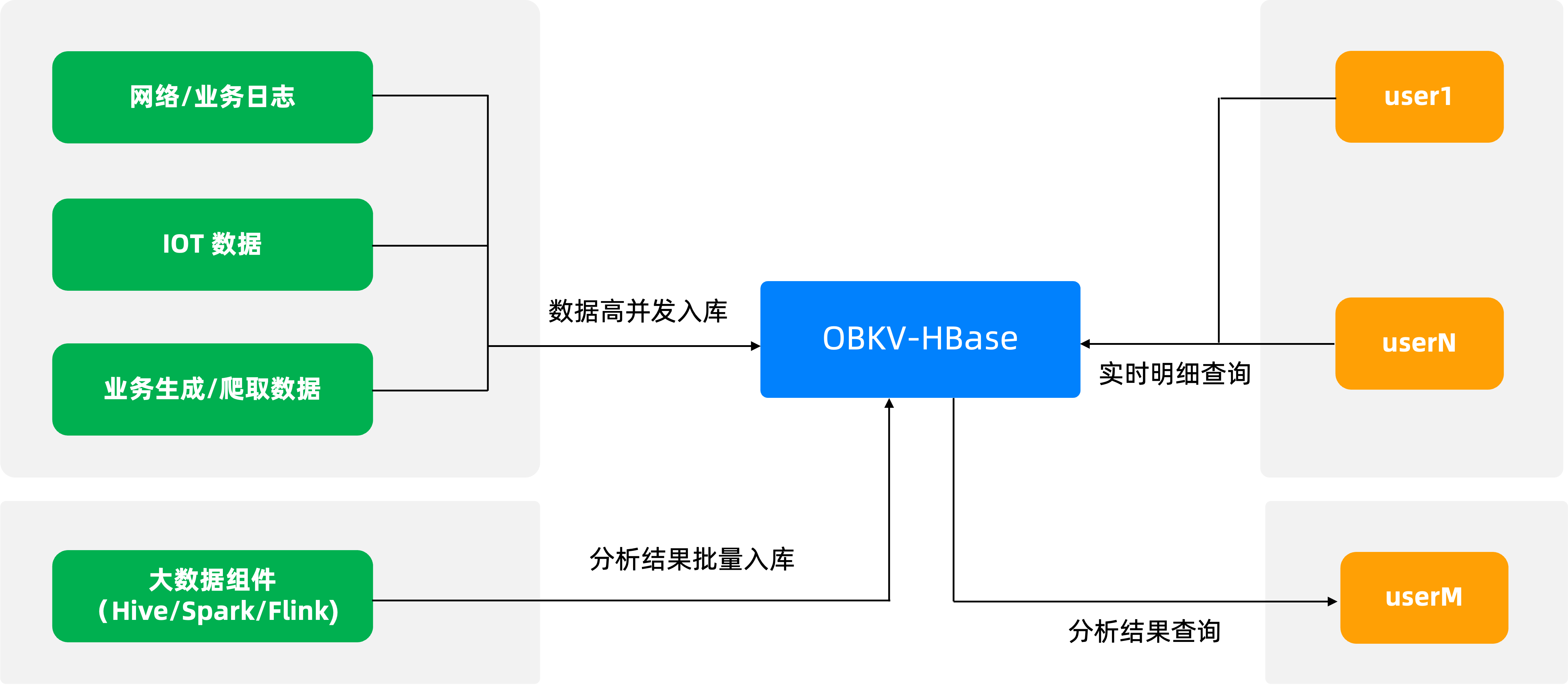
Massive data storage
Built on the distributed storage engine of OceanBase AI Database, OBKV-HBase provides real-time reads and writes and low-cost storage for massive data. It supports API-based batch import and direct load.
OBKV-HBase also adapts to open-source components such as DataX and Flink for efficient incremental and full data synchronization. It can integrate with Flink and other data warehousing and big data components for real-time or offline data analysis. Alternatively, with the integration and real-time data warehousing capabilities of OceanBase AI Database, you can perform real-time analysis of data in a single database.
You can use OBKV-HBase to quickly store application logs, Internet of Things (IoT) data, trace data, and monitoring data in real time, and then perform online or offline data analysis by using data warehousing or big data components.
High-performance real-time access to characteristic data in scenarios such as recommendation and risk control
Based on the TP capabilities that OceanBase AI Database has accumulated over more than 10 years, OBKV-HBase provides low-latency data reads. Through horizontal scaling, it can handle concurrent access at a level of tens of millions or higher.
OBKV-HBase supports HBase features such as schemaless design, wide tables, sparse columns, multiple data versions, and TTL. This allows it to flexibly store characteristic data and support high-performance access to such data in scenarios such as recommendation and risk control.