
Applicability
Hibernate is applicable to OceanBase Database in MySQL and Oracle modes. This topic provides an example for MySQL mode only.
This topic describes how to use the Hibernate framework and OceanBase Database to build an application that performs basic database operations such as creating tables, inserting data, and querying data.
 Download the java-oceanbase-hibernate sample project
 Prerequisites
- You have installed OceanBase Database.
- You have installed Java Development Kit (JDK) 1.8 and Maven.
- You have installed IntelliJ IDEA.
Note
In this topic, IntelliJ IDEA Community Edition 2021.3.2 is used to run the sample code. You can also choose a suitable tool as needed.
Procedure
Note
The following procedure applies to Windows. If you use another operating system or compiler, the procedure can be slightly different.
- Obtain the OceanBase Database connection string.
- Import the
java-oceanbase-hibernateproject to IntelliJ IDEA. - Modify the database connection information in the
java-oceanbase-hibernateproject. - Run the
java-oceanbase-hibernateproject.
Step 1: Obtain the OceanBase Database connection string
Contact the deployment personnel or administrator of OceanBase Database to obtain the connection string.
obclient -hxx.xx.xx.xx -P2883 -uroot@sys#cluster -p**** -AEnter the URL of OceanBase Database.
Note
The URL of OceanBase Database is required in the
hibernate.cfg.xmlfile.jdbc:oceanbase://host:port/schema_name?user=$user_name&password=$passwordThe parameters are described as follows:
host: the IP address for connecting to OceanBase Database. It is the IP address of ODP for connection through ODP, or the IP address of an OBServer node for direct connection.port: the port for connecting to OceanBase Database. For connection through ODP, the default value is2883, which can be customized when ODP is deployed. For direct connection, the default value is2881, which can be customized when OceanBase Database is deployed.schema_name: the name of the schema to be accessed.user_name: the username of the account in the format of user@tenant#cluster name or username@SERVICE:service name, which is specified by the-uparameter. When the value is in the user@tenant#cluster name format, the default tenant issysand the default administrator isroot. The cluster name is not required when you directly connect to OceanBase Database, but is required when you connect to OceanBase Database through ODP.password: the password of the account.
For more information about URL parameters, see Database URL.
Step 2: Import the java-oceanbase-hibernate project to IntelliJ IDEA
Start IntelliJ IDEA and choose File > Open....

In the Open File or Project window, select the project files and click OK to import the files.
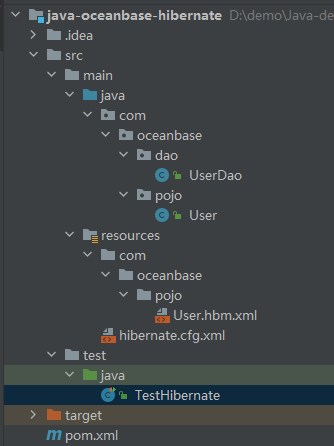
IntelliJ IDEA automatically identifies various files in the project. You can view project information such as the directory structure, file list, module list, and dependencies in the Project window. Generally, the Project window is at the leftmost of the UI of IntelliJ IDEA and is opened by default. If the Project window is closed, you can choose View > Tool Windows > Project in the menu bar or press the keyboard shortcut Alt + 1 to open it.
Note
When you use IntelliJ IDEA to import a project, IntelliJ IDEA automatically detects the
pom.xmlfile in the project, downloads the required dependency libraries based on the dependencies described in the file, and adds them to the project.View the project.
Step 3: Modify the database connection information in the java-oceanbase-hibernate project
Modify the database connection string in the hibernate.cfg.xml file based on the information obtained in Step 1: Obtain the OceanBase Database connection string.
Note
If you need to add additional properties to the JDBC connection string, see Database URL.
Here is an example:
- The name of the database driver is
com.mysql.cj.jdbc.Driver. - The IP address of the OBServer node is
172.30.xxx.xxx. - The access port is 2881.
- The name of the schema to be accessed is
test. - The tenant account is
root@mysql001.mysql001is a MySQL user tenant created in OceanBase Database, androotis the username of a user in themysql001tenant. - The password is
******.
Here is the sample code:
<property name="hibernate.connection.driver_class">com.mysql.cj.jdbc.Driver</property>
<property name="hibernate.connection.url">jdbc:mysql://172.30.xxx.xxx:2881/test</property>
<property name="hibernate.connection.username">root@mysql001</property>
<property name="hibernate.connection.password">******</property>
Step 4: Run the java-oceanbase-hibernate project
Path
- Find the
TestHibernate.javafile under src > test > java in the project package. - Choose Run > Run... > TestHibernate in the menu bar or click the green triangle in the upper-right corner to run the project.
- View the logs and output of the project in the Console window of IntelliJ IDEA.
Result
User{id=2, name='update'}
User{id=3, name='user_insert3'}
User{id=4, name='user_insert4'}
User{id=5, name='user_insert5'}
Project code
Click here to download the project code, which is a package named java-oceanbase-hibernate.zip.
Decompress the package to obtain a folder named java-oceanbase-hibernate. The directory structure is as follows:
│--pom.xml
│
├─.idea
├─src
│  ├─main
│  │  ├─java
│  │  │  └─com
│  │  │      └─oceanbase
│  │  │          ├─dao
│  │  │          │   └─--UserDao.java
│  │  │          │
│  │  │          └─pojo
│  │  │              └─--User.java
│  │  │
│  │  └─resources
│  │      │--hibernate.cfg.xml
│  │      │
│  │      └─com
│  │          └─oceanbase
│  │              └─pojo
│  │                  └─--User.hbm.xml
│  │
│  └─test
│      └─java
│          └─--TestHibernate.java
│
└─target
The files and directories are described as follows:
pom.xml: the configuration file of the Maven project, which contains the dependencies, plug-ins, and build rules of the project..idea: a directory used in an Integrated Development Environment (IDE) to store configuration information related to the project.src: a directory that stores the source code in the project.main: a directory that stores the main source code and resource files.java: a directory that stores the Java source code.com: the root directory of the Java package.oceanbase: the root directory of the project.dao: stores the data access object (DAO) package for accessing databases or other data storage services.UserDao.java: the user DAO that is used to add, delete, modify, and query user data.User.java: the user persistent object that is mapped to fields in a user data table.pojo: stores the persistent Java class, which follows the Plain Old Java Object (POJO) programming model, mapped to a database table. It is used for the mapping to a database table or another database storage structure.resources: a directory that stores resource files, such as configuration files and SQL files.hibernate.cfg.xml: the Hibernate configuration file, which is used to configure the basic parameters of Hibernate and other information such as the data source.User.hbm.xml: defines the mapping between the user persistent object and the user data table.test: a directory that stores the test code and resource files.TestHibernate.java: the directory that stores the Java class for testing Hibernate.target: a directory that stores compiled class files and JAR packages.
Code in pom.xml
Note
You can retain the default code in this file for verification purposes or modify the code in the file as needed.
Perform the following steps to configure the pom.xml file:
Declare the file.
Declare the file to be an XML file that uses the XML standard 1.0 and character encoding format UTF-8.
Here is the sample code:
<?xml version="1.0" encoding="UTF-8"?>Configure namespaces and the POM version.
xmlns: the default XML namespace for the POM, which is set tohttp://maven.apache.org/POM/4.0.0.xmlns:xsi: the XML namespace for XML elements prefixed withxsi, which is set tohttp://www.w3.org/2001/XMLSchema-instance.xsi:schemaLocation: the location of an XML schema definition (XSD) file. The value consists of two parts: the default XML namespace(http://maven.apache.org/POM/4.0.0)and the URI of the XSD file (http://maven.apache.org/xsd/maven-4.0.0.xsd).<modelVersion>: the POM version used by the POM file, which is set to4.0.0.
Here is the sample code:
<project xmlns="http://maven.apache.org/POM/4.0.0"
      xmlns:xsi="http://www.w3.org/2001/XMLSchema-instance"
      xsi:schemaLocation="http://maven.apache.org/POM/4.0.0 http://maven.apache.org/xsd/maven-4.0.0.xsd">
 <modelVersion>4.0.0</modelVersion>
</project>
Configure basic project information.
<groupId>: the ID of the project group, which is set tocom.oceanbase.<artifactId>: the name of the project, which is set tojava-oceanbase-hibernate.<version>: the project version, which is set to1.0-SNAPSHOT.
Here is the sample code:
 <groupId>com.oceanbase</groupId>
 <artifactId>java-oceanbase-hibernate</artifactId>
 <version>1.0-SNAPSHOT</version>
Use
<build>to define the build process for the project.<plugins>: the plug-ins in the project.<plugin>: a plug-in in the project.<groupId>: the ID of the project group, which is set toorg.apache.maven.plugins.<artifactId>: the name of the project, which is set tomaven-compiler-plugin.<configuration>: the parameters of the plug-in.<source>: the source code version for the compiler, which is set to8.<target>: the target code version for the compiler, which is set to8.
Here is the sample code:
 <build>
     <plugins>
         <plugin>
             <groupId>org.apache.maven.plugins</groupId>
             <artifactId>maven-compiler-plugin</artifactId>
             <configuration>
                 <source>8</source>
                 <target>8</target>
             </configuration>
         </plugin>
     </plugins>
 </build>
Configure project dependencies in
<dependencies>.Define a dependency named
oceanbase-clientthat belongs to thecom.oceanbasegroup and whose version is2.4.2.Here is the sample code:
    <dependencies>
    <dependency>
        <groupId>com.oceanbase</groupId>
        <artifactId>oceanbase-client</artifactId>
        <version>2.4.2</version>
    </dependency>
    </dependencies>
Define a dependency named
junitthat belongs to thejunitgroup and whose version is4.13.Here is the sample code:
    <dependencies>
    <dependency>
        <groupId>junit</groupId>
        <artifactId>junit</artifactId>
        <version>4.13</version>
    </dependency>
    </dependencies>
Define a dependency named
hibernate-corethat belongs to theorg.hibernategroup and whose version is5.2.17.Final.Here is the sample code:
<dependencies>
  <dependency>
      <groupId>org.hibernate</groupId>
      <artifactId>hibernate-core</artifactId>
      <version>5.2.17.Final</version>
  </dependency>
</dependencies>
Define a dependency named
hibernate-c3p0that belongs to theorg.hibernategroup and whose version is5.2.17.Final.Here is the sample code:
<dependencies>
  <dependency>
      <groupId>org.hibernate</groupId>
      <artifactId>hibernate-c3p0</artifactId>
      <version>5.2.17.Final</version>
  </dependency>
</dependencies>
Code in User.hbm.xml
The User.hbm.xml file is a Hibernate mapping file that maps Java objects to database tables.
Perform the following steps to configure the User.hbm.xml file:
Declare the file.
Declare the file to be an XML file that uses the XML standard 1.0 and character encoding format UTF-8. Specify the Document Type Definition (DTD) of the Hibernate mapping file by setting the type of the DTD file to
hibernate-mapping, the version to3.0, the language toEN, and the URL tohttp://www.hibernate.org/dtd/hibernate-mapping-3.0.dtd.Here is the sample code:
<?xml version="1.0" encoding="UTF-8"?>
<!DOCTYPE hibernate-mapping PUBLIC
        "-//Hibernate/Hibernate Mapping DTD 3.0//EN"
        "http://www.hibernate.org/dtd/hibernate-mapping-3.0.dtd">
Configure the mapping file.
Define a Hibernate mapping file that maps an entity class named
Userto a database table namedtest_hibernate_mysql.- Use the
packageattribute to specifycom.oceanbase.pojoas the Java package in the mapping file. - Use the
classtag to map a Java class to a database table. In the tag, use thenameattribute to specifyUseras the name of the Java class, and use thetableattribute to specifytest_hibernate_mysqlas the mapped-to database table. - Use the
idtag to define a member variable for the Java classUseras the primary key. In the tag, use thenameattribute to specifyidas the member variable name, and use thecolumnattribute to specifyUSER_IDas the name of the mapped-to database field. - Use the
generatortag to define the strategy for primary key generation. In the tag, use theclassattribute to specifysequenceas the type of the primary key generator, and use theparamelement to specifySQ_USERas the sequence name. Use thepropertytag to define another member variable for the Java class. In the tag, use thenameattribute to specifyUSER_NAMEas the name of the mapped-to database column, and use thetypeattribute to specifystringas the data type of the member variable.
Here is the sample code:
<hibernate-mapping package="com.oceanbase.pojo"> <class name="User" table="test_hibernate_mysql"> <!-- Configure primary key generation strategy --> <id name="id" column="USER_ID"> <generator class="sequence"> <param name="sequence">SQ_USER</param> </generator> </id> <!-- Configuration Tables and Properties --> <property name="name" column="USER_NAME" type="string"/> </class> </hibernate-mapping>- Use the
Code in hibernate.cfg.xml
The hibernate.cfg.xml file is a Hibernate configuration file that configures the operating environment of Hibernate and the parameters for connecting to the database.
Perform the following steps to configure the hibernate.cfg.xml file:
Declare the file.
Declare the file to be an XML file that uses the XML standard 1.0 and character encoding format UTF-8. Specify the DTD of the Hibernate configuration file by setting the type of the DTD file to
hibernate-configuration, the version to3.0, the language toEN, and the URL tohttp://www.hibernate.org/dtd/hibernate-configuration-3.0.dtd.Here is the sample code:
<?xml version="1.0" encoding="utf-8"?>
<!DOCTYPE hibernate-configuration PUBLIC
        "-//Hibernate/Hibernate Configuration DTD 3.0//EN"
        "http://www.hibernate.org/dtd/hibernate-configuration-3.0.dtd">
Configure the
configurationparameter.In the
<hibernate-configuration>root element, use the<session-factory>element to configure the Hibernate session factory for creating and managing session objects. The session factory contains database connection configurations (such as the driver class name, URL, username, and password), connection pool configurations, as well as SQL interaction configurations (such as the database dialect, SQL printing and formatting, automatic creation of database tables, current session context, batch size, and use of secondary cache).Configure database connection properties.
Configure the properties that Hibernate uses to connect to the database, including the driver class name, URL, username, and password.
hibernate.connection.driver_class: the database driver used to establish a connection with OceanBase Database, which is set tocom.mysql.cj.jdbc.Driver.hibernate.connection.url: the URL of the database, which contains the IP address, port number, and name of the database.hibernate.connection.username: the username for connecting to the database.hibernate.connection.password: the password for connecting to the database.
Here is the sample code:
    <property name="hibernate.connection.driver_class">com.mysql.cj.jdbc.Driver</property>
    <property name="hibernate.connection.url">jdbc:oceanbase://host:port/schema_name</property>
    <property name="hibernate.connection.username">user_name</property>
    <property name="hibernate.connection.password">******</property>
Configure connection pool properties.
Configure the properties of the connection pool used by Hibernate. Specify C3P0 as the connection pool, and set the maximum/minimum number of connections in the connection pool, timeout period for obtaining a connection, timeout period for an idle connection, maximum number of cached statements, interval for testing idle connections, number of connections to acquire at a time, and connection validation method.
Note
The following properties are not a complete list and are for reference only. If you need to configure other properties, see the relevant documentation for more detailed property information.
hibernate.connection.provider_class: the connection pool used to manage the creation and release of database connections, which is set toC3P0.hibernate.c3p0.max_size: the maximum number of connections in the connection pool, which is set to60.hibernate.c3p0.min_size: the minimum number of connections in the connection pool, which is set to30.hibernate.c3p0.checkoutTimeout: the timeout period for obtaining a connection from the connection pool, which is set to 30,000 milliseconds.hibernate.c3p0.timeout: the timeout period after which an idle connection in the connection pool is closed, which is set to 2,000 milliseconds.hibernate.c3p0.max_statements: the maximum number of SQL statements that can be cached in the connection pool, which is set to100.hibernate.c3p0.idle_test_period: the interval at which idle connections in the connection pool are tested, which is set to 3,000 milliseconds.hibernate.c3p0.acquire_increment: the number of connections to acquire at a time by the connection pool when the pool is exhausted, which is set to3.hibernate.c3p0.validate: specifies whether to perform verification when the connection pool is used for connection, which is set totrue.
Here is the sample code:
<property name="hibernate.connection.provider_class">org.hibernate.c3p0.internal.C3P0ConnectionProvider</property>
<property name="hibernate.c3p0.max_size">60</property>
<property name="hibernate.c3p0.min_size">30</property>
<property name="hibernate.c3p0.checkoutTimeout">30000</property>
<property name="hibernate.c3p0.timeout">20000</property>
<property name="hibernate.c3p0.max_statements">100</property>
<property name="hibernate.c3p0.idle_test_period">3000</property>
<property name="hibernate.c3p0.acquire_increment">3</property>
<property name="hibernate.c3p0.validate">true</property>
Configure SQL interaction properties. Configure the properties used by Hibernate to map the database, including the database dialect, SQL printing and formatting, automatic creation of tables, current session context, batch size, cache usage, and mapping file to load.
dialect: the database dialect for ensuring compatibility with OceanBase Database's MySQL-compatible mode, which is set toMySQL 5.7.hibernate.show_sql: specifies whether to print SQL statements generated by Hibernate in the console.hibernate.format_sql: specifies whether to format the printed SQL statements.hbm2ddl.auto: specifies to automatically create tables.current_session_context_class: specifies to use thread-level current session context.hibernate.jdbc.batch_size: the batch size.hibernate.cache.use_second_level_cache: specifies whether to use a secondary cache.- Specify
com/oceanbase/pojo/User.hbm.xmlas the mapping file to load.
Here is the sample code:
  <property name="dialect">org.hibernate.dialect.MySQL57Dialect</property>
  <property name="hibernate.show_sql">true</property>
  <property name="hibernate.format_sql">true</property>
  <property name="hbm2ddl.auto">create</property>
  <property name="current_session_context_class">thread</property>
  <property name="hibernate.jdbc.batch_size">10</property>
  <property name="hibernate.cache.use_second_level_cache">false</property>
  <mapping resource="com/oceanbase/pojo/User.hbm.xml"/>
Code in UserDao.java
The UserDao.java file defines a user DAO class and creates a Session object to add, delete, modify, and query user data.
Perform the following steps to configure the UserDao.java file:
Reference other classes and interfaces.
Declare this file to contain the following interfaces and classes:
Userclass: operates user objects.Sessionclass: interacts with the database.SessionFactoryclass: createsSessioninstances.Transactionclass: manages database transactions.Configurationclass: loads the configuration file of Hibernate.Queryclass: performs query operations.Listinterface: operates the query result set.
Here is the sample code:
import com.oceanbase.pojo.User;
import org.hibernate.Session;
import org.hibernate.SessionFactory;
import org.hibernate.Transaction;
import org.hibernate.cfg.Configuration;
import org.hibernate.query.Query;
import java.util.List;
Define the
UserDaoclass.
The Java class UserDao is a DAO class for persisting user objects. This class encapsulates a series of methods related to database interaction, such as adding, deleting, modifying, and querying user objects. By calling methods in the UserDao class, the application can easily interact with the database to implement persistence operations.
Initialize a
UserDaoinstance.Use an object initialization block to initialize the
Sessionobject during the instantiation of the class.First, create a
Configurationobject and call theconfiguremethod to read the Hibernate configuration file (hibernate.cfg.xml). Then, call thebuildSessionFactorymethod to create aSessionFactoryobject. Finally, call theopenSessionmethod to create aSessionobject and assign the object to thesessionvariable.Here is the sample code:
private Session session;
{
    Configuration cfg = new Configuration().configure();
    // Create SessionFactory
    SessionFactory sessionFactory = cfg.buildSessionFactory();
    session = sessionFactory.openSession();
} //Read the hibernate.cfg.xml file
Query user data by user ID.
Call the
selectUserByIdmethod to query user data by user ID.Use the
getmethod ofsessionto obtain the user record of the specified ID according to the inputUser.classandIDparameters, and store the record in theuservariable.Here is the sample code:
public User selectUserById(int ID) {
    User user = session.get(User.class, ID);
    return user;
}
Query user data by username.
Call the
selectUserbyNamemethod to query user data by username. First, define a Hibernate Query Language (HQL) statement to query user data with a specified username. The table name istest_hibernate_mysql, the table alias isu, and the query field name isname. Call thecreateQuerymethod of theSessionobject to create aQueryobject and pass in the HQL statement and the entity class as parameters. Call thesetParametermethod of theQueryobject to set query parameters, where0represents the parameter position andnamerepresents the parameter value. Call thelistmethod of theQueryobject to execute the query and convert the query results into a list ofUserobjects.Here is the sample code:
public List<User> selectUserbyName(String name) {
  String sql = "FROM test_hibernate_mysql u WHERE u.name =?";
  Query<User> query = session.createQuery(sql, User.class);
  query.setParameter(0, name);
  List<User> users = query.list();
  return users;
}
Query all user data.
Call the
selectUsermethod to query all user data. Define an SQL statement to query all user data. Call thecreateNativeQuerymethod of theSessionobject to create aQueryobject and pass in the SQL statement as a parameter. Then, call theaddEntitymethod to add the entity classUserto the query, so that the query results can be converted into a list ofUserobjects. Call thegetResultListmethod of theQueryobject to execute the query and convert the query results into a list ofUserobjects.Here is the sample code:
public List<User> selectUser() {
    String sql = "SELECT * FROM test_hibernate_mysql";
    Query<User> query = session.createNativeQuery(sql).addEntity(User.class);
    List<User> users = query.getResultList();
    return users;
}
Insert user data.
Call the
insertUsermethod to insert user data. Specify theuserparameter of theUsertype, which is passed in as theuserobject to be inserted. Call thebeginTransactionmethod of theSessionobject to create a transaction object and assign the object to thebeginTransactionvariable. Call thesavemethod to save the user object to the database. Call thegetTransactionmethod of theSessionobject to obtain the current transaction, call thecommitmethod to commit the transaction to persist the previous operation to the database, and return the insertion result.Here is the sample code:
public int insertUser(User user) {
    // open transaction
    Transaction beginTransaction = session.beginTransaction();
    session.save(user);
    session.getTransaction().commit();
    return 1;
}
Delete user data.
Call the
deleteUserByIdmethod to delete the user record of the corresponding ID from the database. Specify theidparameter of the integer type to pass in the ID of the user to be deleted. Call thebeginTransactionmethod of theSessionobject to start a new transaction. Call thegetmethod to get the user object that matches the specified user ID and the entity class typeUser.class. Call thedeletemethod to delete the user object. Call thegetTransactionmethod ofSessionto obtain the current transaction, call thecommitmethod to commit the transaction to persist the user delete operation to the database, and return the result of the delete operation.Here is the sample code:
public int deleteUserById(int id) {
    // open transaction
    session.beginTransaction();
    User user = session.get(User.class, id);
    session.delete(user);
    session.getTransaction().commit();
    return 1;
}
Modify user data.
Call the
updateUserByIdmethod to update the corresponding user data. Specify theuserparameter of theUsertype. Call thebeginTransactionmethod of theSessionobject to start a transaction. Call thegetmethod of theSessionobject to obtain the correspondingUserobject by user ID. Call themergemethod of theSessionobject to merge the inputUserobject with the obtainedUserobject and update the input user data to the database. Call thegetTransactionmethod of theSessionobject to obtain the current transaction, and call thecommitmethod to commit the transaction. Return the result of the modify operation.Here is the sample code:
public int updateUserById(User user) {
    // open transaction
    session.beginTransaction();
    User user1 = session.get(User.class, user.getId());
    session.merge(user);
    session.getTransaction().commit();
    return 1;
}
Code in User.java
The User.java file defines a user DAO class and creates a Session object to add, delete, modify, and query user data.
Perform the following steps to configure the User.java file:
Reference other classes.
Declare that the current file uses Java Persistence API (JPA) annotations to configure the mapping between a class and a database table.
Columnannotation: specifies the mapping between an attribute in the entity class and a column in the database table.Entityannotation: marks the class as an entity class.GeneratedValueannotation: specifies that values of the attribute are automatically generated.GenerationTypeannotation: specifies the primary key generation strategy.Idannotation: marks an attribute as the unique identifier attribute.Tableannotation: specifies the name of the table that the entity class is mapped to.
Here is the sample code:
import javax.persistence.Column;
import javax.persistence.Entity;
import javax.persistence.GeneratedValue;
import javax.persistence.GenerationType;
import javax.persistence.Id;
import javax.persistence.Table;
Map to a table in the database.
Map the entity class to a table named
test_hibernate_mysqlin the database.Here is the sample code:
@Entity
@Table(name = "test_hibernate_mysql")
Define the
Userclass.This class is mapped to a table named
test_hibernate_mysqlin the database.Define the
idandnameattributes. Use annotations to mark the mappings between theidandnameattributes of theUserclass and columns in the database table. Specifically, use the@Idannotation to mark theidattribute as the primary key, use the@GeneratedValueannotation to specifysequenceas the primary key generation strategy, and use the@Columnannotation to specify mappings between attributes in the class and columns in the database table. Theidattribute stores the user ID, and thenameattribute stores the username.Here is the sample code:
@Id
@GeneratedValue(strategy = GenerationType.SEQUENCE)
@Column(name = "user_id")
private int id;

@Column(name = "user_name")
private String name;
Create a
Userobject.Define two constructors of the
Userclass for creating aUserobject. Define a parameterless constructor for Hibernate query operations. Define a constructor with parameters for initializing theidandnameattributes.Here is the sample code:
public User() {
}

public User(int id, String name) {
    this.id = id;
    this.name = name;
}
Get and set the
idandnamevalues.Define four methods in the
Userclass to get and set the values of theidandnameattributes. ThegetIdmethod gets theidvalue. ThesetIdmethod sets theidvalue. ThegetNamemethod gets thenamevalue. ThesetNamemethod sets thenamevalue.Here is the sample code:
public int getId() {
    return id;
}

public void setId(int id) {
    this.id = id;
}

public String getName() {
    return name;
}

public void setName(String name) {
    this.name = name;
}
Return a string that represents the
Userobject.Override the
toStringmethod in theUserclass to return a string that represents theUserobject. Use the@Overrideannotation to override the method of the same name in the parent class. Define thetoStringmethod that returns a string representation of theUserobject. Concatenate theidandnamevalues to generate a string and return it to the caller.Here is the sample code:
@Override
public String toString() {
    return "User{" +
            "id=" + id +
            ", name='" + name + '\'' +
            '}';
}
Code in TestHibernate.java
The TestHibernate.java file uses the UserDao object to demonstrate basic database operations of Hibernate, such as the insert, delete, update, and query operations.
Perform the following steps to configure the TestHibernate.java file:
Reference other classes and interfaces.
Declare the classes and interfaces related to the current file, such as
UserDao,User,Session,SessionFactory, andConfiguration.UserDaoclass: performs user-related database operations.Userclass: operates user objects.Sessionclass: performs database session operations.SessionFactoryclass: creates session objects.Configurationclass: configures Hibernate.SessionImplclass: obtains underlying JDBC connections.Testannotation: marks a test method.IOExceptionclass: handles I/O exceptions.Connectionclass: obtains JDBC connections.SQLExceptionclass: handles SQL exceptions.Listclass: stores query result sets.UUIDclass: generates unique identifiers.
Here is the sample code:
import com.oceanbase.dao.UserDao;
import com.oceanbase.pojo.User;
import org.hibernate.Session;
import org.hibernate.SessionFactory;
import org.hibernate.cfg.Configuration;
import org.hibernate.internal.SessionImpl;
import org.junit.Test;
import java.io.IOException;
import java.sql.Connection;
import java.sql.SQLException;
import java.util.List;
import java.util.UUID;
Define the
testHibernatemethod. ThetestHibernatemethod provides basic database operations such as inserting, deleting, updating, and querying data. Create aUserDaoobject and insert five user data records in a loop. Call theinsertUsermethod to insert user data. Call thedeleteUserByIdmethod to delete the data of the user with the ID1. Call theupdateUserByIdmethod to update the data of the user with the ID2. Call theselectUsermethod to query all user data. Traverse the query results and print them to the console.Here is the sample code:
public class TestHibernate {
    @Test
    public void testHibernate() throws SQLException, IOException {
        UserDao userDao = new UserDao();
        for (int i = 1; i <= 5; i++) {
            userDao.insertUser(new User(i, "user_insert" + i));
        }
        int deleteUserById = userDao.deleteUserById(1);
        int update = userDao.updateUserById(new User(2, "update"));
        List<User> users = userDao.selectUser();
        users.forEach(System.out::println);
    }
}
Complete code
<?xml version="1.0" encoding="UTF-8"?>
<project xmlns="http://maven.apache.org/POM/4.0.0"
         xmlns:xsi="http://www.w3.org/2001/XMLSchema-instance"
         xsi:schemaLocation="http://maven.apache.org/POM/4.0.0 http://maven.apache.org/xsd/maven-4.0.0.xsd">
    <modelVersion>4.0.0</modelVersion>

    <groupId>com.oceanbase</groupId>
    <artifactId>java-oceanbase-hibernate</artifactId>
    <version>1.0-SNAPSHOT</version>
    <build>
        <plugins>
            <plugin>
                <groupId>org.apache.maven.plugins</groupId>
                <artifactId>maven-compiler-plugin</artifactId>
                <configuration>
                    <source>8</source>
                    <target>8</target>
                </configuration>
            </plugin>
        </plugins>
    </build>
    <dependencies>
        <dependency>
            <groupId>junit</groupId>
            <artifactId>junit</artifactId>
            <version>4.13</version>
        </dependency>
        <dependency>
            <groupId>mysql</groupId>
            <artifactId>mysql-connector-java</artifactId>
            <version>8.0.27</version>
        </dependency>
        <dependency>
            <groupId>org.hibernate</groupId>
            <artifactId>hibernate-core</artifactId>
            <version>5.2.17.Final</version>
        </dependency>
        <!-- Hibernate c3p0 connection pool-->
        <dependency>
            <groupId>org.hibernate</groupId>
            <artifactId>hibernate-c3p0</artifactId>
            <version>5.2.17.Final</version>
        </dependency>

    </dependencies>

</project>
<?xml version="1.0" encoding="UTF-8"?>
<!DOCTYPE hibernate-mapping PUBLIC
        "-//Hibernate/Hibernate Mapping DTD 3.0//EN"
        "http://www.hibernate.org/dtd/hibernate-mapping-3.0.dtd">
<hibernate-mapping package="com.oceanbase.pojo">
    <class name="User" table="test_hibernate_mysql">
        <!-- Configure primary key generation strategy -->
        <id name="id" column="USER_ID">
            <generator class="sequence">
                <param name="sequence">SQ_USER</param>
            </generator>
        </id>
        <!-- Configuration Tables and Properties -->
        <property name="name" column="USER_NAME" type="string"/>
    </class>
</hibernate-mapping>
<?xml version="1.0" encoding="utf-8"?>
<!DOCTYPE hibernate-configuration PUBLIC
        "-//Hibernate/Hibernate Configuration DTD 3.0//EN"
        "http://www.hibernate.org/dtd/hibernate-configuration-3.0.dtd">
<hibernate-configuration>

    <session-factory>
        <property name="hibernate.connection.driver_class">com.mysql.cj.jdbc.Driver</property>
        <property name="hibernate.connection.url">jdbc:mysql://host:port/schema_name</property>
        <property name="hibernate.connection.username">user_name</property>
        <property name="hibernate.connection.password">******</property>
        <property name="hibernate.connection.provider_class">org.hibernate.c3p0.internal.C3P0ConnectionProvider</property>
        <property name="hibernate.c3p0.max_size">60</property>
        <property name="hibernate.c3p0.min_size">30</property>

        <property name="hibernate.c3p0.checkoutTimeout">30000</property>
        <property name="hibernate.c3p0.timeout">20000</property>

        <property name="hibernate.c3p0.max_statements">100</property>
        <property name="hibernate.c3p0.idle_test_period">3000</property>
        <property name="hibernate.c3p0.acquire_increment">3</property>
        <property name="hibernate.c3p0.validate">true</property>

        <property name="dialect">org.hibernate.dialect.MySQL57Dialect</property>
        <property name="hibernate.show_sql">true</property>
        <property name="hibernate.format_sql">true</property>
        <property name="hbm2ddl.auto">create</property>
        <property name="current_session_context_class">thread</property>
        <property name="hibernate.jdbc.batch_size">10</property>
        <property name="hibernate.cache.use_second_level_cache">false</property>
        <mapping resource="com/oceanbase/pojo/User.hbm.xml"/>
    </session-factory>
</hibernate-configuration>
package com.oceanbase.dao;

import com.oceanbase.pojo.User;
import org.hibernate.Session;
import org.hibernate.SessionFactory;
import org.hibernate.Transaction;
import org.hibernate.cfg.Configuration;
import org.hibernate.query.Query;

import java.util.List;

public class UserDao {
    private Session session;
    {
        Configuration cfg = new Configuration().configure();
        // Create SessionFactory
        SessionFactory sessionFactory = cfg.buildSessionFactory();
        session = sessionFactory.openSession();
    } //Read the hibernate.cfg.xml file
//    private Session session = HibernateUtil.getSession();

    public User selectUserById(int ID) {
        User user = session.get(User.class, ID);
        return user;
    }

    public List<User> selectUserbyName(String name) {
        String sql = "FROM test_hibernate_mysql u WHERE u.name =?";
        Query<User> query = session.createQuery(sql, User.class);
        query.setParameter(0, name);
        List<User> users = query.list();
        return users;
    }

    public List<User> selectUser() {
        String sql = "SELECT * FROM test_hibernate_mysql";
        Query<User> query = session.createNativeQuery(sql).addEntity(User.class);
        List<User> users = query.getResultList();
        return users;
    }

    public int insertUser(User user) {
        // open transaction
        Transaction beginTransaction = session.beginTransaction();
        session.save(user);
        session.getTransaction().commit();
        return 1;
    }

    public int deleteUserById(int id) {
        // open transaction
        session.beginTransaction();
        User user = session.get(User.class, id);
        session.delete(user);
        session.getTransaction().commit();
        return 1;
    }

    public int updateUserById(User user) {
        // open transaction
        session.beginTransaction();
        User user1 = session.get(User.class, user.getId());
        session.merge(user);
        session.getTransaction().commit();
        return 1;
    }

}
package com.oceanbase.pojo;

import javax.persistence.Column;
import javax.persistence.Entity;
import javax.persistence.GeneratedValue;
import javax.persistence.GenerationType;
import javax.persistence.Id;
import javax.persistence.Table;

@Entity
@Table(name = "test_hibernate_mysql")
public class User {
    @Id
    @GeneratedValue(strategy = GenerationType.SEQUENCE)
    @Column(name = "user_id")
    private int id;

    @Column(name = "user_name")
    private String name;

    public User() {
    }

    public User(int id, String name) {
        this.id = id;
        this.name = name;
    }

    public int getId() {
        return id;
    }

    public void setId(int id) {
        this.id = id;
    }

    public String getName() {
        return name;
    }

    public void setName(String name) {
        this.name = name;
    }

    @Override
    public String toString() {
        return "User{" +
                "id=" + id +
                ", name='" + name + '\'' +
                '}';
    }
}
import com.oceanbase.dao.UserDao;
import com.oceanbase.pojo.User;
import org.hibernate.Session;
import org.hibernate.SessionFactory;
import org.hibernate.cfg.Configuration;
import org.hibernate.internal.SessionImpl;
import org.junit.Test;

import java.io.IOException;
import java.sql.Connection;
import java.sql.SQLException;
import java.util.List;
import java.util.UUID;

public class TestHibernate {
    @Test
    public void testHibernate() throws SQLException, IOException {
        UserDao userDao = new UserDao();
        for (int i = 1; i <= 5; i++) {
            userDao.insertUser(new User(i, "user_insert" + i));
        }
        int deleteUserById = userDao.deleteUserById(1);
        int update = userDao.updateUserById(new User(2, "update"));
        List<User> users = userDao.selectUser();
        users.forEach(System.out::println);
    }
}
References
For more information about OceanBase Connector/J, see OceanBase Connector/J.