OceanBase
English日本語简体中文
Docs Home
Products
Integrations
Release Notes

Databases

OceanBase DatabaseOceanBase Cloud OceanBase Best Practices

Tools

OceanBase Cloud PlatformOceanBase Migration ServiceOceanBase Developer CenterOceanBase Migration AssessmentOceanBase Admin ToolOceanBase Loader and DumperOceanBase DeployerKubernetes operator for OceanBaseOceanBase Diagnostic Tool OceanBase Binlog Service

Connectors and Middleware

OceanBase Database Proxy OceanBase Connector/C OceanBase Connector/J OceanBase Connector/ODBC OceanBase Connector/NETOceanBase Command-Line Client

Databases

OceanBase DatabaseOceanBase Cloud OceanBase Best Practices

Connectors and Middleware

OceanBase Database Proxy OceanBase Connector/C OceanBase Connector/J OceanBase Connector/ODBC OceanBase Connector/NETOceanBase Command-Line Client

Tools

OceanBase Cloud PlatformOceanBase Migration ServiceOceanBase Developer CenterOceanBase Migration AssessmentOceanBase Admin ToolOceanBase Loader and DumperOceanBase DeployerKubernetes operator for OceanBaseOceanBase Diagnostic Tool OceanBase Binlog Service
OceanBase DatabaseOceanBase Cloud ToolsConnectors and MiddlewareLifecycle Support Policy

OceanBase Developer Center

V4.4.3
  • Topics Overview
  • Overview
    • What is ODC?
    • Features
    • Architecture
    • Limitations
    • ODC console
  • Quick Start
    • Client ODC
      • Overview
      • Install Client ODC
      • Use Client ODC
    • Web ODC
      • Overview
      • Deploy Web ODC
      • Use Web ODC
  • Data Source Management
    • Create a data source
    • Data sources and project collaboration
    • Database O&M
      • Session management
      • Global variable management
      • Recycle bin management
  • SQL Development
    • Edit and execute SQL statements
    • Perform PL compilation and debugging
    • Use the command-line window
    • Edit and export the result set
    • Execution analysis
    • Generate test data
    • System settings
    • Intelligent SQL development
    • Common features
    • Database objects
      • Table objects
        • Overview
        • Create a table
      • View objects
        • Overview
        • Create a view
        • Manage views
      • Materialized view objects
        • Overview
        • Create a materialized view
        • Manage materialized views
      • Function objects
        • Overview
        • Create a function
        • Manage functions
      • Stored procedure objects
        • Overview
        • Create a stored procedure
        • Manage stored procedures
      • Sequence objects
        • Overview
        • Create a sequence
        • Manage sequences
      • Package objects
        • Overview
        • Create a program package
        • Manage program packages
      • Trigger objects
        • Overview
        • Create a trigger
        • Manage triggers
      • Type objects
        • Overview
        • Create a type
        • Manage types
      • Synonym objects
        • Overview
        • Create a synonym
        • Manage synonyms
      • External resource objects
        • External resources
        • Create an external resource
        • Manage external resources
  • Database Change Risk Management
    • Project collaborative management
      • Project management
      • Manage databases
      • Manage logical databases
      • Add object storage files
      • Manage project members
      • Desensitize data
      • Notification management
        • Overview
        • View notification records
        • Manage notification channels
          • Create a notification channel
          • View, edit, and delete a notification channel
          • Configure a custom channel
        • Manage notification rules
    • Manage user permissions
      • Users and roles
      • Automatic authorization
      • Apply for project permissions
      • Apply for database permissions
      • Apply table/view permissions
    • Security standards
      • Environment configuration
        • SQL check specifications
        • SQL window specification
      • Risk Management
        • Overview
        • Manage risk identification rules
        • Manage approval processes
      • Desensitization algorithms
      • Operation audit
  • Ticket Management
    • Import schemas and data
    • Export schemas and data
    • Database change management
    • Manage changes to logical databases
    • Batch database change management
    • Online schema changes
    • Synchronize shadow tables
    • Schema comparison
  • Data Lifecycle Management
    • Data archiving
    • Data cleanup
    • Manage partitioning plans
      • Manage partitioning plans
      • Set partitioning strategies
      • Examples of partitioning strategies
    • SQL Plan
  • System Integration
    • Login integration
    • Approval integration
    • SQL approval integration
    • Bastion host integration
    • Integrate with LLMs
  • Deployment Guide
    • Deployment overview
    • Preparations before deployment
    • Deploy ODC in single-node mode
    • Deploy ODC in high-availability mode
    • Deployment verification
  • Upgrade Guide
    • Upgrade Overview
    • Preparations for upgrade
    • Update single-node ODC
    • Update high-avaliability ODC
    • Upgrade verification
    • Rollback after upgrade failed
  • Best Practices
    • Tips for SQL development
    • Explore ODC team workspaces
    • Understanding real-time SQL diagnostics for OceanBase AP
    • OceanBase historical database solutions
    • ODC SQL check for automatic identification of high-risk operations
    • Integration with ODC enterprise-level account system
    • Manage and modify sharded databases and tables via ODC
    • Data masking and control practices
    • Enterprise-level control and collaboration: Safeguard every database change
  • Troubleshooting
    • ODC troubleshooting process
    • Collect message
      • View the runtime environment and version information
      • View web ODC logs
      • View client ODC logs
      • View end-to-end ODC-related logs
      • View ODC MetaDB data
      • Query the index status in OceanBase Database V4.x
      • Query the index status in OceanBase Database V1.4.x to V3.2.x
      • Collect JVM runtime information
      • Use tcpdump to capture packets
    • FAQ
      • Installation of client ODC
      • Web ODC deployment and startup
      • Connection Information
      • Command-line window
      • DDL statement display
  • Release Notes
    • V4.4
      • ODC V4.4.0
      • ODC V4.4.1
      • ODC V4.4.2
      • ODC V4.4.3
    • V4.3
      • ODC V4.3.4
      • ODC V4.3.3
      • ODC V4.3.2
      • ODC V4.3.1
      • ODC V4.3.0
    • V4.2
      • ODC V4.2.4
      • ODC V4.2.3
      • ODC V4.2.2
      • ODC V4.2.1
      • ODC V4.2.0
    • V4.1
      • ODC V4.1.3
      • ODC V4.1.2
      • ODC V4.1.1
      • ODC V4.1.0
    • V4.0
      • ODC V4.0.2
      • ODC V4.0.0
    • V3.4
      • ODC V3.4.0
    • V3.3
      • ODC V3.3.3
      • ODC V3.3.2
      • ODC V3.3.1
      • ODC V3.3.0
    • V3.2
      • ODC V3.2.3
      • ODC V3.2.2
      • ODC V3.2.1
      • ODC V3.2.0

Download PDF

Document Feedback
  1. Documentation Center
  2. OceanBase Developer Center
  3. V4.4.3

Manage stored procedures

Last Updated:2026-09-03 09:11:30

Overview
Structure tree
Management actions
Shortcut function
Right-click function
Stored procedure management page
Stored procedure editing page
Stored procedure output page

Overview

After you log in to OceanBase Developer Center (ODC), you can click the name of a connection on the homepage to go to the corresponding connection management page. In the left-side navigation pane, you can click Stored Procedure to get a list of stored procedures in the current database.

In the stored procedure list, you can view the Structure tree of an object, or right-click the object to perform some Management actions on the object. You can also double-click the name of the stored procedure in the list to go to the Stored procedure management page.

Structure tree

You can click the expand icon before the name of the target stored procedure in the stored procedure list, and the structure tree of the stored procedure is displayed in a drop-down list, as shown in the following figure.

The structure tree of a stored procedure can have up to three levels. When you right-click an item in the tree, the shortcut menu displays some actions that you can perform on the item. For more information about these actions, see the Management actions section. In this section, you can find the table describing the management options.
2

Management actions

The names of stored procedure objects support ascending order by the head character by default in the stored procedure list.

Shortcut function

The following functions are provided in the upper right corner of the tree:

Action
Description
Create Click this option to create stored procedure.
Filter Click this option to display valid/invalid stored procedures.
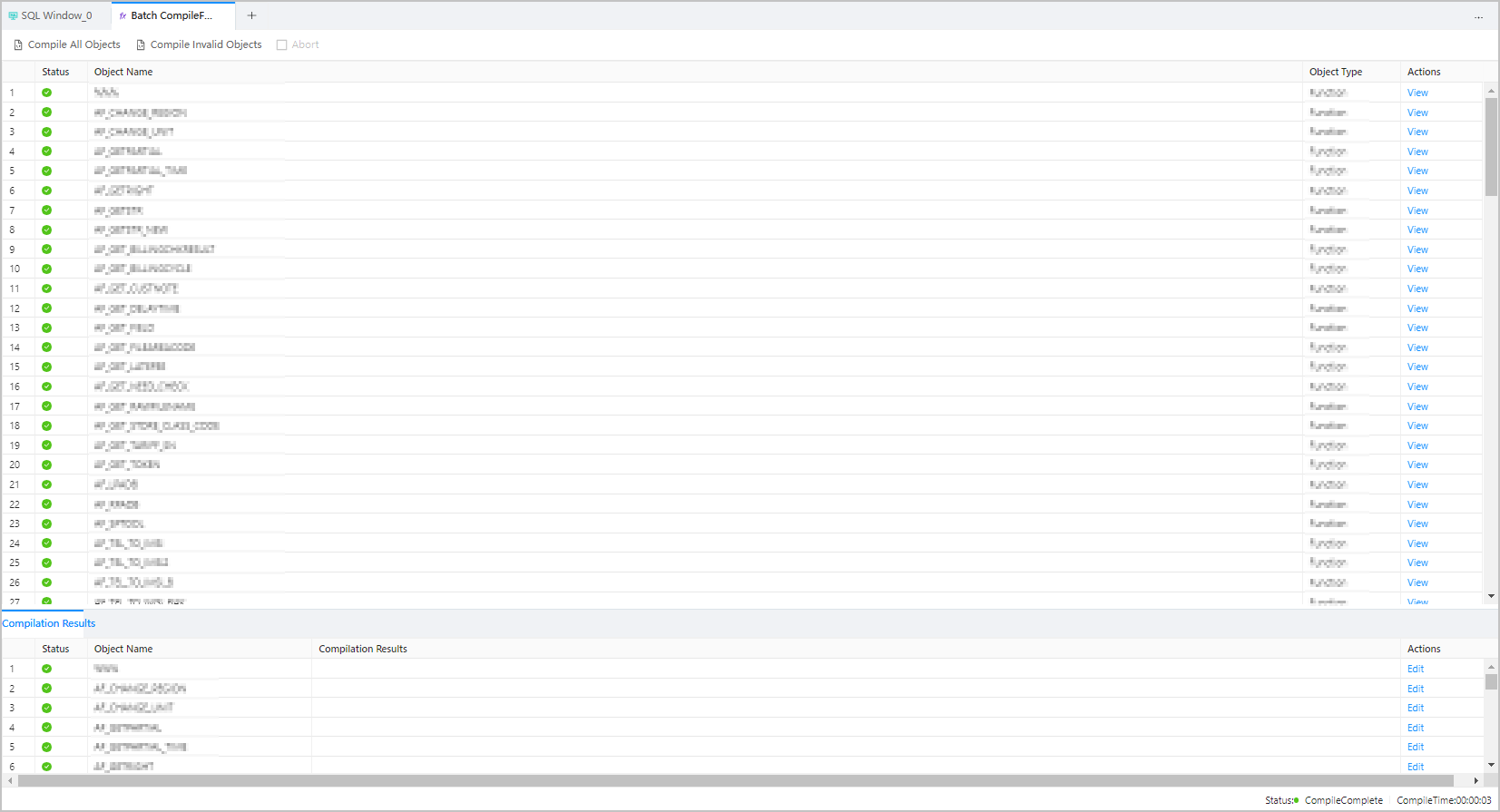
Batch Compile Click this option to batch compile the stored procedure object. Including: compile all objects and compile invalid objects.
batch compile
Refresh Click this option to refresh the structure tree after you perform management actions on the stored procedure, so that the structure tree displays the latest information.

Right-click function

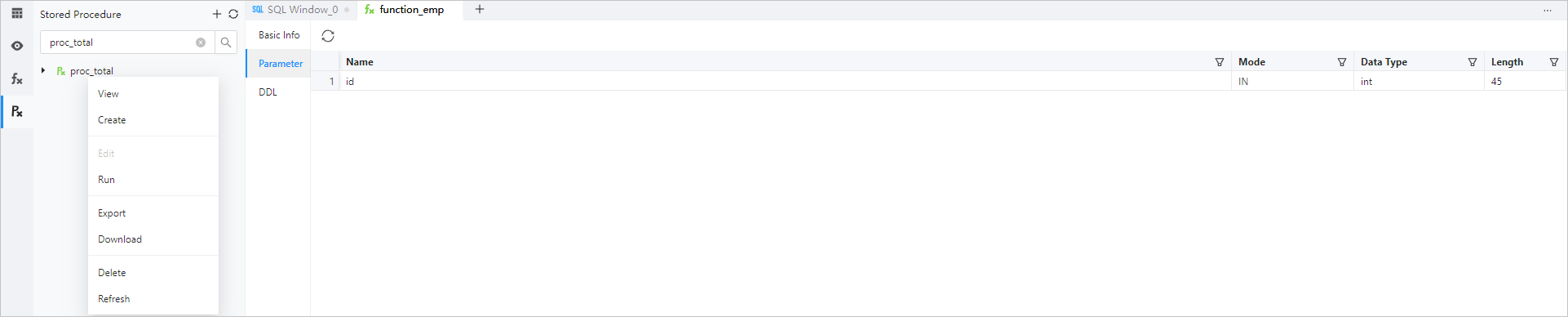
Right-click the target object in the structure tree. A shortcut menu appears, displaying some management options provided by ODC for you to conveniently manage the target object. The following table describes the management options.

Action
Description
View Click this option to go to the Stored procedure management page, where you can view comprehensive information such as the basic information, parameters, and code of the stored procedure.
Create Click this option to go to the Create Stored Procedure page, where you can create a stored procedure as prompted.
Edit Click this option to go to the Stored procedure editing page, which displays the statements that define the stored procedure and where you can edit the stored procedure.
Compile Click this option to compile the stored procedure.
Debug Click this option to go to the debugging page, where you can debug the stored procedure.

Note

  • ODC V4.0.0 and later support setting the parameter value as DEFAULT, NULL or empty string.
  • It is recommended to upgrade the OceanBase database to version 3.2.4 and above to obtain better debugging capabilities and stability.
Run Click this option to execute the stored procedure.
Export Click this option to export objects. The current object is exported by default. For more information, see Export schemas and data.
Download Download the SQL file for the stored procedure object.
Delete Click this option to delete the stored procedure.
Refresh Click this option to refresh the structure tree after you perform management actions on the stored procedure so that the structure tree displays the latest information.

Note

  • We recommend that you upgrade to OBServer V2.2.77 or later. This is because some versions of OBServer have been found with PL/SQL debugging issues, which may compromise the OBServer stability.
  • ODC V3.2.2 or earlier does not support the debugging feature when you connect ODC to the target instance by using OBProxy. To use the debugging feature, directly connect ODC to the target instance.
  • ODC V3.2.2 and later support PL/SQL debugging when you connect to OBServer by using OBProxy.

Stored procedure management page

Parameters

You can double-click the name of a stored procedure in the function list to go to the stored procedure management page. The stored procedure management page displays the following information:

Section
Description
Basic Information This section displays the basic information about the stored procedure in fields such as Stored Procedure Name, Created By, Creation At, and Last Modified At.
Parameter This section displays the information about the parameters in fields such as Name, Mode, Data Type, Length, and Default Value.Click the icon to refresh the parameters.
DDL This section displays the script that defines the stored procedure and provides the Edit, Download, Find, Format, and Refresh buttons.

Note

Click the Edit icon to go to the PL object editing page.

Stored procedure editing page

Right-click the target item in the stored procedure list. In the menu that appears, click Edit to go to the stored procedure editing page. In the code area of the editing page, the statements that define the stored procedure are displayed. You can edit the statements. In addition, the toolbar provides the following buttons:

Button
Description
Confirm modification Click this button to apply the current modification.
Compile Click this button to compile the statements on the current page.

Note

  • During the compilation, a code line is highlighted if it contains the name of an external object that cannot be referenced.
  • After the compilation, the Compilation Result tab displays the compilation status. If alerts exist, the alert details are displayed.
Run Click this button to execute the statements in the code area.
Debug Click this button to enter the debug mode, which allows you to edit the PL or SQL object in the code area. After the debugging, you can close the debugging window.
Format Click this button to apply formatting, such as indentation, line break, and keyword highlighting, to the selected SQL statements or all the SQL statements in the current SQL window.
Find and Replace You can enter text in the search field to find the specific content and enter text in the replacement field to replace the content found.
Undo Click this button to undo the last operation.
Redo Click this button to reverse an Undo operation.
Case Sensitivity The system supports three capitalization options: All Caps, All Lowercase, and Capitalize First Letter. Click the corresponding option to convert the selected statements in the script to the desired capitalization format.
Indent You can add indents to or delete indents from the statements that you selected.
Comments You can click Add Comments to convert the statements that you selected into comments or click Delete Comment to convert comments to SQL statements.
IN Value Conversion Click this button to convert the copied rows or columns into the specified format during queries. After you paste the copied data to the SQL editing area, select the copied data and click IN Value Conversion to convert it into the in('A','B') format.
  • Column values are separated with line breaks.
  • Row values are separated with spaces or tabs.

Stored procedure output page

Output

After the stored procedure is executed, you can view the information of execution results in the Output and DBMS Output tabs.

Tab
Description
Output Displays the status, parameters, parameter types, parameter values, return type, and return value of the stored procedure.
DBMS Output Displays DBMS outputs of the stored procedure.

Previous topic

Create a stored procedure
Last

Next topic

Overview
Next
on this page
Overview
Structure tree
Management actions
Shortcut function
Right-click function
Stored procedure management page
Stored procedure editing page
Stored procedure output page

