OceanBase
English日本語简体中文
Docs Home
Products
Integrations
Release Notes

Databases

OceanBase DatabaseOceanBase Cloud OceanBase Best Practices

Tools

OceanBase Cloud PlatformOceanBase Migration ServiceOceanBase Developer CenterOceanBase Migration AssessmentOceanBase Admin ToolOceanBase Loader and DumperOceanBase DeployerKubernetes operator for OceanBaseOceanBase Diagnostic Tool OceanBase Binlog Service

Connectors and Middleware

OceanBase Database Proxy OceanBase Connector/C OceanBase Connector/J OceanBase Connector/ODBC OceanBase Connector/NETOceanBase Command-Line Client

Databases

OceanBase DatabaseOceanBase Cloud OceanBase Best Practices

Connectors and Middleware

OceanBase Database Proxy OceanBase Connector/C OceanBase Connector/J OceanBase Connector/ODBC OceanBase Connector/NETOceanBase Command-Line Client

Tools

OceanBase Cloud PlatformOceanBase Migration ServiceOceanBase Developer CenterOceanBase Migration AssessmentOceanBase Admin ToolOceanBase Loader and DumperOceanBase DeployerKubernetes operator for OceanBaseOceanBase Diagnostic Tool OceanBase Binlog Service
OceanBase DatabaseOceanBase Cloud ToolsConnectors and MiddlewareLifecycle Support Policy

OceanBase Database Proxy

V4.4.0
  • What is ODP?
  • Installation and deployment
    • Overview
    • Deploy ODP by using obd
    • Deploy ODP by using OCP
    • Deploy ODP by using the CLI
    • Deployment modes
  • Basic operations
  • Configuration parameter
    • View and modify parameters
    • Parameter summary
    • Global parameters
      • automatic_match_work_thread
      • block_thread_num
      • cache_cleaner_clean_interval
      • check_tenant_locality_change
      • client_max_connections
      • client_max_memory_size
      • client_session_id_version
      • client_sock_option_flag_out
      • client_tcp_keepcnt
      • client_tcp_keepidle
      • client_tcp_keepintvl
      • client_tcp_user_timeout
      • cluster_count_high_water_mark
      • cluster_expire_time
      • config_server_refresh_interval
      • congestion_fail_window
      • congestion_failure_threshold
      • congestion_retry_interval
      • connection_diagnosis_option
      • connection_pool_mode
      • connect_observer_max_retries
      • current_local_config_version
      • default_buffer_water_mark
      • default_inactivity_timeout
      • delay_exit_time
      • delay_update_entry_interval
      • detect_server_timeout
      • digest_sql_length
      • enable_abort_conn_info
      • enable_async_log
      • enable_async_pull_location_cache
      • enable_auto_restart
      • enable_bad_route_reject
      • enable_binlog_service
      • enable_cached_server
      • enable_causal_order_read
      • enable_client_connection_lru_disconnect
      • enable_client_ip_checkout
      • enable_cluster_checkout
      • enable_compression_protocol
      • enable_congestion
      • enable_connection_diagnosis
      • enable_cpu_isolate
      • enable_cpu_topology
      • enable_crash_error_log
      • enable_cross_shard_txn
      • enable_extra_prometheus_metric
      • enable_flow_control
      • enable_full_link_trace
      • enable_full_username
      • enable_get_rslist_remote
      • enable_global_ps_cache
      • enable_index_route
      • enable_monitor_stat
      • enable_ob_protocol_v2
      • enable_obproxy_rpc_service
      • enable_partition_table_route
      • enable_performance_mode
      • enable_pl_route
      • enable_primary_zone
      • enable_prometheus
      • enable_proxy_scramble
      • enable_qa_mode
      • enable_qos
      • enable_report_session_stats
      • enable_reroute
      • enable_scan_all_request
      • enable_sequence_prefetch
      • enable_sharding
      • enable_single_leader_node_routing
      • enable_standby
      • enable_stat
      • enable_strict_kernel_release
      • enable_strict_stat_time
      • enable_sync_all_stats
      • enable_syslog_file_compress
      • enable_syslog_wf
      • enable_trace
      • enable_trace_stats
      • enable_trans_detail_stats
      • enable_transaction_internal_routing
      • enable_xa_route
      • fetch_proxy_bin_random_time
      • fetch_proxy_bin_timeout
      • flow_consumer_reenable_threshold
      • flow_event_queue_threshold
      • flow_high_water_mark
      • flow_low_water_mark
      • grpc_client_num
      • grpc_thread_num
      • hot_upgrade_exit_timeout
      • hot_upgrade_failure_retries
      • hot_upgrade_rollback_timeout
      • idc_list_refresh_interval
      • ignore_local_config
      • internal_cmd_mem_limited
      • ip_listen_mode
      • is_need_skip_delay_interval_schema_changed
      • ldg_info_refresh_interval
      • listen_port
      • local_bound_ip
      • local_bound_ipv6_ip
      • log_cleanup_interval
      • log_dir_size_threshold
      • log_file_percentage
      • long_async_task_timeout
      • max_log_file_size
      • max_syslog_file_count
      • max_syslog_file_time
      • mem_leak_check_class_name
      • mem_leak_check_mod_name
      • metadb_server_state_refresh_interval
      • min_congested_connect_timeout
      • min_keep_congestion_interval
      • monitor_cost_ms_unit
      • monitor_item_limit
      • monitor_item_max_idle_period
      • monitor_log_level
      • monitor_stat_dump_interval
      • monitor_stat_high_threshold
      • monitor_stat_low_threshold
      • monitor_stat_middle_threshold
      • need_convert_vip_to_tname
      • net_accept_threads
      • net_config_poll_timeout
      • normal_pl_update_threshold
      • obproxy_config_server_url
      • obproxy_sys_password
      • partition_location_expire_relative_time
      • prometheus_cost_ms_unit
      • prometheus_listen_port
      • prometheus_sync_interval
      • protocol_diagnosis_level
      • proxy_cluster
      • proxy_hot_upgrade_check_interval
      • proxy_id
      • proxy_info_check_interval
      • proxy_local_cmd
      • proxy_mem_limited
      • qa_mode_mock_public_cloud_slb_addr
      • qos_stat_clean_interval
      • qos_stat_item_limit
      • refresh_idc_list
      • refresh_json_config
      • refresh_rslist
      • request_buffer_length
      • rootservice_list
      • rpc_client_net_write_timeout
      • rpc_client_net_read_timeout
      • rpc_async_pull_batch_max_size
      • rpc_async_task_thread_num
      • rpc_ctx_expire_time
      • routing_cache_mem_limited
      • rpc_enable_async_analyze
      • rpc_enable_async_pull_batch_tablets
      • rpc_async_pull_batch_max_times
      • rpc_async_pull_batch_wait_interval
      • rpc_enable_direct_expire_route_entry
      • rpc_enable_congestion
      • rpc_enable_lower_case_table_names
      • rpc_enable_global_index
      • rpc_enable_force_srv_black_list
      • rpc_enable_requestsm_info
      • rpc_enable_reroute
      • rpc_enable_parallel_handler
      • rpc_enable_retry_request_info_log
      • rpc_force_use_original_redis_protocol
      • rpc_enable_sub_req_log
      • rpc_force_srv_black_list
      • rpc_listen_port
      • rpc_max_request_batch_size
      • rpc_max_response_batch_size
      • rpc_max_server_table_entry_num
      • rpc_net_timeout_base
      • rpc_partition_calc_max_retries
      • rpc_redis_operation_timeout
      • rpc_request_server_entry_max_retries
      • rpc_request_timeout
      • rpc_request_max_retries
      • rpc_redis_default_database_name
      • rpc_redis_max_monitor_num
      • rpc_period_task_interval
      • rpc_redis_default_user_name
      • rpc_request_retry_waiting_time
      • rpc_server_entry_expire_time
      • rpc_request_timeout_delta
      • rpc_server_net_invalid_time_us
      • rpc_server_net_handler_expire_time
      • rpc_srv_session_pool_inactive_timeout
      • rpc_service_mode
      • rpc_server_net_max_pending_request
      • rpc_sub_request_isolation_mode
      • rpc_support_key_partition_shard_request
      • rpc_sub_request_weight
      • rpc_sub_req_max_retries
      • scan_buffered_rows_warning_threshold
      • sequence_entry_expire_time
      • sequence_fail_retry_count
      • sequence_prefetch_threshold
      • server_detect_fail_threshold
      • server_detect_mode
      • server_detect_refresh_interval
      • server_protocol
      • server_routing_mode
      • server_state_refresh_interval
      • server_tcp_init_cwnd
      • server_tcp_keepcnt
      • server_tcp_keepidle
      • server_tcp_keepintvl
      • server_tcp_user_timeout
      • session_pool_idle_timeout
      • session_pool_reset_interval
      • session_pool_stat_log_interval
      • session_pool_thread_num
      • session_pool_thread_schedule_interval
      • shard_scan_thread_num
      • short_async_task_timeout
      • skip_proxy_sys_private_check
      • skip_proxyro_check
      • slow_proxy_process_time_threshold
      • slow_transaction_time_threshold
      • sock_option_flag_out
      • sock_packet_mark_out
      • sock_packet_tos_out
      • sock_recv_buffer_size_out
      • sock_send_buffer_size_out
      • sql_table_cache_expire_relative_time
      • sql_table_cache_mem_limited
      • sqlaudit_mem_limited
      • stack_size
      • stat_dump_interval
      • stat_table_sync_interval
      • syslog_io_bandwidth_limit
      • syslog_level
      • table_entry_retry_build_limit
      • task_thread_num
      • tenant_location_valid_time
      • tunnel_request_size_threshold
      • username_separator
      • work_thread_num
      • xflush_log_level
    • Multi-level parameters
      • binlog_service_ip
      • compression_algorithm
      • enable_check_cluster_name
      • enable_client_ssl
      • enable_cloud_full_username
      • enable_read_write_split
      • enable_rpc_throttle
      • enable_server_ssl
      • enable_standby_read_write_split
      • enable_transaction_split
      • enable_weak_reroute
      • init_sql
      • mysql_version
      • ob_max_read_stale_time
      • obproxy_force_parallel_query_dop
      • obproxy_read_consistency
      • obproxy_read_only
      • observer_query_timeout_delta
      • observer_sys_password
      • observer_sys_password1
      • proxy_idc_name
      • proxy_primary_zone_name
      • proxy_route_policy
      • proxy_tenant_name
      • query_digest_time_threshold
      • read_stale_retry_interval
      • rootservice_cluster_name
      • route_diagnosis_level
      • rpc_request_throttle_waiting_time
      • rpc_throttle_limit_qps_qa
      • route_target_replica_type
      • rpc_throttle_trigger_percentage
      • slow_query_time_threshold
      • sql_firewall_config
      • ssl_attributes
      • target_db_server
      • weakread_weight_zone
  • Connection management
    • Principles
    • Session status synchronization
    • Configure a globally unique client session ID
    • Client session
    • Server session
    • Network connection
    • Session connection pool
  • Data routing
    • Factors affecting data routing
    • ODP routing
    • Intra-tenant routing
      • Overview
      • IP address-based routing
      • Partitioned table-based routing for strong-consistency reads
      • Global index table-based routing for strong-consistency reads
      • Replicated table-based routing for strong-consistency reads
      • Primary zone-based routing for strong-consistency reads
      • Strategy-based routing
      • Distributed transaction routing
      • Rerouting
      • Forcible routing
      • Weight-based load-balanced routing
      • Equality derivation for partition calculation
    • Automatic routing to the primary/standby tenants
    • Read/Write separation
    • Follower latency threshold
    • Function partition key routing
      • Overview
      • String functions
      • Numeric calculation functions
      • Date calculation functions
      • FAQ
    • Character set-based routing
    • Partitioning key types supported for routing by ODP
  • Logs
    • Overview
    • obproxy_diagnosis.log
    • obproxy_digest.log
    • obproxy_error.log
    • obproxy_slow.log
    • obproxy_stat.log
    • obproxy.log
  • Commands
    • Overview
    • Dedicated ODP commands
      • ALTER
      • KILL
        • KILL GLOBALSESSION
        • KILL PROXYSESSION
      • ping
      • SHOW
        • SHOW
        • SHOW GLOBALSESSION
        • SHOW PROXYPS
    • Compatible MySQL commands
      • BINLOG
      • KILL
      • SHOW PROCESSLIST
      • SHOW RELAYLOG EVENTS
      • SHOW SLAVE HOSTS
  • High availability mechanism
    • Overview
    • High availability of ODP services
    • High availability of OceanBase Database
    • High availability testing
  • OBKV
    • RPC service port
    • Throttling
  • Security and protocols
  • Operation and maintenance
    • Troubleshooting logic
    • Performance analysis
    • Show Trace
    • Routing diagnostics
      • Overview
      • Obtain diagnostic information
      • Diagnostic point troubleshooting
        • Overview
        • SQL_PARSE
        • ROUTE_INFO
        • LOCATION_CACHE_LOOKUP
        • ROUTINE_ENTRY_LOOKUP_DONE
        • FETCH_TABLE_RELATED_DATA
        • TABLE_ENTRY_LOOKUP_DONE
        • EXPR_PARSE
        • CALC_ROWID
        • RESOLVE_TOKEN
        • RESOLVE_EXPR
        • CALC_PARTITION_ID
        • PARTITION_ID_CALC_DONE
        • PARTITION_ENTRY_LOOKUP_DONE
        • ROUTE_POLICY
        • CONGESTION_CONTROL
        • RETRY
        • HANDLE_RESPONSE
      • Examples
    • Memory leak diagnostics
    • Connection diagnostics
    • Prometheus monitoring
    • SQL firewall
  • Release Notes
    • Version number rules
    • Enterprise Edition
      • V4.3
        • OceanBase Database Proxy Enterprise Edition V4.3.6
        • OceanBase Database Proxy Enterprise Edition V4.3.5
        • OceanBase Database Enterprise Edition V4.3.4
        • ODP Enterprise Edition V4.3.3
        • ODP Enterprise Edition V4.3.2
        • ODP Enterprise Edition V4.3.1
        • ODP Enterprise Edition V4.3.0
      • V4.2
        • ODP Enterprise Edition V4.2.3
        • ODP Enterprise Edition V4.2.2
        • ODP Enterprise Edition V4.2.1
      • V4.1
        • ODP Enterprise Edition V4.1.0
      • V4.0
        • ODP Enterprise Edition V4.0.0
      • V3.2
        • ODP Enterprise Edition V3.2.11
        • ODP Enterprise Edition V3.2.3.5
    • Community Edition
      • V4.3
        • OceanBase Database Proxy Community Edition V4.3.6
        • OceanBase Database Proxy Community Edition V4.3.5
        • OceanBase Database Proxy Community Edition V4.3.4
        • ODP Community Edition V4.3.3
        • ODP Community Edition V4.3.2
        • ODP Community Edition V4.3.1
      • V4.2
        • ODP Community Edition V4.2.3
        • ODP Community Edition V4.2.1
        • ODP Community Edition V4.2.0
      • V4.1
        • ODP Community Edition V4.1.0
      • V4.0
        • ODP Community Edition V4.0.0

Download PDF

Document Feedback
  1. Documentation Center
  2. OceanBase Database Proxy
  3. V4.4.0

Factors affecting data routing

Last Updated:2026-09-04 08:23:04

Functionality
Performance
High availability

Before we learn about the routing principles of ODP, let's first look at the factors affecting data routing, so as to better understand and evaluate the routing feature. This topic describes the following factors: functionality, performance, and high availability.

Functionality

This section takes the PreparedStatement feature as an example to illustrate how functionality affects routing. A PreparedStatement object is executed in two steps:

  1. Perform the PREPARE operation, for example, sending the select * from t1 where c1 = ? statement.

  2. Perform the EXECUTE operation to pass the data used by the SELECT statement and execute the SELECT statement.

Step 2 depends on step 1. Assume that the execution is as shown in the following figure. When OBServer2 receives an EXECUTE request in Step 2 and does not know the content of the PREPARE request in Step 1, OBServer2 gracefully reports an error or forcibly disconnects the connection.
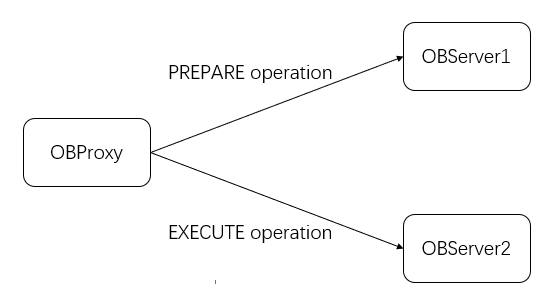
PS execution

In this case, two solutions are available:

  • Solution 1: Record the node OBServer1 to which the PREPARE request is routed, and also route the EXECUTE request to OBServer1. This method is simple to implement, but does not fully utilize the advantage of a distributed system.

  • Solution 2: Synchronize the status of the PREPARE request to OBServer2 before executing the EXECUTE request. For more information about status synchronization, see Session status synchronization. This method requires ODP to synchronize connection status, which is complex to implement, but fully leverages the advantage of a distributed system. ODP adopts this method.
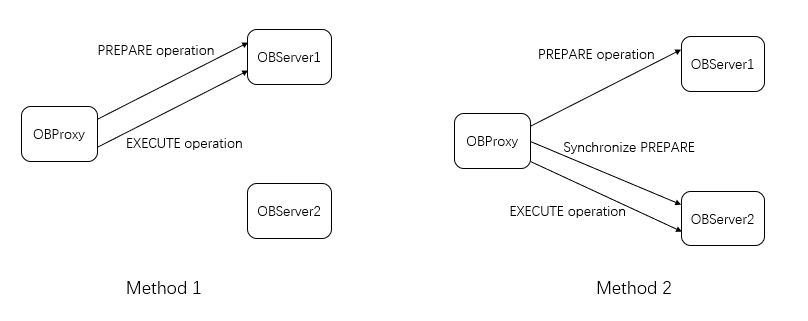
Solution

Performance

High performance is an important characteristic of OceanBase Database. Routing affects performance mainly in terms of latency, namely network communication overheads. ODP reduces network communication overheads and improves overall performance by perceiving data distribution and geographic locations of servers.

  • Data distribution

    Data distribution determines the number of hops on an execution link. In best cases, ODP directly hits the node where the data resides in routing. The section uses the select c1 from test statement as an example to illustrate the impact of data distribution on performance. As shown in the following figure, data in Table t1 is distributed on OBServer1. In Routing method 1, the statement is directly routed to OBServer1. This is the most efficient method. In Routing method 2, the SQL statement is sent to OBServer2, and OBServer2 then routes the statement to OBServer1. Compared with Routing method 1, this routing method is less efficient. To implement Routing method 1, ODP must be aware of the distribution of SQL statements and table data.
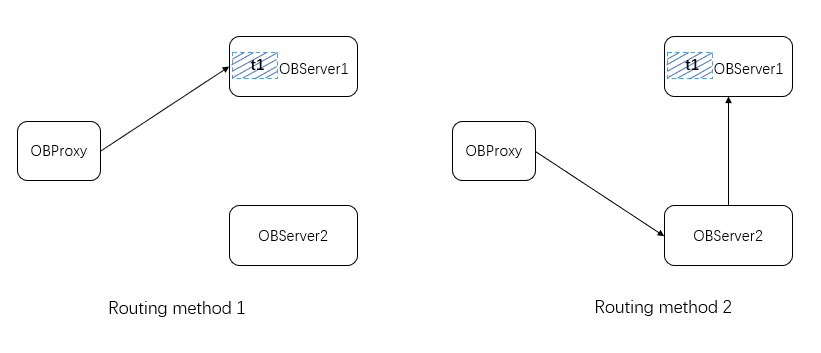
    Routing methods

  • Geographic location of servers

    The geographic location of a server affects the network latency. When a remote node is selected, SQL execution slows down. Sometimes, the network latency is much longer than the database execution time. Therefore, ODP selects servers in different geographic locations in the following priority: a server in the same IDC > a server in a different IDC in the same city > a server in a different city.

High availability

High availability means that OceanBase Database is tolerant of server faults, which makes the faults transparent and imperceptible to applications. High availability is implemented by using fault detection, the blacklist mechanism, and the retry logic. When ODP finds that an OBServer node is faulty, it excludes the faulty node and selects a healthy node during routing. ODP also allows failed SQL statements to be retried.

For more information about high availability, see High availability mechanism.

Previous topic

Session connection pool
Last

Next topic

ODP routing
Next
on this page
Functionality
Performance
High availability