OceanBase
English日本語简体中文
Docs Home
Products
Integrations
Release Notes

Databases

OceanBase DatabaseOceanBase Cloud OceanBase Best Practices

Tools

OceanBase Cloud PlatformOceanBase Migration ServiceOceanBase Developer CenterOceanBase Migration AssessmentOceanBase Admin ToolOceanBase Loader and DumperOceanBase DeployerKubernetes operator for OceanBaseOceanBase Diagnostic Tool OceanBase Binlog Service

Connectors and Middleware

OceanBase Database Proxy OceanBase Connector/C OceanBase Connector/J OceanBase Connector/ODBC OceanBase Connector/NETOceanBase Command-Line Client

Databases

OceanBase DatabaseOceanBase Cloud OceanBase Best Practices

Connectors and Middleware

OceanBase Database Proxy OceanBase Connector/C OceanBase Connector/J OceanBase Connector/ODBC OceanBase Connector/NETOceanBase Command-Line Client

Tools

OceanBase Cloud PlatformOceanBase Migration ServiceOceanBase Developer CenterOceanBase Migration AssessmentOceanBase Admin ToolOceanBase Loader and DumperOceanBase DeployerKubernetes operator for OceanBaseOceanBase Diagnostic Tool OceanBase Binlog Service
OceanBase DatabaseOceanBase Cloud ToolsConnectors and MiddlewareLifecycle Support Policy

OceanBase Database Proxy

V4.4.0
  • What is ODP?
  • Installation and deployment
    • Overview
    • Deploy ODP by using obd
    • Deploy ODP by using OCP
    • Deploy ODP by using the CLI
    • Deployment modes
  • Basic operations
  • Configuration parameter
    • View and modify parameters
    • Parameter summary
    • Global parameters
      • automatic_match_work_thread
      • block_thread_num
      • cache_cleaner_clean_interval
      • check_tenant_locality_change
      • client_max_connections
      • client_max_memory_size
      • client_session_id_version
      • client_sock_option_flag_out
      • client_tcp_keepcnt
      • client_tcp_keepidle
      • client_tcp_keepintvl
      • client_tcp_user_timeout
      • cluster_count_high_water_mark
      • cluster_expire_time
      • config_server_refresh_interval
      • congestion_fail_window
      • congestion_failure_threshold
      • congestion_retry_interval
      • connection_diagnosis_option
      • connection_pool_mode
      • connect_observer_max_retries
      • current_local_config_version
      • default_buffer_water_mark
      • default_inactivity_timeout
      • delay_exit_time
      • delay_update_entry_interval
      • detect_server_timeout
      • digest_sql_length
      • enable_abort_conn_info
      • enable_async_log
      • enable_async_pull_location_cache
      • enable_auto_restart
      • enable_bad_route_reject
      • enable_binlog_service
      • enable_cached_server
      • enable_causal_order_read
      • enable_client_connection_lru_disconnect
      • enable_client_ip_checkout
      • enable_cluster_checkout
      • enable_compression_protocol
      • enable_congestion
      • enable_connection_diagnosis
      • enable_cpu_isolate
      • enable_cpu_topology
      • enable_crash_error_log
      • enable_cross_shard_txn
      • enable_extra_prometheus_metric
      • enable_flow_control
      • enable_full_link_trace
      • enable_full_username
      • enable_get_rslist_remote
      • enable_global_ps_cache
      • enable_index_route
      • enable_monitor_stat
      • enable_ob_protocol_v2
      • enable_obproxy_rpc_service
      • enable_partition_table_route
      • enable_performance_mode
      • enable_pl_route
      • enable_primary_zone
      • enable_prometheus
      • enable_proxy_scramble
      • enable_qa_mode
      • enable_qos
      • enable_report_session_stats
      • enable_reroute
      • enable_scan_all_request
      • enable_sequence_prefetch
      • enable_sharding
      • enable_single_leader_node_routing
      • enable_standby
      • enable_stat
      • enable_strict_kernel_release
      • enable_strict_stat_time
      • enable_sync_all_stats
      • enable_syslog_file_compress
      • enable_syslog_wf
      • enable_trace
      • enable_trace_stats
      • enable_trans_detail_stats
      • enable_transaction_internal_routing
      • enable_xa_route
      • fetch_proxy_bin_random_time
      • fetch_proxy_bin_timeout
      • flow_consumer_reenable_threshold
      • flow_event_queue_threshold
      • flow_high_water_mark
      • flow_low_water_mark
      • grpc_client_num
      • grpc_thread_num
      • hot_upgrade_exit_timeout
      • hot_upgrade_failure_retries
      • hot_upgrade_rollback_timeout
      • idc_list_refresh_interval
      • ignore_local_config
      • internal_cmd_mem_limited
      • ip_listen_mode
      • is_need_skip_delay_interval_schema_changed
      • ldg_info_refresh_interval
      • listen_port
      • local_bound_ip
      • local_bound_ipv6_ip
      • log_cleanup_interval
      • log_dir_size_threshold
      • log_file_percentage
      • long_async_task_timeout
      • max_log_file_size
      • max_syslog_file_count
      • max_syslog_file_time
      • mem_leak_check_class_name
      • mem_leak_check_mod_name
      • metadb_server_state_refresh_interval
      • min_congested_connect_timeout
      • min_keep_congestion_interval
      • monitor_cost_ms_unit
      • monitor_item_limit
      • monitor_item_max_idle_period
      • monitor_log_level
      • monitor_stat_dump_interval
      • monitor_stat_high_threshold
      • monitor_stat_low_threshold
      • monitor_stat_middle_threshold
      • need_convert_vip_to_tname
      • net_accept_threads
      • net_config_poll_timeout
      • normal_pl_update_threshold
      • obproxy_config_server_url
      • obproxy_sys_password
      • partition_location_expire_relative_time
      • prometheus_cost_ms_unit
      • prometheus_listen_port
      • prometheus_sync_interval
      • protocol_diagnosis_level
      • proxy_cluster
      • proxy_hot_upgrade_check_interval
      • proxy_id
      • proxy_info_check_interval
      • proxy_local_cmd
      • proxy_mem_limited
      • qa_mode_mock_public_cloud_slb_addr
      • qos_stat_clean_interval
      • qos_stat_item_limit
      • refresh_idc_list
      • refresh_json_config
      • refresh_rslist
      • request_buffer_length
      • rootservice_list
      • rpc_client_net_write_timeout
      • rpc_client_net_read_timeout
      • rpc_async_pull_batch_max_size
      • rpc_async_task_thread_num
      • rpc_ctx_expire_time
      • routing_cache_mem_limited
      • rpc_enable_async_analyze
      • rpc_enable_async_pull_batch_tablets
      • rpc_async_pull_batch_max_times
      • rpc_async_pull_batch_wait_interval
      • rpc_enable_direct_expire_route_entry
      • rpc_enable_congestion
      • rpc_enable_lower_case_table_names
      • rpc_enable_global_index
      • rpc_enable_force_srv_black_list
      • rpc_enable_requestsm_info
      • rpc_enable_reroute
      • rpc_enable_parallel_handler
      • rpc_enable_retry_request_info_log
      • rpc_force_use_original_redis_protocol
      • rpc_enable_sub_req_log
      • rpc_force_srv_black_list
      • rpc_listen_port
      • rpc_max_request_batch_size
      • rpc_max_response_batch_size
      • rpc_max_server_table_entry_num
      • rpc_net_timeout_base
      • rpc_partition_calc_max_retries
      • rpc_redis_operation_timeout
      • rpc_request_server_entry_max_retries
      • rpc_request_timeout
      • rpc_request_max_retries
      • rpc_redis_default_database_name
      • rpc_redis_max_monitor_num
      • rpc_period_task_interval
      • rpc_redis_default_user_name
      • rpc_request_retry_waiting_time
      • rpc_server_entry_expire_time
      • rpc_request_timeout_delta
      • rpc_server_net_invalid_time_us
      • rpc_server_net_handler_expire_time
      • rpc_srv_session_pool_inactive_timeout
      • rpc_service_mode
      • rpc_server_net_max_pending_request
      • rpc_sub_request_isolation_mode
      • rpc_support_key_partition_shard_request
      • rpc_sub_request_weight
      • rpc_sub_req_max_retries
      • scan_buffered_rows_warning_threshold
      • sequence_entry_expire_time
      • sequence_fail_retry_count
      • sequence_prefetch_threshold
      • server_detect_fail_threshold
      • server_detect_mode
      • server_detect_refresh_interval
      • server_protocol
      • server_routing_mode
      • server_state_refresh_interval
      • server_tcp_init_cwnd
      • server_tcp_keepcnt
      • server_tcp_keepidle
      • server_tcp_keepintvl
      • server_tcp_user_timeout
      • session_pool_idle_timeout
      • session_pool_reset_interval
      • session_pool_stat_log_interval
      • session_pool_thread_num
      • session_pool_thread_schedule_interval
      • shard_scan_thread_num
      • short_async_task_timeout
      • skip_proxy_sys_private_check
      • skip_proxyro_check
      • slow_proxy_process_time_threshold
      • slow_transaction_time_threshold
      • sock_option_flag_out
      • sock_packet_mark_out
      • sock_packet_tos_out
      • sock_recv_buffer_size_out
      • sock_send_buffer_size_out
      • sql_table_cache_expire_relative_time
      • sql_table_cache_mem_limited
      • sqlaudit_mem_limited
      • stack_size
      • stat_dump_interval
      • stat_table_sync_interval
      • syslog_io_bandwidth_limit
      • syslog_level
      • table_entry_retry_build_limit
      • task_thread_num
      • tenant_location_valid_time
      • tunnel_request_size_threshold
      • username_separator
      • work_thread_num
      • xflush_log_level
    • Multi-level parameters
      • binlog_service_ip
      • compression_algorithm
      • enable_check_cluster_name
      • enable_client_ssl
      • enable_cloud_full_username
      • enable_read_write_split
      • enable_rpc_throttle
      • enable_server_ssl
      • enable_standby_read_write_split
      • enable_transaction_split
      • enable_weak_reroute
      • init_sql
      • mysql_version
      • ob_max_read_stale_time
      • obproxy_force_parallel_query_dop
      • obproxy_read_consistency
      • obproxy_read_only
      • observer_query_timeout_delta
      • observer_sys_password
      • observer_sys_password1
      • proxy_idc_name
      • proxy_primary_zone_name
      • proxy_route_policy
      • proxy_tenant_name
      • query_digest_time_threshold
      • read_stale_retry_interval
      • rootservice_cluster_name
      • route_diagnosis_level
      • rpc_request_throttle_waiting_time
      • rpc_throttle_limit_qps_qa
      • route_target_replica_type
      • rpc_throttle_trigger_percentage
      • slow_query_time_threshold
      • sql_firewall_config
      • ssl_attributes
      • target_db_server
      • weakread_weight_zone
  • Connection management
    • Principles
    • Session status synchronization
    • Configure a globally unique client session ID
    • Client session
    • Server session
    • Network connection
    • Session connection pool
  • Data routing
    • Factors affecting data routing
    • ODP routing
    • Intra-tenant routing
      • Overview
      • IP address-based routing
      • Partitioned table-based routing for strong-consistency reads
      • Global index table-based routing for strong-consistency reads
      • Replicated table-based routing for strong-consistency reads
      • Primary zone-based routing for strong-consistency reads
      • Strategy-based routing
      • Distributed transaction routing
      • Rerouting
      • Forcible routing
      • Weight-based load-balanced routing
      • Equality derivation for partition calculation
    • Automatic routing to the primary/standby tenants
    • Read/Write separation
    • Follower latency threshold
    • Function partition key routing
      • Overview
      • String functions
      • Numeric calculation functions
      • Date calculation functions
      • FAQ
    • Character set-based routing
    • Partitioning key types supported for routing by ODP
  • Logs
    • Overview
    • obproxy_diagnosis.log
    • obproxy_digest.log
    • obproxy_error.log
    • obproxy_slow.log
    • obproxy_stat.log
    • obproxy.log
  • Commands
    • Overview
    • Dedicated ODP commands
      • ALTER
      • KILL
        • KILL GLOBALSESSION
        • KILL PROXYSESSION
      • ping
      • SHOW
        • SHOW
        • SHOW GLOBALSESSION
        • SHOW PROXYPS
    • Compatible MySQL commands
      • BINLOG
      • KILL
      • SHOW PROCESSLIST
      • SHOW RELAYLOG EVENTS
      • SHOW SLAVE HOSTS
  • High availability mechanism
    • Overview
    • High availability of ODP services
    • High availability of OceanBase Database
    • High availability testing
  • OBKV
    • RPC service port
    • Throttling
  • Security and protocols
  • Operation and maintenance
    • Troubleshooting logic
    • Performance analysis
    • Show Trace
    • Routing diagnostics
      • Overview
      • Obtain diagnostic information
      • Diagnostic point troubleshooting
        • Overview
        • SQL_PARSE
        • ROUTE_INFO
        • LOCATION_CACHE_LOOKUP
        • ROUTINE_ENTRY_LOOKUP_DONE
        • FETCH_TABLE_RELATED_DATA
        • TABLE_ENTRY_LOOKUP_DONE
        • EXPR_PARSE
        • CALC_ROWID
        • RESOLVE_TOKEN
        • RESOLVE_EXPR
        • CALC_PARTITION_ID
        • PARTITION_ID_CALC_DONE
        • PARTITION_ENTRY_LOOKUP_DONE
        • ROUTE_POLICY
        • CONGESTION_CONTROL
        • RETRY
        • HANDLE_RESPONSE
      • Examples
    • Memory leak diagnostics
    • Connection diagnostics
    • Prometheus monitoring
    • SQL firewall
  • Release Notes
    • Version number rules
    • Enterprise Edition
      • V4.3
        • OceanBase Database Proxy Enterprise Edition V4.3.6
        • OceanBase Database Proxy Enterprise Edition V4.3.5
        • OceanBase Database Enterprise Edition V4.3.4
        • ODP Enterprise Edition V4.3.3
        • ODP Enterprise Edition V4.3.2
        • ODP Enterprise Edition V4.3.1
        • ODP Enterprise Edition V4.3.0
      • V4.2
        • ODP Enterprise Edition V4.2.3
        • ODP Enterprise Edition V4.2.2
        • ODP Enterprise Edition V4.2.1
      • V4.1
        • ODP Enterprise Edition V4.1.0
      • V4.0
        • ODP Enterprise Edition V4.0.0
      • V3.2
        • ODP Enterprise Edition V3.2.11
        • ODP Enterprise Edition V3.2.3.5
    • Community Edition
      • V4.3
        • OceanBase Database Proxy Community Edition V4.3.6
        • OceanBase Database Proxy Community Edition V4.3.5
        • OceanBase Database Proxy Community Edition V4.3.4
        • ODP Community Edition V4.3.3
        • ODP Community Edition V4.3.2
        • ODP Community Edition V4.3.1
      • V4.2
        • ODP Community Edition V4.2.3
        • ODP Community Edition V4.2.1
        • ODP Community Edition V4.2.0
      • V4.1
        • ODP Community Edition V4.1.0
      • V4.0
        • ODP Community Edition V4.0.0

Download PDF

Document Feedback
  1. Documentation Center
  2. OceanBase Database Proxy
  3. V4.4.0

Deployment modes

Last Updated:2026-09-04 08:23:04

Deploy ODP together with OceanBase Database
Deploy ODP separately from the OBServer nodes

This topic describes how to deploy OceanBase Database Proxy (ODP).

The deployment mode varies based on the actual physical environment and business requirements. When you deploy ODP in a production environment, take the following factors into consideration:

  • Delivery mode

    ODP is delivered as an RPM package and can be deployed by using OceanBase Deployer (obd), OceanBase Cloud Platform (OCP), or the CLI.

  • Quantity

    The number of ODPs that can be deployed is relevant with the number of applications or OBServer nodes, depending on the specific deployment mode.

  • Deployment mode

    The deployment modes supported for ODP differ in the response time and resource contention. The performance varies significantly based on the deployment mode.

Deploy ODP together with OceanBase Database

When you deploy OceanBase Database, you can deploy an ODP process on the server where OceanBase Database resides, forming a 1:1 correspondence between the OBServer node and the ODP. In this deployment mode, the number of ODPs is irrelevant with the number of applications. You can also deploy one ODP in each zone.

The following figure shows a common ODP deployment mode in a private cloud. You must deploy and configure the load balancer.
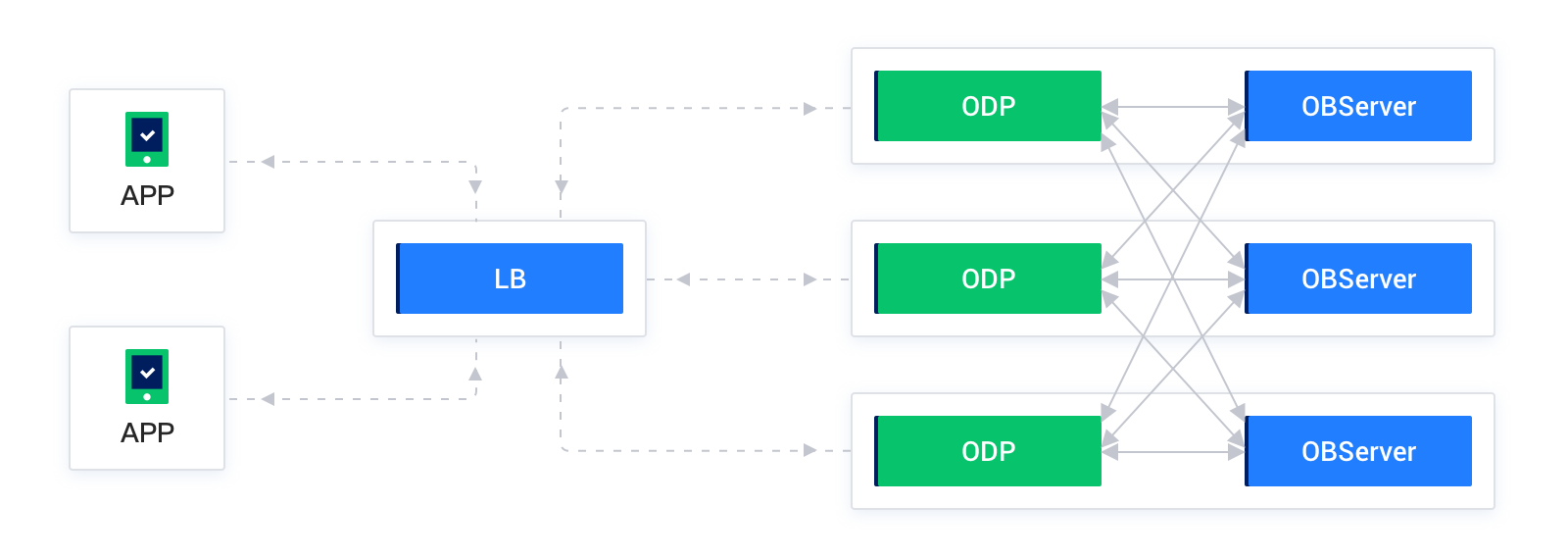
Figure 2

Deploy ODP separately from the OBServer nodes

You can deploy ODP on each application server that needs to access the database or deploy it independently.

  • If you deploy ODP on each application server, the application directly connects to the ODP deployed on the same server. All requests are sent by ODP to the appropriate OceanBase Database server.

  • If you deploy ODP independently, you can deploy it on a dedicated server. The number of ODPs is irrelevant with the number of applications or OBServer nodes, and is determined based on actual business requirements.

    We recommend that you use a midrange computer, for example, an Elastic Compute Service (ECS) instance with 16 CPU cores and 16 GB of memory. If ODP is deployed independently, it does not contend for resources with OceanBase Database. You can better manage ODP and use ODP as a resource pool to provide external services. This deployment mode has been applied in the public cloud.
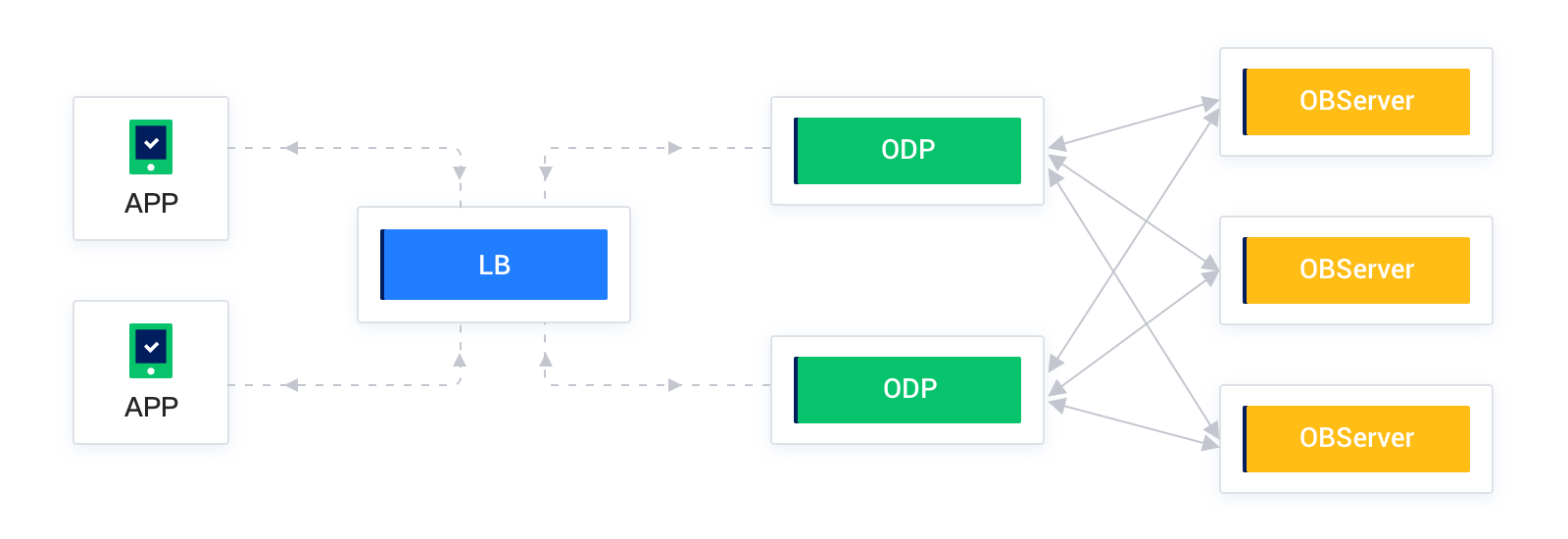
    Figure 3

    Note

    You must deploy and configure the load balancer.

Previous topic

Deploy ODP by using the CLI
Last

Next topic

Basic operations
Next
on this page
Deploy ODP together with OceanBase Database
Deploy ODP separately from the OBServer nodes