OceanBase
English日本語简体中文
Docs Home
Products
Integrations
Release Notes

Databases

OceanBase DatabaseOceanBase Cloud OceanBase Best Practices

Tools

OceanBase Cloud PlatformOceanBase Migration ServiceOceanBase Developer CenterOceanBase Migration AssessmentOceanBase Admin ToolOceanBase Loader and DumperOceanBase DeployerKubernetes operator for OceanBaseOceanBase Diagnostic Tool OceanBase Binlog Service

Connectors and Middleware

OceanBase Database Proxy OceanBase Connector/C OceanBase Connector/J OceanBase Connector/ODBC OceanBase Connector/NETOceanBase Command-Line Client

Databases

OceanBase DatabaseOceanBase Cloud OceanBase Best Practices

Connectors and Middleware

OceanBase Database Proxy OceanBase Connector/C OceanBase Connector/J OceanBase Connector/ODBC OceanBase Connector/NETOceanBase Command-Line Client

Tools

OceanBase Cloud PlatformOceanBase Migration ServiceOceanBase Developer CenterOceanBase Migration AssessmentOceanBase Admin ToolOceanBase Loader and DumperOceanBase DeployerKubernetes operator for OceanBaseOceanBase Diagnostic Tool OceanBase Binlog Service
OceanBase DatabaseOceanBase Cloud ToolsConnectors and MiddlewareLifecycle Support Policy

OceanBase Database Proxy

V4.4.1
  • What is ODP?
  • Installation and deployment
    • Overview
    • Deploy ODP by using obd
    • Deploy ODP by using OCP
    • Deploy ODP by using the CLI
    • Deployment modes
  • Basic operations
  • Configuration parameter
    • View and modify parameters
    • Parameter summary
    • Global parameters
      • automatic_match_work_thread
      • block_thread_num
      • cache_cleaner_clean_interval
      • check_tenant_locality_change
      • client_max_connections
      • client_max_memory_size
      • client_session_id_version
      • client_sock_option_flag_out
      • client_tcp_keepcnt
      • client_tcp_keepidle
      • client_tcp_keepintvl
      • client_tcp_user_timeout
      • cluster_count_high_water_mark
      • cluster_expire_time
      • config_server_refresh_interval
      • congestion_fail_window
      • congestion_failure_threshold
      • congestion_retry_interval
      • connection_diagnosis_option
      • connection_pool_mode
      • connect_observer_max_retries
      • current_local_config_version
      • default_buffer_water_mark
      • default_inactivity_timeout
      • delay_exit_time
      • delay_update_entry_interval
      • detect_server_timeout
      • digest_sql_length
      • enable_abort_conn_info
      • enable_async_log
      • enable_async_pull_location_cache
      • enable_auto_restart
      • enable_bad_route_reject
      • enable_binlog_service
      • enable_cached_server
      • enable_causal_order_read
      • enable_client_connection_lru_disconnect
      • enable_client_ip_checkout
      • enable_cluster_checkout
      • enable_compression_protocol
      • enable_congestion
      • enable_connection_diagnosis
      • enable_cpu_isolate
      • enable_cpu_topology
      • enable_crash_error_log
      • enable_cross_shard_txn
      • enable_extra_prometheus_metric
      • enable_flow_control
      • enable_full_link_trace
      • enable_full_username
      • enable_get_rslist_remote
      • enable_global_ps_cache
      • enable_index_route
      • enable_monitor_stat
      • enable_ob_protocol_v2
      • enable_obproxy_rpc_service
      • enable_partition_table_route
      • enable_performance_mode
      • enable_pl_route
      • enable_primary_zone
      • enable_prometheus
      • enable_proxy_scramble
      • enable_qa_mode
      • enable_qos
      • enable_report_session_stats
      • enable_reroute
      • enable_scan_all_request
      • enable_sequence_prefetch
      • enable_sharding
      • enable_single_leader_node_routing
      • enable_standby
      • enable_stat
      • enable_strict_kernel_release
      • enable_strict_stat_time
      • enable_sync_all_stats
      • enable_syslog_file_compress
      • enable_syslog_wf
      • enable_trace
      • enable_trace_stats
      • enable_trans_detail_stats
      • enable_transaction_internal_routing
      • enable_xa_route
      • fetch_proxy_bin_random_time
      • fetch_proxy_bin_timeout
      • flow_consumer_reenable_threshold
      • flow_event_queue_threshold
      • flow_high_water_mark
      • flow_low_water_mark
      • grpc_client_num
      • grpc_thread_num
      • hot_upgrade_exit_timeout
      • hot_upgrade_failure_retries
      • hot_upgrade_rollback_timeout
      • idc_list_refresh_interval
      • ignore_local_config
      • internal_cmd_mem_limited
      • ip_listen_mode
      • is_need_skip_delay_interval_schema_changed
      • ldg_info_refresh_interval
      • listen_port
      • local_bound_ip
      • local_bound_ipv6_ip
      • log_cleanup_interval
      • log_dir_size_threshold
      • log_file_percentage
      • long_async_task_timeout
      • max_log_file_size
      • max_syslog_file_count
      • max_syslog_file_time
      • mem_leak_check_class_name
      • mem_leak_check_mod_name
      • metadb_server_state_refresh_interval
      • min_congested_connect_timeout
      • min_keep_congestion_interval
      • monitor_cost_ms_unit
      • monitor_item_limit
      • monitor_item_max_idle_period
      • monitor_log_level
      • monitor_stat_dump_interval
      • monitor_stat_high_threshold
      • monitor_stat_low_threshold
      • monitor_stat_middle_threshold
      • need_convert_vip_to_tname
      • net_accept_threads
      • net_config_poll_timeout
      • normal_pl_update_threshold
      • obproxy_config_server_url
      • obproxy_sys_password
      • partition_location_expire_relative_time
      • prometheus_cost_ms_unit
      • prometheus_listen_port
      • prometheus_sync_interval
      • protocol_diagnosis_level
      • proxy_cluster
      • proxy_hot_upgrade_check_interval
      • proxy_id
      • proxy_info_check_interval
      • proxy_local_cmd
      • proxy_mem_limited
      • qa_mode_mock_public_cloud_slb_addr
      • qos_stat_clean_interval
      • qos_stat_item_limit
      • refresh_idc_list
      • refresh_json_config
      • refresh_rslist
      • request_buffer_length
      • rootservice_list
      • rpc_client_net_write_timeout
      • rpc_client_net_read_timeout
      • rpc_async_pull_batch_max_size
      • rpc_async_task_thread_num
      • rpc_ctx_expire_time
      • routing_cache_mem_limited
      • rpc_enable_async_analyze
      • rpc_enable_async_pull_batch_tablets
      • rpc_async_pull_batch_max_times
      • rpc_async_pull_batch_wait_interval
      • rpc_enable_direct_expire_route_entry
      • rpc_enable_congestion
      • rpc_enable_lower_case_table_names
      • rpc_enable_global_index
      • rpc_enable_force_srv_black_list
      • rpc_enable_requestsm_info
      • rpc_enable_reroute
      • rpc_enable_parallel_handler
      • rpc_enable_retry_request_info_log
      • rpc_force_use_original_redis_protocol
      • rpc_enable_sub_req_log
      • rpc_force_srv_black_list
      • rpc_listen_port
      • rpc_max_request_batch_size
      • rpc_max_response_batch_size
      • rpc_max_server_table_entry_num
      • rpc_net_timeout_base
      • rpc_partition_calc_max_retries
      • rpc_redis_operation_timeout
      • rpc_request_server_entry_max_retries
      • rpc_request_timeout
      • rpc_request_max_retries
      • rpc_redis_default_database_name
      • rpc_redis_max_monitor_num
      • rpc_period_task_interval
      • rpc_redis_default_user_name
      • rpc_request_retry_waiting_time
      • rpc_server_entry_expire_time
      • rpc_request_timeout_delta
      • rpc_server_net_handler_expire_time
      • rpc_server_net_invalid_time_us
      • rpc_srv_session_pool_inactive_timeout
      • rpc_service_mode
      • rpc_server_net_max_pending_request
      • rpc_sub_request_isolation_mode
      • rpc_support_key_partition_shard_request
      • rpc_sub_request_weight
      • rpc_sub_req_max_retries
      • scan_buffered_rows_warning_threshold
      • sequence_entry_expire_time
      • sequence_fail_retry_count
      • sequence_prefetch_threshold
      • server_detect_fail_threshold
      • server_detect_mode
      • server_detect_refresh_interval
      • server_protocol
      • server_routing_mode
      • server_state_refresh_interval
      • server_tcp_init_cwnd
      • server_tcp_keepcnt
      • server_tcp_keepidle
      • server_tcp_keepintvl
      • server_tcp_user_timeout
      • session_pool_idle_timeout
      • session_pool_reset_interval
      • session_pool_stat_log_interval
      • session_pool_thread_num
      • session_pool_thread_schedule_interval
      • shard_scan_thread_num
      • short_async_task_timeout
      • skip_proxy_sys_private_check
      • skip_proxyro_check
      • slow_proxy_process_time_threshold
      • slow_transaction_time_threshold
      • sock_option_flag_out
      • sock_packet_mark_out
      • sock_packet_tos_out
      • sock_recv_buffer_size_out
      • sock_send_buffer_size_out
      • sql_table_cache_expire_relative_time
      • sql_table_cache_mem_limited
      • sqlaudit_mem_limited
      • stack_size
      • stat_dump_interval
      • stat_table_sync_interval
      • syslog_io_bandwidth_limit
      • syslog_level
      • table_entry_retry_build_limit
      • task_thread_num
      • tenant_location_valid_time
      • tunnel_request_size_threshold
      • username_separator
      • work_thread_num
      • xflush_log_level
    • Multi-level parameters
      • binlog_service_ip
      • compression_algorithm
      • enable_check_cluster_name
      • enable_client_ssl
      • enable_cloud_full_username
      • enable_read_write_split
      • enable_rpc_throttle
      • enable_server_ssl
      • enable_standby_read_write_split
      • enable_transaction_split
      • enable_weak_reroute
      • init_sql
      • mysql_version
      • ob_max_read_stale_time
      • obproxy_force_parallel_query_dop
      • obproxy_read_consistency
      • obproxy_read_only
      • observer_query_timeout_delta
      • observer_sys_password
      • observer_sys_password1
      • proxy_idc_name
      • proxy_primary_zone_name
      • proxy_route_policy
      • proxy_tenant_name
      • query_digest_time_threshold
      • read_stale_retry_interval
      • rootservice_cluster_name
      • route_diagnosis_level
      • rpc_request_throttle_waiting_time
      • rpc_throttle_limit_qps_qa
      • route_target_replica_type
      • rpc_throttle_trigger_percentage
      • slow_query_time_threshold
      • sql_firewall_config
      • ssl_attributes
      • target_db_server
      • weakread_weight_zone
  • Connection management
    • Principles
    • Session status synchronization
    • Configure a globally unique client session ID
    • Client session
    • Server session
    • Network connection
    • Session connection pool
  • Data routing
    • Factors affecting data routing
    • ODP routing
    • Intra-tenant routing
      • Overview
      • IP address-based routing
      • Partitioned table-based routing for strong-consistency reads
      • Global index table-based routing for strong-consistency reads
      • Replicated table-based routing for strong-consistency reads
      • Primary zone-based routing for strong-consistency reads
      • Strategy-based routing
      • Distributed transaction routing
      • Rerouting
      • Forcible routing
      • Weight-based load-balanced routing
      • Equality derivation for partition calculation
    • Automatic routing to the primary/standby tenants
    • Read/Write separation
    • Follower latency threshold
    • Function partition key routing
      • Overview
      • String functions
      • Numeric calculation functions
      • Date calculation functions
      • FAQ
    • Character set-based routing
    • Partitioning key types supported for routing by ODP
  • Logs
    • Overview
    • obproxy_diagnosis.log
    • obproxy_digest.log
    • obproxy_error.log
    • obproxy_slow.log
    • obproxy_stat.log
    • obproxy.log
  • Commands
    • Overview
    • Dedicated ODP commands
      • ALTER
      • KILL
        • KILL GLOBALSESSION
        • KILL PROXYSESSION
      • ping
      • SHOW
        • SHOW
        • SHOW GLOBALSESSION
        • SHOW PROXYPS
    • Compatible MySQL commands
      • BINLOG
      • KILL
      • SHOW PROCESSLIST
      • SHOW RELAYLOG EVENTS
      • SHOW SLAVE HOSTS
  • High availability mechanism
    • Overview
    • High availability of ODP services
    • High availability of OceanBase Database
    • High availability testing
  • OBKV
    • RPC service port
    • Throttling
  • Security and protocols
  • Operation and maintenance
    • Troubleshooting logic
    • Performance analysis
    • Show Trace
    • Routing diagnostics
      • Overview
      • Obtain diagnostic information
      • Diagnostic point troubleshooting
        • Overview
        • SQL_PARSE
        • ROUTE_INFO
        • LOCATION_CACHE_LOOKUP
        • ROUTINE_ENTRY_LOOKUP_DONE
        • FETCH_TABLE_RELATED_DATA
        • TABLE_ENTRY_LOOKUP_DONE
        • EXPR_PARSE
        • CALC_ROWID
        • RESOLVE_TOKEN
        • RESOLVE_EXPR
        • CALC_PARTITION_ID
        • PARTITION_ID_CALC_DONE
        • PARTITION_ENTRY_LOOKUP_DONE
        • ROUTE_POLICY
        • CONGESTION_CONTROL
        • RETRY
        • HANDLE_RESPONSE
      • Examples
    • Memory leak diagnostics
    • Connection diagnostics
    • Prometheus monitoring
    • SQL firewall
  • Release Notes
    • Version number rules
    • Enterprise Edition
      • V4.4
        • OceanBase Database Proxy Enterprise Edition V4.4.1
      • V4.3
        • OceanBase Database Proxy Enterprise Edition V4.3.6
        • OceanBase Database Proxy Enterprise Edition V4.3.5
        • OceanBase Database Enterprise Edition V4.3.4
        • ODP Enterprise Edition V4.3.3
        • ODP Enterprise Edition V4.3.2
        • ODP Enterprise Edition V4.3.1
        • ODP Enterprise Edition V4.3.0
      • V4.2
        • ODP Enterprise Edition V4.2.3
        • ODP Enterprise Edition V4.2.2
        • ODP Enterprise Edition V4.2.1
      • V4.1
        • ODP Enterprise Edition V4.1.0
      • V4.0
        • ODP Enterprise Edition V4.0.0
      • V3.2
        • ODP Enterprise Edition V3.2.11
        • ODP Enterprise Edition V3.2.3.5
    • Community Edition
      • V4.4
        • OceanBase Database Proxy Community Edition V4.4.1
      • V4.3
        • OceanBase Database Proxy Community Edition V4.3.6
        • OceanBase Database Proxy Community Edition V4.3.5
        • OceanBase Database Proxy Community Edition V4.3.4
        • ODP Community Edition V4.3.3
        • ODP Community Edition V4.3.2
        • ODP Community Edition V4.3.1
      • V4.2
        • ODP Community Edition V4.2.3
        • ODP Community Edition V4.2.1
        • ODP Community Edition V4.2.0
      • V4.1
        • ODP Community Edition V4.1.0
      • V4.0
        • ODP Community Edition V4.0.0

Download PDF

Document Feedback
  1. Documentation Center
  2. OceanBase Database Proxy
  3. V4.4.1

Session status synchronization

Last Updated:2026-09-04 08:25:03

Purpose
Process

This topic describes the purpose and process of OceanBase Database Proxy (ODP) session status synchronization.

Purpose

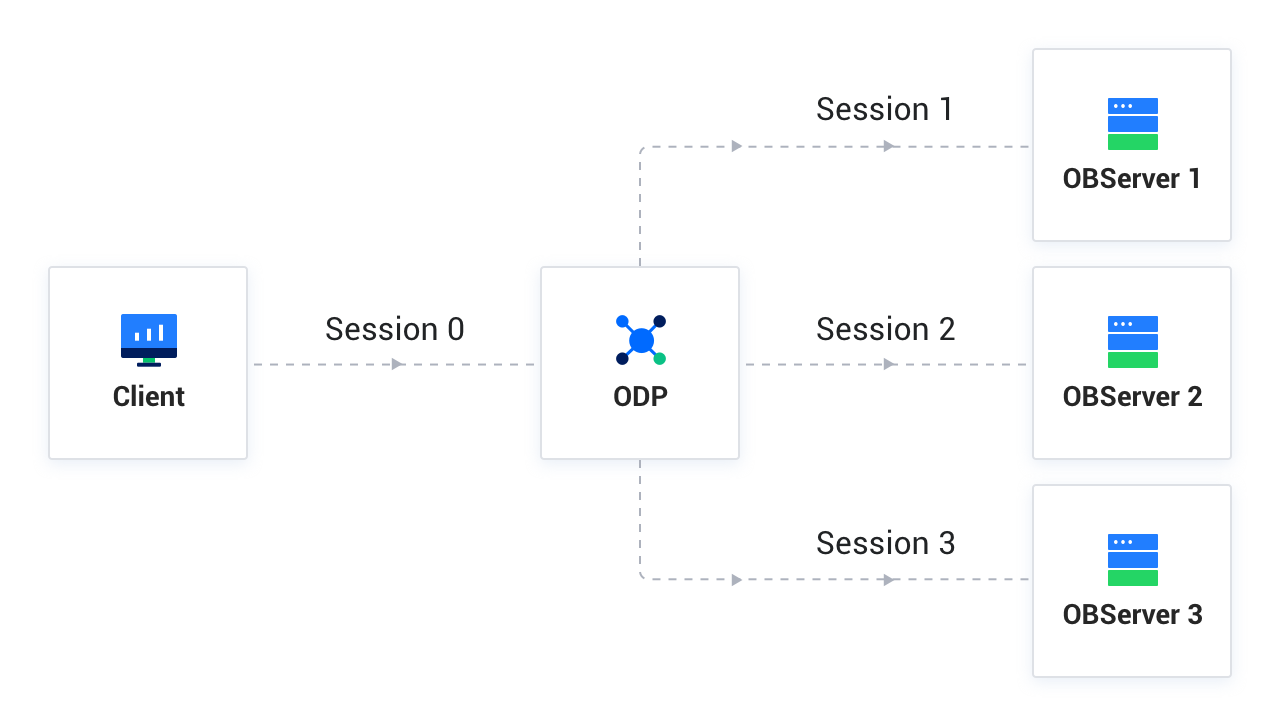
When a client establishes a connection to OceanBase Database through ODP, there is only one connection between the client and ODP and there may be multiple connections between ODP and OBServer nodes, as shown in the following figure. In other words, one client connection maps multiple server connections. To ensure the accuracy of execution results, the session status of multiple server connections must be consistent.
Session

As shown in the figure above, between the client and ODP, there is a session called Session0, which is perceived by the client. If the state of Session0 is not synchronized to Session1, Session2, or Session3, an error may occur when an SQL statement is executed.

To solve this problem, ODP introduces the versioning mechanism to ensure the status synchronization of the database, session variables, last_insert_id, and prepared statements. ODP will synchronize the state of Session0 (such as system variables, user variables, and transaction status) to Session1, Session2, and Session3 so that OBServer nodes can take correct actions based on the session status.

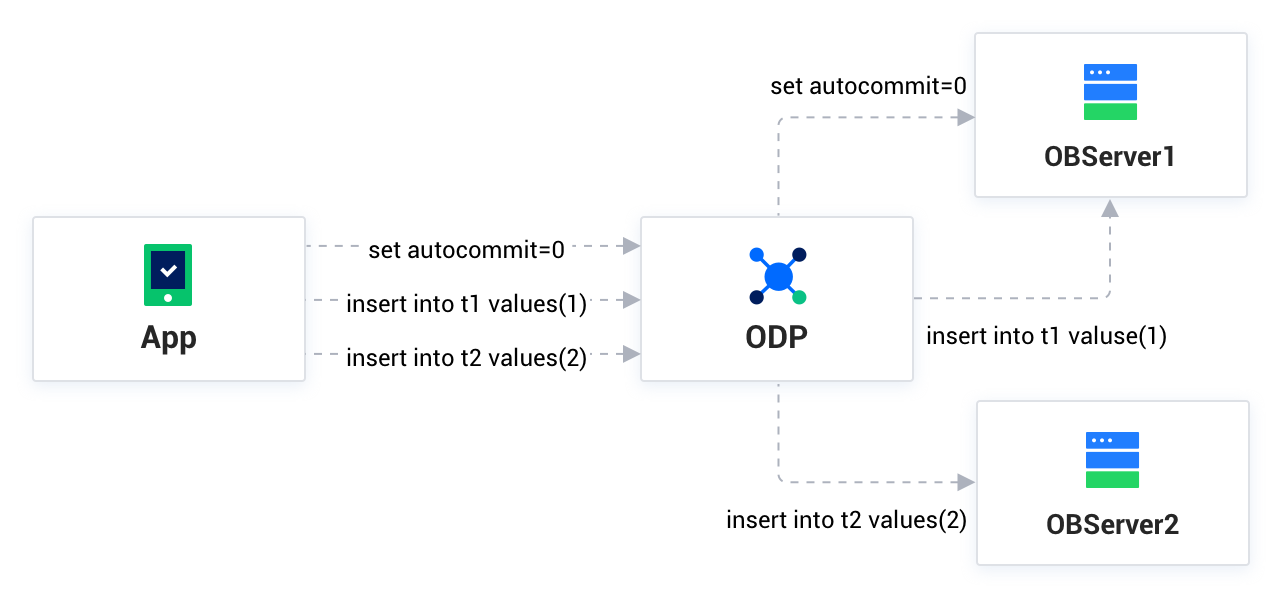
As an example to illustrate the problem caused by out-of-sync state, assuming that autocommit is set to 1 for the current cluster, execute the following statements:

set autocommit = 0;
insert into t1 values(1);
insert into t2 values(2);

The execution process is as follows:

  1. ODP sends the set autocommit = 0; statement to OBServer1.

  2. ODP sends the insert into t1 values(1); statement to OBServer1.

  3. ODP switches to the connection with OBServer2 and sends the insert into t2 values(2); statement to OBServer2.

Example

Since the connection status autocommit=0 is not synchronized to the session between ODP and OBServer2, the transaction is committed on OBServer2 after the third SQL statement insert into t2 values(2); is executed, but OBServer1 is still in the transaction. To avoid this issue, ODP must synchronize the value of the autocommit variable before sending the INSERT SQL statement to OBServer2.

Process

In this section, we demonstrate how ODP performs status synchronization by modifying session-level system variables.

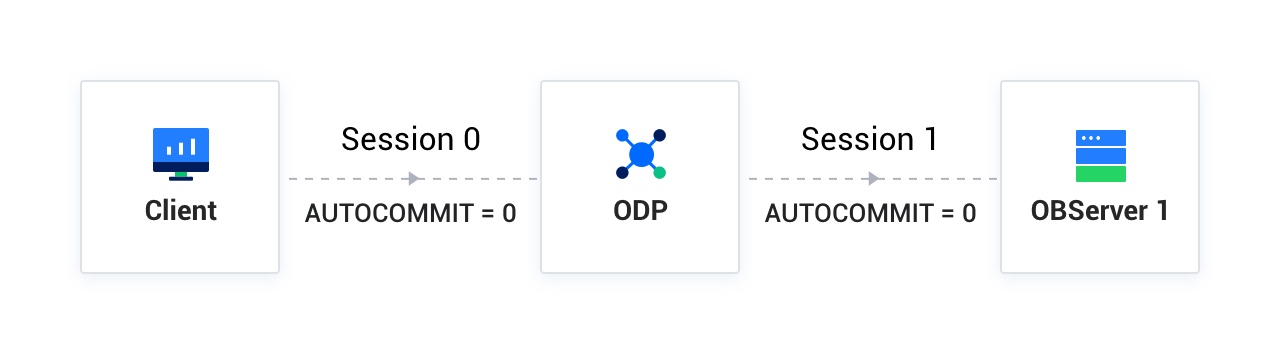
  1. The client initiates a connection (Session0) with ODP, and ODP establishes a connection (Session1) with one of the OBServer nodes in the current cluster.

  2. Assuming that autocommit is set to 1 for the cluster, when the client sends the set autocommit = 0 statement to change the value of the system variable autocommit to 0, ODP records the change in Session0 and then forwards it to OBServer1 through Session1.
    Session1

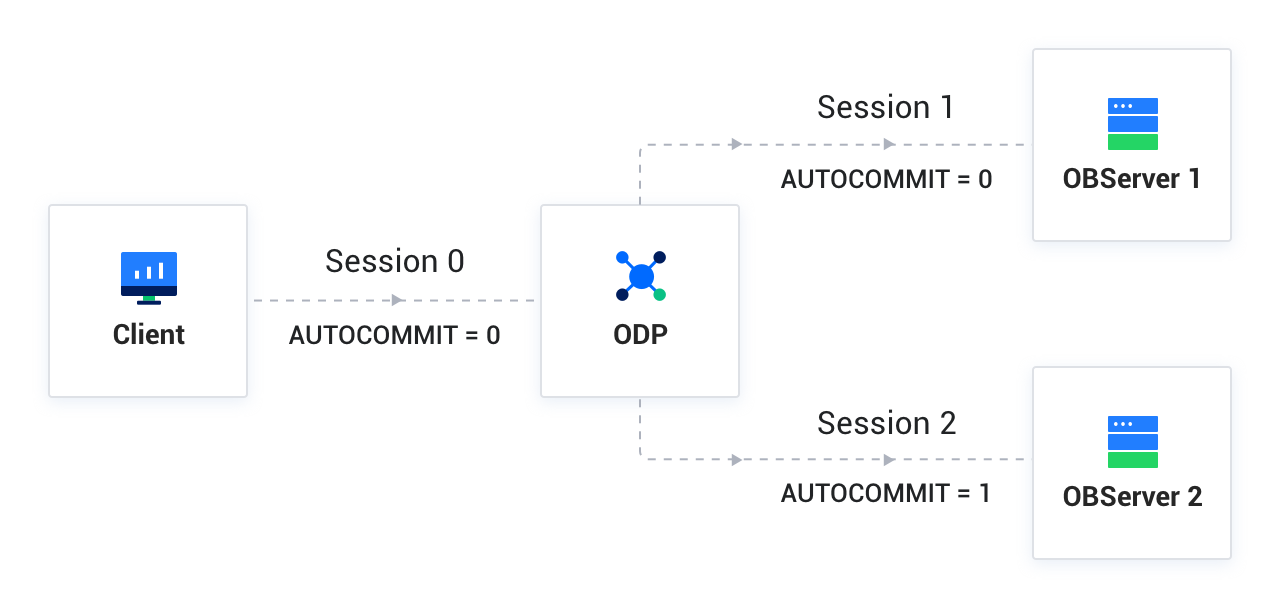
  3. If the client sends an SQL statement to access the data on OBServer2, ODP parses the statement and establishes a connection (Session2) with OBServer2 upon receipt of the statement.
    Session2

  4. In Session0, the system variable autocommit is set to 0, while in Session2, the system variable remains at its default value of 1. In this case, ODP will override the value of AUTOCOMMIT=0 from Session0 to Session2 to ensure that the client's session status remains consistent with the server's session status.
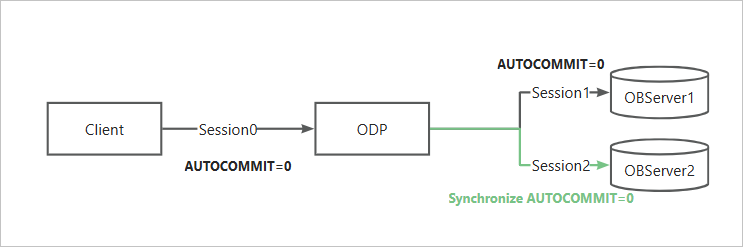
    Synchronization

Previous topic

Principles
Last

Next topic

Configure a globally unique client session ID
Next
on this page
Purpose
Process