OceanBase
English日本語简体中文
Docs Home
Products
Integrations
Release Notes

Databases

OceanBase DatabaseOceanBase Cloud OceanBase Best Practices

Tools

OceanBase Cloud PlatformOceanBase Migration ServiceOceanBase Developer CenterOceanBase Migration AssessmentOceanBase Admin ToolOceanBase Loader and DumperOceanBase DeployerKubernetes operator for OceanBaseOceanBase Diagnostic Tool OceanBase Binlog Service

Connectors and Middleware

OceanBase Database Proxy OceanBase Connector/C OceanBase Connector/J OceanBase Connector/ODBC OceanBase Connector/NETOceanBase Command-Line Client

Databases

OceanBase DatabaseOceanBase Cloud OceanBase Best Practices

Connectors and Middleware

OceanBase Database Proxy OceanBase Connector/C OceanBase Connector/J OceanBase Connector/ODBC OceanBase Connector/NETOceanBase Command-Line Client

Tools

OceanBase Cloud PlatformOceanBase Migration ServiceOceanBase Developer CenterOceanBase Migration AssessmentOceanBase Admin ToolOceanBase Loader and DumperOceanBase DeployerKubernetes operator for OceanBaseOceanBase Diagnostic Tool OceanBase Binlog Service
OceanBase DatabaseOceanBase Cloud ToolsConnectors and MiddlewareLifecycle Support Policy

OceanBase Cloud Platform

V4.3.5
  • Document Overview
  • Product Introduction
    • What is OceanBase Cloud Platform?
    • Differences between Enterprise Edition and Community Edition
    • System architecture
    • Features
    • Limits
      • System requirements
      • Dependencies
  • Deploy OceanBase Cloud Platform (OCP)
    • Deploy OceanBase Cloud Platform (OCP) Enterprise Edition
      • Deployment overview
        • Deploy OCP cluster in the Single-node
        • Deploy OCP cluster in the High-availability
      • Prepare the deployment environment
        • Install OAT
        • Add a server
        • Check the environment
      • Deploy OCP
        • Plan resources
          • Planning resources of a single node OCP
            • OCP-Server specifications
            • MetaDB resources
            • MonitorDB resources
            • Host resources
          • Planning resources of a high availability OCP
            • OCP-Server specifications
            • MetaDB resources
            • MonitorDB resources
            • Host resources
        • Deploy OCP
          • Deploying a single point of OCP
            • Prepare installation media
            • Create MetaDB
            • Install OCP
            • Initialize system parameters
          • Deploying a high availability of OCP
            • Prepare installation media
            • Create MetaDB
            • Install OCP
            • Register an OCP cluster
            • Initialize system parameters
        • Check after deployment
      • Deployment FAQ
        • Optimize MonitorDB parameters
        • F5 Big-IP LTM and alert configuration
          • Connect OBProxy to F5 Big-IP LTM
          • Connect OCP-Console to F5 Big-IP LTM
          • OCP Service Health Monitoring
        • Ubuntu deployment FAQ
        • EulerOS deployment FAQ
        • Client requirements
        • Start and stop OCP
      • Appendix
        • Uninstall OCP
        • Check the NTP offset
    • Deploy OceanBase Cloud Platform (OCP) Community Edition
      • Overview
      • Installation process
      • Installation planning
        • User planning
        • Host planning
        • Disk and directory planning
        • Port planning
      • Prepare for the installation
      • Deploy OCP on the GUI
      • Use Docker to deploy OCP
      • Post-deployment check
      • Appendix
        • Install Docker
        • Uninstall OCP
        • Restart OCP
        • FAQ about deployment
  • Upgrade OceanBase Cloud Platform (OCP)
    • Upgrade OceanBase Cloud Platform (OCP) Enterprise Edition
      • Overview
      • Considerations
      • Preparations
      • Upgrade OCP
        • Take over OCP
        • Upgrade OCP
      • Verify after upgrade
        • Verify the cluster feature
        • Verify the tenant feature
        • Verify the host feature
        • Verify the software package feature
        • Verify the OBProxy feature
        • Verify the backup and restore feature
        • Verify the alert feature
        • Verify the task feature
        • Verify the password box feature
      • Appendix
        • Change a user's password
        • Version mapping
    • Upgrade OceanBase Cloud Platform (OCP) Community Edition
      • Upgrade OCP on the GUI
      • Upgrade OCP using Docker containers
      • Post-upgrade check
  • Quick Start
    • OCP operations
    • Log on to the OCP console
    • Upload a software package
    • Add a host
    • Create a cluster
    • Create a tenant
    • Create a user
    • Create an OBProxy cluster
  • Cluster Management
    • Overview
    • Create a cluster
      • Create a distributed cluster
      • Create a standalone centralized database
    • Manage clusters
      • Create a standby cluster
      • View the details of a cluster
      • Upgrade a standalone centralized database to a distributed cluster
      • Take over a cluster
      • Restart a cluster
      • Stop a cluster
      • Move out a cluster
      • Delete a cluster
      • Change the password
      • Manage Arbitration Service of a cluster
        • Add an arbitration service
        • Add an arbitration service group
        • Replace the arbitration service for a cluster
        • Remove an arbitration service
      • Enable automatic detection of deadlocks
      • Disable automatic detection of deadlocks
      • Manage O&M configuration
        • Overview
        • Manage parameters
        • View the parameter modification history
        • Configure resources for OCP Agent
      • Manage CPU binding configurations
    • Manage zones of a cluster
      • Add a zone
      • Edit a zone
      • Restart a zone
      • Stop a zone
      • Delete a zone
    • Manage OBServers of a cluster
      • Add an OBServer node
      • Restart a faulty OBServer node
      • Stop an OBServer service
      • Stop the observer process
      • Replace an OBServer node
      • Reinstall an OBServer
      • Delete an OBServer
    • Upgrade an OceanBase cluster
    • View the topology of a cluster
    • Overview of cluster tenant management
    • Manage cluster resource
      • View the unit distribution
      • View resource usage
    • Manage major compaction of a cluster
      • Modify the major compaction settings of a cluster
      • Perform a major compaction
      • View details of a major compaction
      • View statistics of a major compaction
      • View the major compaction records
    • Manage cluster parameters
      • Parameter types
      • View parameters
      • Modify parameters
      • View the history of parameter changes
    • Manage Arbitration Services
      • Arbitration service Overview
      • Create an arbitration service
      • Take over an arbitration service
      • Stop an arbitration service
      • Start an arbitration service
      • Upgrade an arbitration service
      • Restart an arbitration service
      • Migrate an arbitration service
      • Replace an arbitration service
      • Associate a cluster
      • Dissociate an arbitration service
      • Delete an arbitration service
    • Manage Service Groups
      • Overview
      • Create an arbitration service group
      • Upgrade an arbitration service group
      • Edit an arbitration service group
      • Delete an arbitration service group
    • Manage cluster parameter templates
  • Tenant Management
    • Tenant and resource management
    • View tenant overview information
    • Create a primary tenant
    • Manage tenants
      • View the details of a tenant
      • Create a standby tenant
      • Copy a tenant
      • Rename a tenant
      • Lock a tenant
      • Clone a tenant
      • Delete a tenant
      • Change the password of the sys tenant
      • Configure full link tracking for a tenant
      • Modify the allowlist of a tenant
      • Modify zone priorities
      • Manage the binlog service for a tenant
      • Manage service names
    • Manage topulogy of a tenant
      • View the topology of a tenant
      • View the topology of the primary/standby relationships of a tenant
    • Manage replicas of a tenant
      • Add a replica
      • Edit a tenant replica in a zone
      • Delete a tenant replica from a zone
    • Manage databases
    • Manage users and permissions under a tenant
      • Manage users in a MySQL tenant
      • Manage user under an Oracle tenant
        • User overview under an Oracle tenant
        • Create a user under an Oracle tenant
        • Change the password of a user under an Oracle tenant
        • Delete a user under an Oracle tenant
        • Create a role under an Oracle tenant
        • Manage users
        • Manage roles
      • System privileges in a MySQL tenant
    • Manage resource isolation
      • Overview
      • Create a resource group
      • Create a resource isolation plan
      • Enable or disable a resource isolation plan
      • Modify a resource isolation plan
      • Delete a resource isolation plan
      • Modify a resource group
      • Delete a resource group
    • Manage the resources of a tenant
    • Manage major compaction under a tenant
      • Modify major compaction settings of a tenant
      • View details of tenant major compaction
      • Perform a major compaction
      • View the major compaction records
    • Manage statistical information
      • Overview
      • Collect statistics
      • Manage statistics collection tasks
    • Manage tenant parameters
      • View the parameters
      • Modify a parameter
      • View the parameter modification history
    • Manage unit specifications
    • View OCP resource unit specifications
    • Manage tenant parameter templates
  • OBProxy Management
    • OBProxy management overview
    • View details on the OBProxy page
    • Create an OBProxy cluster
    • Manage OBProxy Clusters
      • View details on the Overview page of an OBProxy cluster
      • Add a connectable OceanBase cluster
      • Manage load balancing
      • Change the password of the proxysys user
      • Change the password of the proxyro user
      • Move out an OBProxy cluster
      • Delete an OBProxy cluster
      • Upgrade an OBProxy cluster
      • Manage CPU core binding configurations
      • Stop or start an ODP cluster
      • Restart an ODP cluster
      • Delete a connected OceanBase cluster
      • Manage the proxyro account
    • Manage OBProxy Servers
      • Add an OBProxy
      • Take over an OBProxy
      • Delete an OBProxy
      • Restart an OBProxy
      • Stop or start an OBProxy
      • Remove an OBProxy
      • Launch an OBProxy
      • Upgrade an OBProxy
      • Refresh OBProxy configurations
    • Request analysis
    • Parameter management
    • Client configuration
    • Manage OBProxy parameter templates
    • OBProxy parameters descpription
  • Binlog Service Management
    • Binlog service overview
    • Create a binlog cluster
    • Manage Binlog Clusters
      • View information about a binlog cluster
      • Upgrade a binlog cluster
      • Start and stop a binlog cluster
      • Restart a binlog cluster
      • Delete a binlog cluster
      • Manage Binlog Instance
        • View a binlog instance
        • Configure throttling
        • Start and stop a binlog instance
        • Restart a binlog instance
        • Manage binlog instance parameters
      • Manage Binlog Server
        • Add a binlog node
        • Start and stop a binlog server
        • Delete a binlog server
        • Clear binlog instances on a host
    • Manage binlog cluster parameters
    • Manage binlog parameter templates
  • Host Management
    • Host management operations
    • View details of a host
    • Add a host
    • View the details of tasks on a host
    • Modify a host
    • Restart OCP-Agent
    • Reinstall OCP Agent
    • Remove a host
    • Perform host standardization checks
    • Host standardization check items
    • OCP-Agent processes
    • OCP-Agent O&M Script Instructions
  • Alert Management
    • Overview
    • Alert-related concepts
    • Manage alert rules
      • Create an alert rule
      • View an alert rule
      • Copy an alert rule
      • Edit an alert rule
      • Delete an alert rule
      • Alert rule groups
      • Export alert rule configurations
    • Manage alert templates
      • Create an alert template
      • Set alert objects
      • Export alert templates
      • View an alert template
      • Copy an alert template
      • Edit an alert template
      • Delete an alert template
    • Manage alert channels
      • Create an alert channel
      • View an alert channel
      • Edit an alert channel
      • Copy an alert channel
      • Delete an alert channel
      • Examples of alert channel configuration
      • Examples of alert channel configuration
    • Manage alert push
      • Create an alert push
      • View an alert push
      • Edit an alert push
      • Delete an alert push
    • View alert events
    • Manage blocking conditions
      • Create a blocking condition
      • Edit an alert blocking condition
      • Delete an alert blocking condition
    • OCP alert template tag
    • Optional monitoring metrics for custom alerts
  • Dashboard Management
    • Monitoring dashboard overview
    • Manage dashboards
    • Manage groups
    • Manage charts
  • Performance Monitoring
    • Manage monitoring
      • Overview
      • View database performance monitoring data
      • View host performance monitoring data
      • View OBServer node performance monitoring data
      • View performance and SQL monitoring data
      • View transaction performance monitoring data
      • View storage and cache monitoring data
      • View database object monitoring data
      • View OBKV-Table monitoring data
      • View OBKV-HBase monitoring data
      • View OBKV-Redis monitoring data
      • View subscription connection monitoring charts
      • View performance monitoring data of a binlog instance
      • View resource monitoring data of a binlog instance
      • View host resource monitoring data
      • View host process monitoring data
      • View service monitoring data
      • View system monitoring data
      • View performance monitoring
      • Drill-down monitoring
      • Integrate monitoring data to an external time-series system
    • Use the custom monitoring feature
      • Overview
      • View collection items
      • Manage indicator items
        • Create a metric
        • Manage metrics
      • Manage charts
        • Create a chart
        • Manage charts
      • OCP metrics
  • Diagnostics and Tuning
    • SQL Diagnostics
      • SQL Diagnostics Introduction
        • SQL diagnostics overview
        • SQL statement execution statistics
        • SQL execution plans
      • View the OceanBase Autonomy Service page
      • Diagnose suspicious SQL statements
      • Diagnose top SQL statements
      • View Comparison of Top SQL Statements
      • Diagnose slow SQL statements
      • Diagnose parallel SQL statements
      • Diagnose high-risk SQL statements
      • Diagnose new SQL statements
      • View the details of an SQL statement
      • View outlines
      • View the SQL collection enabling/disabling history
      • View SQL request analysis data
      • Parameters related to SQL performance diagnostics
    • Transaction Diagnostics
      • Transaction overview
      • Diagnose transactions
      • Diagnose XA transactions and suspended transactions
    • Manage sessions
      • Manage the sessions of a tenant
      • View session statistics
      • View the deadlock history
      • View row lock analytics
    • View the Optimization Center page
    • View the capacity center
    • View diagnostics reports
      • Manage ASH reports
      • Manage performance reports
  • O&M Management
    • Manage Information Collection
      • Overview
      • Configure information collection items
      • Create an information collection task
      • View information collection details
      • Download an information collection report
    • Manage Plans
      • Overview
      • Manage plans
      • View plan execution details
    • Manage Inspection
      • Inspection
      • Configure inspection items
      • Configure Scheduling Rules
        • Configure a scheduling rule for a single object
        • Configure a global scheduling rule
      • Initiate Inspection
        • Initiate an inspection for a single object
        • Initiate a global inspection
      • View an inspection task
      • Manage Inspection reports
        • View an inspection report
        • Download an inspection report
  • Backup and Recovery
    • Overview
    • Backup and restore guide
    • Overview
    • Backup now
      • Back up a cluster now
      • Back up a tenant now
    • Regular backup
      • Manage cluster-level backup strategy
        • Create a cluster-level backup strategy
        • Modify a cluster-level backup strategy
        • Delete a cluster-level backup strategy
        • Pause backup scheduling
        • View a cluster-level backup stategy
      • Manage tenant-level backup strategy
        • Create a tenant-level backup strategy
        • Modify a tenant-level backup strategy
        • Delete a tenant-level backup strategy
        • Pause backup scheduling
        • View a tenant-level backup stategy
    • Manage backup tasks
      • View backup tasks
      • View second backup tasks
    • Initiate a restore task
    • Regular recovery
      • Create a sampling strategy for recovery
      • View sampling strategies
      • View sampling tasks
    • View restore task information
    • Copy a restore task
    • Manage backup and recovery service
      • View services
      • Install a service
      • Add a node
      • Upgrade the version of a service
      • Update service configurations
      • Copy a service
      • Delete a service
      • Stop a service on a node
      • Restart a service on a node
      • View O\&M tasks
      • Uninstall a service on a node
  • Disaster Recovery
    • Switching primary and standby tenants
      • Switchover
      • Failover
      • Decouple a standby tenant from its primary tenant
      • Create a standby tenant for a primary tenant managed by another OCP cluster
    • Switching primary and standby databases
      • Routine primary/standby cluster switchover
      • Primary/Standby cluster switchover for disaster recovery
      • Decouple a standby cluster from the primary cluster
      • Start the original primary cluster in read-only mode after a failover
    • OCP Manage OCP clusters in the multi-cluster mode
      • OCP multi-cluster mode overview
      • Register an OCP cluster
      • View Leader \& Follower Details
      • Manage OCP cluster parameters
      • Switch an OCP cluster in daily maintenance
      • Switch an OCP cluster in a failover
      • Delete a faulty follower OCP cluster
      • Unbind a leader and a follower OCP cluster
      • Enable the OCP multi-cluster mode
  • Log Management
    • Query logs
    • Download logs
    • Configure trace query parameters
    • Trace query
    • About OpenSearch
    • Configure log retention strategies
  • Software Package Management
    • Upload a software package
    • Download a software package
    • Delete a software package
  • System Management
    • Manage password box
      • Create a credential
      • Export a credential
      • Import a credential
      • Verify a credential
      • Edit a credential
      • Delete a credential
      • Batch operations on credentials
    • Manage users and permissions
      • Overview
      • Manage a organization
        • Create an organization
        • View the resources of an organization
        • Rename an organization
        • Share resource configurations
        • Delete an organization
      • Manage a role
        • Create a role
        • View a role
        • Edit a role
        • Copy a role
        • Delete a role
        • Default OCP roles
      • Manage a user
        • Create a user
        • View a user
        • Edit a user
        • Copy a user
        • Change the password of a user
        • Delete a user
        • View the login history
    • Manage tags
      • Overview
      • Create a tag
      • Modify objects bound to a tag
      • Edit a tag
      • Delete a tag
    • View operation records
    • Manage external integration
      • Overview
      • Create an SSO integration task
      • Enable/Disable an SSO integration task
      • Edit an SSO integration task
      • Delete an SSO integration task
    • Manage system parameters
      • View system parameters
      • Modify system parameters
      • OCP configuration parameters
    • Manage tasks
    • User center management
      • Configure personal information
      • Change your logon password
      • Log off the OCP console
  • SQL Tuning Practices
    • Locate General Abnormal SQL Statements
      • How can I locate SQL statements with high CPU load in a tenant?
      • How can I locate slow SQL statements that take a long time in a tenant?
      • How can I locate SQL statements for full-table scans in a tenant?
      • How can I locate distributed SQL statements in a tenant?
      • How can I locate remote SQL statements in a tenant?
      • How can I locate slow hard-parsed SQL statements in a tenant?
      • How can I locate erroneous SQL statements in a tenant?
    • Customize Abnormal SQL Statement Determining Rules
      • Conditions
      • Custom column rules
    • General SQL Performance Tuning Scenarios
      • Execution Plan Optimization
        • SQL statement performance deterioration caused by plan changes
      • Index Optimization
        • No suitable indexes
        • Inappropriate index of an SQL statement
        • Invalid index of an SQL statement
  • O&M Best practices
    • Upgrade an OceanBase cluster
    • Migrate a resource unit from an OceanBase Database tenant
    • Expand the high availability of OceanBase clusters and tenants
    • Reduce the high availability of OceanBase clusters and tenants
    • Scale out an OceanBase cluster and scale up an OceanBase Database tenant
    • Scale in an OceanBase cluster and scale down an OceanBase Database tenant
    • Troubleshoot host issues in an OceanBase cluster
    • Migrate a cluster between IDCs in OCP
    • Migrate an OceanBase cluster to another IDC
    • Perform a failover between primary and standby OceanBase clusters for disaster recovery in a scenario with two IDCs
    • Perform a switchover between primary and standby OceanBase Database tenants in a scenario with two IDCs
    • Use the arbitration service of OceanBase Database to achieve HA in a scenario with two IDCs
    • Scale out an OBProxy cluster
    • Scale in an OBProxy cluster
    • Replace an OBProxy
    • Move out an OBProxy cluster
    • Take over OBProxies
    • Delete an OBProxy
    • Perform a failover
    • Decouple a standby tenant from the primary tenant
    • Automatic routing to the new primary tenant after a switchover
    • Back up an OceanBase cluster
    • Restore lost data by using backup and restore
    • Monitor the business load of OceanBase Database
    • Integrate OCP monitoring into Prometheus
    • Import a monitoring dashboard to Grafana
    • Configure custom monitoring
    • Perform an inspection in OCP to detect potential risks in an OceanBase cluster
    • Check clog synchronization
    • Check the NIC rate
    • Check the availability of an auto-increment column
    • Send alert messages to a DingTalk group
    • Send alert messages to a Feishu group
    • Send alert messages to a WeChat Enterprise group
    • Send alert messages through email
    • Push alert messages through HTTP
  • Reference Guide
    • Alarm reference
      • Overview
      • OceanBase alerts
        • ob_cannot_connected
        • ob_cluster_rs_not_same
        • ob_cluster_status_check_failed
        • ob_cluster_exists_inactive_server
        • ob_cluster_exists_index_fail_table
        • ob_cluster_frozen_version_delta_over_threshold
        • ob_cluster_merge_error
        • ob_cluster_merge_timeout
        • ob_cluster_no_frozen
        • ob_cluster_no_merge
        • ob_cluster_operation_info
        • ob_cluster_sync_failed
        • ob_cpu_assigned_percent_over_threshold
        • ob_cpu_percent_over_threshold
        • ob_host_connection_percent_over_threshold
        • ob_host_disk_readonly
        • ob_tenant_expired_trans_exist
        • ob_host_load1_per_cpu_over_threshold
        • ob_host_partition_count_over_threshold
        • OceanBase log alerts
        • ob_mem_assigned_percent_over_threshold
        • ob_server_sstable_percent_over_threshold
        • ob_tenant_long_trans_exist
        • ob_tenant_operation_info
        • ob_tenant500_mem_hold_over_threshold
        • ob_tenant500_mem_hold_percent_over_threshold
        • tenant_active_memstore_percent_over_threshold
        • tenant_cpu_percent_over_threshold
        • tenant_memstore_percent_over_threshold
        • obproxy_process_dead
        • obproxyd_process_dead
        • obproxy_cannot_connected
        • ob_cluster_sync_delay_time_too_long
        • ob_host_data_disk_percent_over_threshold
        • ob_host_log_disk_percent_over_threshold
        • ob_host_install_disk_percent_over_threshold
        • ob_tenant_exists_expired_xa_trans
        • ob_cluster_active_session_count_over_threshold
        • ob_tenant_active_session_count_over_threshold
        • ob_host_active_session_count_over_threshold
        • ob_tenant_slow_sql_exists
        • ob_tenant_large_trans_exist
        • same_alarm_rule_detect_too_many_targets
        • ob_tenant_expired_trans_exist
        • ob_tenant_long_trans_exist
        • ob_tenant_task_timeout
        • ob_host_task_timeout
        • ob_tenant_log_disk_usage_high
        • ob_tenant_no_compaction
        • ob_tenant_no_frozen
        • ob_tenant_compaction_error
        • host_operation
        • obproxy_host_operation
        • obproxy_cluster_operation
        • ob_host_operation
        • refresh_location_cache_failed
        • ob_tenant_log_stream_degraded
        • arbitration_service_unavailable
        • observer_process_stop
        • obproxyd_process_stop
        • obproxy_process_stop
        • standby_tenant_sync_delay_too_long
        • standby_tenant_sync_status_error
        • obproxy_client_connections_usage_over_threshold
        • ob_tenant_request_queue_over_threshold
        • oas_anomaly_sql_from_anomaly_event_analysis_cpu_percent_high
        • oas_anomaly_sql_from_anomaly_event_analysis_perf_degradation
        • oas_anomaly_sql_from_anomaly_event_analysis_plan_changed
        • oas_anomaly_sql_from_sql_inspection_perf_degradation
        • oas_anomaly_sql_from_sql_inspection_plan_changed
        • os_observer_not_exist
        • refresh_location_cache_failed_by_metric
        • ob_tenant_cpu_usage_over_threshold
        • ob_tenant_partition_replica_absent
        • ob_tenant_partition_leader_absent
        • ob_tenant500_storage_short_meta_mem_hold_high
        • obproxy_core_dump
        • ob_server_cannot_connect_arbitration
        • agent_process_count_abnormal
        • arbitration_auto_replace_operation_info
        • arbitration_group_auto_replace_failed
      • Application alerts
        • ob_cluster_inspection_not_passed
        • ob_host_ssd_wear_indicator_over_threshold
        • ob_host_mem_percent_over_threshold
        • ob_host_net_recv_percent_over_threshold
        • ob_host_net_send_percent_over_threshold
        • ob_host_tcp_retrans_percent_over_threshold
        • ob_host_cpu_percent_over_threshold
        • inc_backup_delay
        • base_backup_fail
        • base_backup_too_long_time_no_one_success_task
        • backup_process_dead
        • backup_storage_capacity_over_threshold
        • backup_storage_capacity_retry_times_exceeded
        • backup_storage_capacity_timeout_or_interrupted
        • ocp_remote_server_time_diff_too_large
        • monitor_exporter_unavailable
        • system_obproxy_unavailable
        • host_unavailable
        • host_ntp_offset_too_large
        • host_ntp_service_not_exist
        • host_agent_res_memory_over_threshold
        • host_agent_open_fd_count_over_threshold
        • host_agent_goroutine_count_over_threshold
        • partition_create_failed
        • obagent_dead
        • host_disk_readonly
        • ic_server_connect_failed Inter-Connector
        • vpc_connect_failed
        • node_load1_peak
        • Host log alerts
        • base_backup_timeout
        • base_secondary_backup_fail
        • ocp_meta_db_disconnected
        • ocp_http_request_timeout
        • ocp_http_request_too_many_errors_occur
        • ocp_alarm_detect_timeout
        • odp_instance_compress_failed
        • odp_instance_expanse_failed
        • odp_sql_execute_failed
        • odp_sql_query_slow
        • agentd_process_stop
        • mgragent_process_stop
        • monagent_process_stop
        • ocp_contingency_failed
        • ob_host_invalid_disk_exists
        • ob_cluster_recyclebin_disk_used_over_threshold
        • ob_host_monitordb_disconnected
        • upgrade_ocp_agent_failed
        • host_agent_version_not_same
        • ocp_collect_metric_failure_rate_high
      • OAS alerts
        • os_cpu_irq_error
        • os_tsar_cpu_sys_abnormal
        • os_observer_fd_usage
        • os_tsar_cpu_util_full
        • os_tsar_cpu_util_hwm
        • os_kernel_io_hang
        • os_tsar_sda_ioawait
        • os_tsar_nvme_ioawait
        • os_tsar_traffic_drop
        • os_tsar_traffic_error
        • os_observer_core_dump
        • os_nic_1000m_full
        • os_nic_1000m_hwm
        • os_tsar_traffic_overload
        • node_file_root_usage
        • node_file_inode_usage
        • os_kernel_ntp_down
        • os_kernel_ntp_delay
        • node_memory_peak
        • os_home_file_usage
        • node_file_data1_usage
        • node_file_datalog1_usage
        • sql_audit_collect_lost_percent_over_threshold
      • Appendix
        • Exception handling for OceanBase cluster compaction
        • Apply throttling to an OceanBase cluster
        • Network troubleshooting
        • Execute the alert clearance plan
    • API Reference
      • Overview
      • API call description
      • Rules for generating a signature by using AK/SK
      • Task return structure
      • Cluster management
        • Query OceanBase clusters
        • Create an OceanBase cluster
        • Delete an OceanBase cluster
        • Stop an OceanBase cluster
        • Start an OceanBase cluster
        • Restart an OceanBase cluster
        • Upgrade an OceanBase cluster
        • Move out an OceanBase cluster
        • Perform a takeover precheck on an OceanBase cluster
        • Take over an OceanBase cluster
        • Query zones of an OceanBase cluster
        • Create a zone for an OceanBase cluster
        • Delete a zone from an OceanBase cluster
        • Stop a zone in an OceanBase cluster
        • Start a zone in an OceanBase cluster
        • Restart a zone in an OceanBase cluster
        • Add an OBServer node
        • Delete multiple OBServers at a time
        • Stop an OBServer node
        • Start an OBServer node
        • Restart an OBServer node
        • Replace an OBServer node
        • Change the password of an OceanBase cluster
        • Query the parameter metadata of OceanBase clusters
        • Query parameters of an OceanBase cluster
        • Modify parameters of an OceanBase cluster
        • Query OBServer nodes of an OceanBase cluster
        • Query OBServer nodes in a zone
        • Perform a switchover pre-check
        • Perform a failover pre-check
        • Perform a switchover
        • Perform a failover
        • Query resource statistics of an OceanBase cluster
        • Query resource statistics of all OBServer nodes in an OceanBase cluster
        • Query units of an OceanBase cluster
        • Create an arbitration service
        • Query details of an arbitration service
        • Query the list of arbitration services
        • Stop an arbitration service
        • Start an arbitration service
        • Restart an arbitration service
        • Upgrade an arbitration service
        • Delete an arbitration service
        • Query arbitration service parameters
        • Bind/Unbind tags to/from an arbitration service
        • Perform an arbitration service takeover precheck
        • Take over an arbitration service
        • Migrate an arbitration service
        • Perform a precheck on batch arbitration service replacement
        • Replace the arbitration service for multiple clusters
        • Perform an association precheck on multiple OceanBase clusters
        • Associate an arbitration service with multiple OceanBase clusters
        • Dissociate an arbitration service from multiple clusters
        • Create an arbitration service group
        • Update an arbitration service group
        • Query information of an arbitration service group
        • Query the list of arbitration service groups
        • Delete an arbitration service group
        • Upgrade an arbitration service group
      • Tenant management
        • Query tenants of a cluster
        • Query all tenants
        • Query details about a tenant
        • Create a tenant
        • Create a standby tenant
        • Delete a tenant
        • Lock a tenant
        • Unlock a tenant
        • Query units of a tenant
        • Delete a unit from a tenant
        • Add a replica for a tenant
        • Delete a replica of a tenant
        • Modify a replica of a tenant
        • Modify zone priorities of a tenant
        • Change the administrator password of a tenant
        • Modify the allowlist of a tenant
        • Query parameters of a tenant
        • Modify parameters of a tenant
        • Obtain a list of unit specifications
        • Create a resource unit specification
        • Delete a resource unit specification
        • Perform a switchover precheck
        • Perform a switchover
        • Perform a batch switchover precheck
        • Perform a batch switchover
        • Perform a failover precheck
        • Perform a failover
        • Perform a batch failover precheck
        • Perform a batch failover
      • OBProxy management
        • Create an OBProxy cluster
        • Delete an OBProxy cluster
        • Query OBProxy clusters
        • Query details about an OBProxy cluster
        • Update configurations of an OBProxy cluster
        • Add an OBProxy
        • Take over an OBProxy
        • Delete an OBProxy
        • Delete an OBProxy (not recommended)
        • Restart an OBProxy
        • Restart an OBProxy
        • Upgrade an OBProxy
        • Upgrade an OBProxy
        • Add a connectable OceanBase cluster for an OBProxy cluster
        • Remove a connectable OceanBase cluster from an OBProxy cluster
        • Query the description information of the OBProxy parameters
        • Query parameters of an OBProxy cluster
        • Stop an OBProxy
        • Start an OBProxy
      • Database management
        • Query databases
        • Create a database
        • Modify a database
        • Delete a database
        • Query the list of database users
        • Query database user details
        • Create a database user
        • Delete a database user
        • Change the password of a database user
        • Lock a database user
        • Unlock a database user
        • Query the list of database roles
        • Query database role details
        • Create a database role
        • Delete a database role
        • Query database objects
        • Grant global privileges to a user
        • Revoke global privileges of a user
        • Change global privileges of a user
        • Grant global privileges to a role
        • Revoke global privileges of a role
        • Change global privileges of a role
        • Grant roles to a user
        • Revoke roles of a user
        • Change roles of a user
        • Grant roles to a role
        • Revoke roles of a role
        • Change roles of a role
        • Grant database privileges to a user
        • Revoke database privileges of a user
        • Change database privileges of a user
        • Grant object privileges to a user
        • Revoke object privileges of a user
        • Change object privileges of a user
        • Grant object privileges to a role
        • Revoke object privileges of a role
        • Change object privileges of a role
      • Monitoring
        • Query the description of a monitoring metric
        • Query monitoring data
        • Query monitoring data by tag
      • Alerts
        • Call an alert API
        • Get the current alert
        • Alert events
          • Query the alert event list
          • Query alert events
        • Get alert history
        • Alert notifications
          • Query alert notifications
        • Query an alert event
      • Inspection
        • Query all inspection tasks
        • Query inspection objects
        • View the details of an inspection report
        • Initiate an inspection
        • Query the last inspection result of an inspection item
        • Query the last inspection result of an inspection object
      • SQL performance
        • Query SQL performance statistics
        • Query the performance statistics trend of SQL statements
        • Query SQL text
        • Query performance indicators of an execution plan
        • Query the performance indicator trend of an execution plan
        • Query the operator structure of an execution plan
        • Query the list of slow SQL statements
        • Query snapshots
        • Generate a performance report
        • Query a performance report
      • Backup and recovery
        • Query backup capabilities of a cluster
        • Create a backup strategy for a cluster
        • Modify the backup strategy of a cluster
        • Delete the backup strategy of a cluster
        • Query the backup strategy of a cluster
        • Query the backup overview of a cluster
        • Query data backup tasks of a cluster
        • Query log backup tasks of a cluster
        • Query recovery tasks of a cluster
        • Immediately back up a cluster
        • Parse cluster backup data
        • Start backup scheduling for a cluster
        • Stop backup scheduling for a cluster
        • Initiate tenant restore
        • Preview a restore task
        • Add restore resources
        • Clear added restore resources
        • Initiate a data backup for a tenant
        • Create a backup strategy for a tenant
        • Delete the backup strategy of a tenant
        • View the data backup tasks of a tenant
        • View the log backup tasks of a tenant
        • View restore tasks
        • Parse the backup information of a tenant
        • Query the backup strategy of a tenant
        • Modify the backup strategy of a tenant
        • Start backup scheduling for a tenant
        • Stop backup scheduling for a tenant
      • Host management
        • Query regions
        • Query details about a region
        • Add region information
        • Delete a region
        • Query IDCs
        • Query details about an IDC
        • Add IDC information
        • Delete an IDC
        • Query host types
        • Query details about a host type
        • Add host type information
        • Delete a host type
        • Query hosts
        • Query details about a host
        • Add multiple hosts at a time
        • Delete a host
        • Delete multiple hosts at a time
      • Software packages
        • Query software packages
        • Upload a software package
        • Delete a software package
      • O&M tasks management
        • Query tasks
        • Query details about a task
        • Retry a task
        • Roll back a task
        • Query subtask logs
        • Retry a subtask
        • Skip a subtask
        • Cancel a subtask
      • System management
        • Health examination
          • Query the basic information of an OCP application
          • Query OCP server time
          • Query OCP application status
        • Operation Audit
          • Query event history
        • Agent management
          • Query OCP Agent details on a host
          • Stop the OCP Agent process on a host
          • Batch stop the OCP Agent processes on hosts
          • Restart the OCP Agent process on a host
          • Batch restart the OCP Agent processes on hosts
          • Query OCP Agent processes on a host
          • Restart the OCP Agent process on a host
          • Stop the OCP Agent process on a host
    • Metric reference
      • Overview of metrics
      • Monitoring metrics list
      • OceanBase cluster
        • Database performance
          • QPS
          • Query response time
          • TPS
          • Transaction response time
          • Number of sessions
          • Request queue time
          • Number of transaction logs
          • Transaction log volume
          • Time consumed by transaction logs
          • IOPS
          • IO time-consuming
          • I/O Throughput
          • TPS
        • OBServer performance
          • Process memory
          • Process CPU utilization
          • Process file descriptors
          • Number of process threads
          • sys500 memory occupation
          • Error logs
      • OceanBase Database tenant
        • Performance and SQL
          • QPS
          • Response time (SQL mode)
          • SQL execution plan category
          • SQL execution plan time
          • Sessions
          • Wait events
          • Metrics related to time consumption of wait events
          • Request waiting queue
          • Request waiting queue time consuming
          • Request queue size
          • Tenant CPU cost
          • Tenant thread usage
          • memroy usage pecent
          • MemStore usage
          • Rpc package rt
          • RPC packet throughput
          • Cursors
          • Clog synchronization delay
          • DB time metrics
          • Metrics for the SQL execution phase
          • Frontend workload metrics
          • Background workload metrics
          • PX worker thread usage
        • Transaction
          • TPS
          • Transaction response time
          • Transaction response time details
          • Number of transaction logs
          • Transaction log volume
          • Time consumed by transaction logs
          • Lock waits
          • Time consumed by lock waits
          • TPS
          • Transaction table read request hits
          • Partitions
          • Number of XA transactions
          • Number of XA statements
          • Average execution duration of XA statements
        • Storage and Cache
          • MemStore
          • IOPS
          • IO time-consuming
          • I/O Throughput
          • Cache size
          • Cache hit rates
          • Number of cache requests
          • Frozen MemStores
          • # Log disk
          • # Data disk
        • Database objects
          • Objects
        • OBKV_Table
          • QPS (OBKV-Table)
          • Response time (OBKV-Table)
          • Average number of statement lines processed (OBKV-Table)
        • OBKV_HBase
          • QPS (OBKV_Hbase)
          • Response time (OBKV-HBase)
          • Average number of statement lines processed (OBKV-HBase)
        • OBKV_Redis
          • QPS (OBKV-Redis)
          • Response time (OBKV-Redis)
      • Binlog Service
        • Subscription Connection Monitoring
          • Sending Delay
          • Associate RPS
          • Network Traffic
        • Binlog Performance Monitoring
          • Binlog Delay
          • Binlog RPS
        • Binlog Resource Monitoring
          • CPU
          • memory used
          • memory
          • disk used
          • Binlog Disk Write Rate
          • disk ratio
          • FD count
          • network bytes
      • OBProxy cluster
        • TPS
        • QPS
        • Client connections
        • Server connections
        • Average response time for each SQL statement
        • Memory for the obproxy process
        • OBProxy CPU usage
        • Number of file descriptors for the obproxy process
        • Number of threads in the obproxy process
        • Log error
        • Route table queries
        • Net bytes
        • RPC sessions
        • RPC requests
        • RPC request time consumption
      • Host
        • Host Performance
          • Linux system load
          • CPU Utilization
          • I/O usage
          • I/O queue length
          • IOPS
          • Time consumed by I/O operations
          • I/O throughput
          • Network throughput
          • TCP retransmission rate
          • Packet forwarding
          • NTP clock offset
          • Inode usage
        • Host Resources
          • Memory
          • Memory usage
          • Disk
        • Host Processes
          • Process resident memory
          • Process CPU utilization
          • Number of process file descriptors
          • Number of process threads
          • Number of OCP-Agent process goroutines
    • Information Collection Reference
      • Major Compaction Exceptions
        • Collect information about the major compaction status of zones of a cluster
        • Collect information about the ongoing major compaction in a cluster
        • Collect suggestions provided based on historical major compactions
        • Collect diagnostic information about major compactions
        • Collect information about DAG warnings in OceanBase Database
        • Collect RootService task records
        • Collect the last-one-day records of major compaction events scheduled by RootService
        • Collect the checksum information about tablets
        • Collect the checksum information about columns
        • Collect major compaction parameter settings
        • Collect the major compaction time
      • OCP Agent Exceptions
        • Collect panic logs of the mgragent process
        • Collect panic logs of the monagent process
        • Collect information about goroutines of the agent processes
      • Cluster Exceptions
        • Collect information about bad disks
        • Collect information about OBServer nodes in a cluster
        • Collect obstack information on a cluster node
        • Collect information about the core dump file of the observer process
        • Collect host logs containing the CRASH ERROR keyword
        • Collect connectivity information of the sys tenant
      • CPU Exceptions
        • Collect information about processes with high CPU utilization on a cluster node
        • Collect information about threads with high CPU utilization in an observer process
      • Data Disk Full
        • Collect the data disk usage information of nodes in a cluster
        • Collect incremental data generated during cluster compactions
        • Collect information about the disk space occupied by temporary files of a tenant
        • Collect information about sizes of data of different versions in major SSTables
        • Collect information about the macroblock utilization of nodes
      • Memory Exceptions
        • Collect information about modules with highest memory usage
        • Collect memory allocation sampling data of OBServer nodes
        • Collect KV cache information of a tenant
        • Collect memory leakage detection information
        • Collect MemStore information of a tenant
      • Host Exceptions
        • Collect logs from the /var/log/messages directory of a host
        • Collect host information by running the df -h command
      • Other Tenants Exceptions
        • Collect host logs containing the dump tenant info keyword
        • Collect host logs containing the dump tenant disk usage keyword
        • Collect host logs containing the dump tenant info keyword
    • Error codes reference
      • OCP error codes
      • OBServer error codes
        • MySQL mode
          • Overview
          • 0001 to 3999
          • 4000 to 4499
          • 4500 to 4999
          • 5000 to 5999
          • 6000 to 6999
          • 7000 to 7999
          • 8000 to 8999
          • 9000 to 9499
          • 9500 to 9999
          • 10000 to 12000
          • 22998, 30926, 38104, and 38105
        • Oracle mode
          • Overview
          • OBE-00000 to OBE-00999
          • OBE-01000 to OBE-01499
          • OBE-01500 to OBE-01999
          • OBE-02000 to OBE-04999
          • OBE-05000 to OBE-10000
          • OBE-10000 to OBE-19999
          • OBE-20000 to OBE-29999
          • OBE-30000 to OBE-49999
          • OBE-50000 to OBE-99999
          • PLS-00000 to PLS-00999
  • FAQ
    • FAQ about deployment
    • FAQ on upgrade
    • FAQ on O&M
      • FAQ on accounts and passwords
      • FAQ on host management
      • FAQ on OceanBase cluster
      • FAQ on OceanBase tenants
      • FAQ on OBProxy
      • FAQ on the OCP software package
      • FAQ on backup and recovery
    • FAQ on monitoring
      • FAQ on monitoring metrics
      • FAQ on SQL monitoring
      • FAQ about resource usage
      • Use OCP-Agent to pull time-series monitoring data
    • FAQ on alerts
    • FAQ on the OCP system
    • OCP multi-cluster FAQ
  • Appendix
    • OCP background tasks
    • Tables managed by the daemon
    • Component listening port list
    • Processes
    • Install and configure OCI
    • Modify the log stream downgrade control time
    • AWS S3 protocol
    • Grafana dashboards
  • Release Notes
    • Version number rules
    • V4.3
      • OCP V4.3.5
      • OCP V4.3.4
      • OCP V4.3.3
      • OCP V4.3.2
      • OCP V4.3.1
      • OCP V4.3.0
    • 99.rn-42x
      • OCP V4.2.2
      • OCP V4.2.1
      • OCP V4.2.0
    • 100.rn-41x
      • OCP V4.1.0
    • 200.rn-40x
      • OCP V4.0.3
      • OCP V4.0.2
      • OCP V4.0.1
      • OCP V4.0.0
    • 300.rn-33x
      • OCP V3.3.5
      • OCP V3.3.4
      • OCP V3.3.3
      • OCP V3.3.1
      • OCP V3.3.0
    • 400.rn-32x
      • OCP V3.2.3
    • 500.rn-31x
      • OCP V3.1.2

Download PDF

Document Feedback
  1. Documentation Center
  2. OceanBase Cloud Platform
  3. V4.3.5

View the details of an SQL statement

Last Updated:2026-09-04 02:20:48

Prerequisites
Go to the SQL details page
View optimization suggestions
View Plan Hash
Bind an execution plan
View diagnostic details
View SQL execution profile
View trace details
Download an execution profile report
View the execution trend of an SQL statement
View the execution plan of an SQL statement
View and bind indexes
Set SQL throttling

This topic describes how to view SQL details in OCP, including the SQL execution status, execution plan, bound indexes, and whether the SQL is throttled.

You can view SQL diagnostics in the following ways:

  • Method 1: Log in to OCP and click OceanBase Autonomy Service in the left-side navigation pane. Click the name of the cluster to go to the Real-time Diagnostics page of the cluster.

  • Method 2: Log in to OCP. On the Overview page of your tenant, click SQL Diagnostics in the left-side navigation pane.

Applicability

SQL diagnostics is not supported in the Community Edition. You can only use Method 2 to view SQL diagnostics.

Prerequisites

  • When you view SQL details through Access Point 1, make sure that the logged-in user in OCP has the following permissions:

    • Cluster Read-Only or Tenant Read-Only resource permissions.
    • Permissions on the Real-time Diagnostics menu of the Autonomous Service.
  • When you view SQL details through Access Point 2, make sure that the logged-in user in OCP has the following permissions:

    • Cluster Read-Only or Tenant Read-Only resource permissions.
    • Permissions on the SQL Diagnostics menu of the tenant.
  • OceanBase Database V3.0 and later versions support viewing SQL execution profiles.

  • For tenants of the MySQL mode, the password of the tenant is stored in the password box of the OCP user.

  • For tenants of the Oracle mode, the password of the SYS tenant is stored in the password box of the OCP user.

    Note

    For the logged-in tenant to be able to bind indexes, bind execution plans, and set throttling, it must have the UPDATE permission on the tenant.

Go to the SQL details page

The following steps are given as an example for Method 1.

  1. In the left-side navigation pane, click OceanBase Autonomy Service. On the Cluster Details page, click the name of the target cluster to go to the Real-time Diagnostics page of the cluster.

  2. The system displays the SQL Diagnostics tab by default.

  3. On the Suspicious SQL, TopSQL, SlowSQL, ParallelSQL, High Risk SQL, and New SQL statement tabs, find the target SQL.

    You can set search conditions to locate the target SQL.

    1

  4. Click the SQL statement of the target SQL to go to the details page of the SQL.
    2

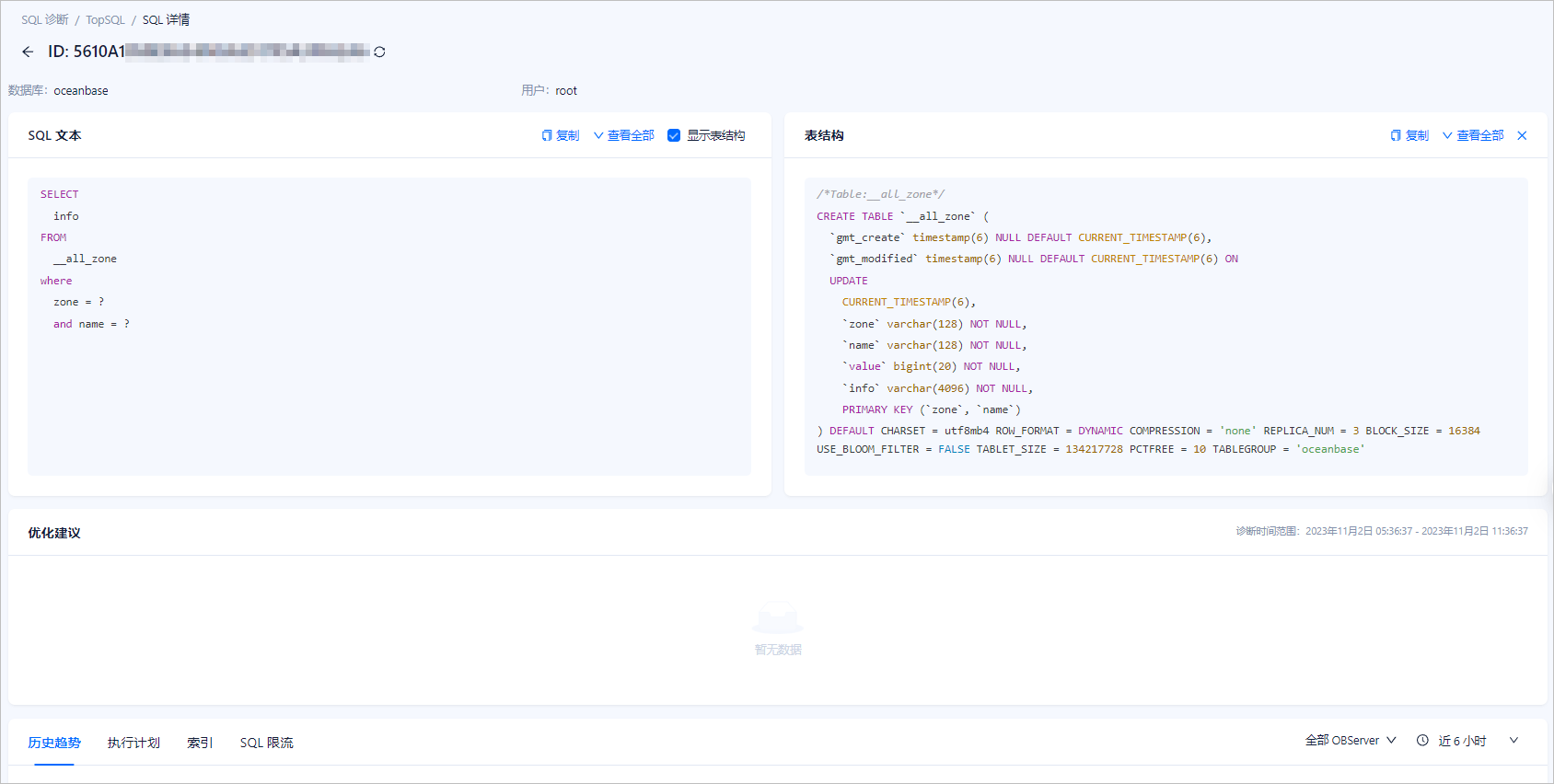
    On the SQL Details page, you can view the following details about the SQL:

    • In the SQL Text section, view the complete SQL statement. OCP will desensitize the SQL statement before displaying it. If the SQL statement fails to be parsed, the original SQL statement will be displayed. If you enable the option to show table schema, the statement for creating the table will be displayed.

    • In the Optimization Suggestions section, view the optimization suggestions for the SQL statement. For more information, see View optimization suggestions.

    • In the SQL Execution Profile section, view the execution details of the SQL statement. For more information, see View SQL execution profile.

    • On the Previous Tendency tab, view the historical trends of the SQL statement. For more information, see View historical trends of the SQL statement.

    • On the Execution Plans tab, view the execution plan of the SQL statement or bind an execution plan to it. For more information, see View execution plan.

    • On the Index tab, view the indexes bound to the SQL statement. For more information, see View and bind indexes.

    • On the SQL Throttling tab, view the throttling status of the SQL statement or set throttling for it. For more information, see Set SQL throttling.

    • On the Execution Plans, Index, and SQL Throttling tabs, you can click View Binding Records in Last 30 Days to view the binding records of the SQL statement.

      In the binding records, you can view the status of the bound plan. You can click Unbind to unbind the SQL statement from the plan or click Bind Plan to bind them again.

View optimization suggestions

When the SQL execution plan changes and the performance decreases, the system provides a plan binding suggestion. When the SQL index is not optimal and meets the following conditions, the system provides an index optimization suggestion:

  • The average response time of the SQL query is greater than 20 ms, or the average CPU time is greater than 10 ms.
  • The SQL query type is one of the following: SELECT, SELECT_FOR_UPDATE, UPDATE, or DELETE.
  • The SQL query does not contain the difficult predicate "OR".
  • The SQL query does not contain JOIN.

You can view the diagnostic issues and suggested solutions for this SQL query in the Optimization Suggestions section, and perform operations such as viewing Plan Hash, binding execution plans, and viewing diagnostic details.

  • When recommending indexes, the system follows the following algorithm:

    • Equi-join columns are placed at the beginning, and can be combined in any order.

    • For range joins, the most selective range join columns are placed after the equi-join columns.

    • For SQL queries without range joins, if the elimination sort condition is met, the sorted columns are placed after the equi-join columns.

    • Columns in other predicates are placed after the index, at which point the index is a half-width index.

    • Columns in other predicates of the SQL query are placed after the index, and a covering index is constructed.

    • If the SQL query contains at most eight columns, a covering index is recommended; otherwise, a half-width index is recommended.

    Note

    Table join scenarios are currently not supported.

    The following parameters are configured:

    • ocp.perf.sql.index-advisor-cpu-time-threshold: the average CPU time threshold for recommending indexes. If the average CPU time of an SQL query is greater than the value of this parameter, an index is recommended for the SQL query.

    • ocp.perf.sql.index-advisor-elapsed-time-threshold: the average response time threshold for recommending indexes. If the average response time of an SQL query is greater than the value of this parameter, an index is recommended for the SQL query.

  • When recommending historical plans, the system analyzes the execution plans of the SQL query in the last seven days. If the average CPU time of a plan is less than 80% of that of the most recent plan of the same type, the plan is recommended. Local plans are prioritized. If no local plans are available, distributed plans are recommended.

    Note

    Only suspicious SQL queries support viewing diagnostic details.

View Plan Hash

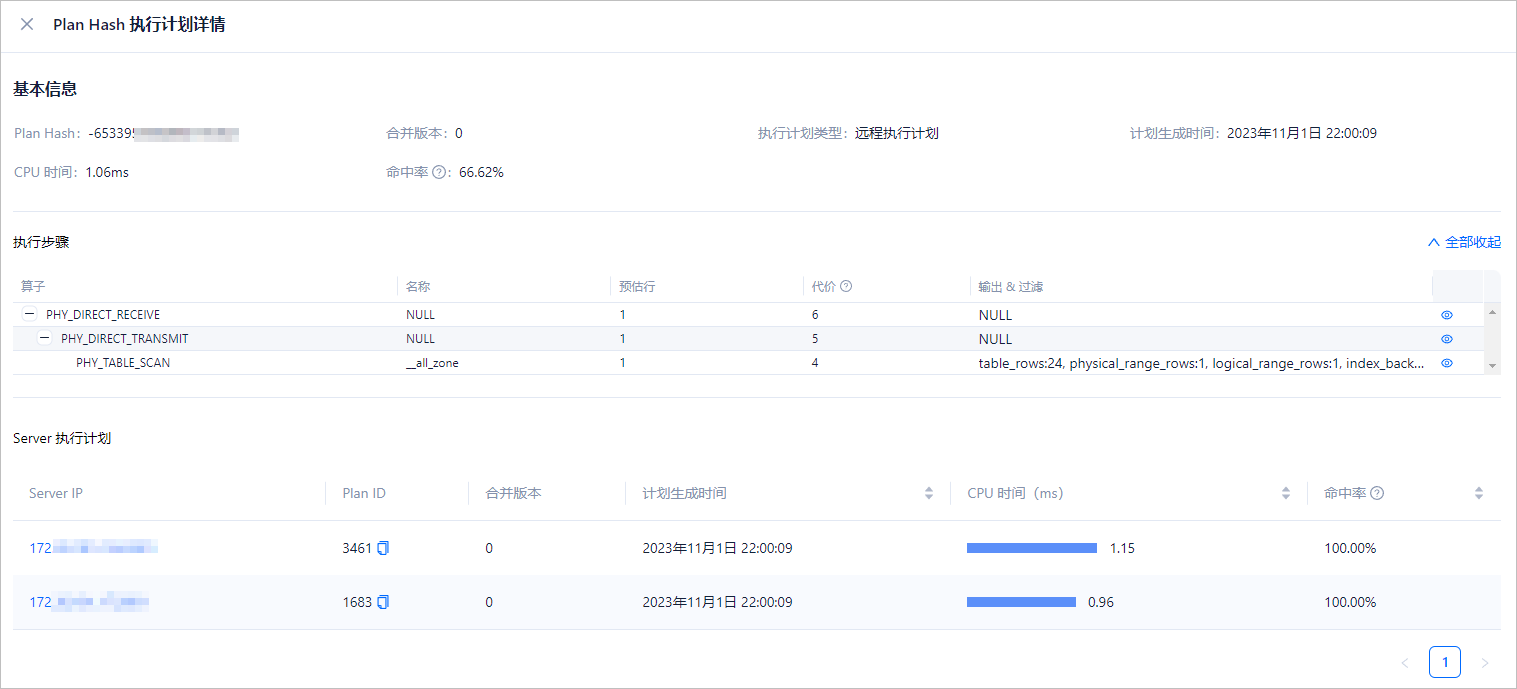
Click the View Plan Hash button to view the execution plan details in the Plan Hash view, including basic information, execution steps, and server execution plan.
5

Bind an execution plan

Click the Bind Execution Plan button. In the dialog box that appears, click Bind. After the binding is successful, refresh the page. You can click View Binding Records in Last 30 Days to view that the execution plan has been bound.

4

View diagnostic details

Click the View Diagnostic Details button to view the diagnostic details of the suspicious SQL query.

View SQL execution profile

On the SQL Execution Profile page, you can view the operator-level SQL execution details within the collection time range, including TraceID, degree of parallelism, request time, response time, and actions.

Note

Only ParalleSQL supports viewing SQL execution profiles.

View trace details

Click the TraceID to go to the Trace Details page, where you can view the execution profile, including trace basic information, schema tables, schema indexes, OBServer details, and operator execution details.

  • Click Download Execution Profile Report in the upper-right corner of the page to export the trace information as an HTML file to your local device.

  • Click the triangle icon next to the Trace ID to switch traces.

  • On the Schema Table tab, click the statement to view the details.

  • On the Schema Index tab, you can bind and unbind indexes.

    5

Download an execution profile report

In the SQL Execution Profile table on the Actions column, click Download Execution Profile Report to export the trace information as an HTML file to your local device.

6

View the execution trend of an SQL statement

On the SQL Details page, click the Previous Tendency tab.

You can view the charts about the SQL execution trend and the plan generation time. If you change the statistics time in the charts, the SQL running chart and SQL plan generation time chart are updated according to the selected time period.

  • SQL execution trend

    By default, the running trend chart displays the Average Response Time, CPU Time, and Execution Time metrics. You can use Metric Management to select the metrics that you want to display.

    7

  • SQL plan generation time

    The Plan Hash column indicates that a new plan is generated. The vertical axis shows the time consumed in generating the plan.

    8

View the execution plan of an SQL statement

On the SQL Details page, click the Execution Plans tab. You can do the following operations on this tab:

  • Use Custom Time to specify the query time range and window duration.

  • Click View Binding Records in Last 30 Days to view the execution plans from the last 30 days.

  • Click on the value of the Plan Hash column to view the detailed execution information of this execution plan, including the basic information, execution steps, and execution status on each OBServer node.

  • Click Bind to bind this execution plan with the current SQL statement.

9

View and bind indexes

On the SQL Details page, click the Index tab, and you can:

10

  • View the index binding status of the SQL statement in the table.

    You can filter indexes by index status and type. You can also click Bind to bind the SQL statement to an index. You can create an index in a console or connect to OceanBase Developer Center (ODC) to create an index.

  • Click View Binding Records in Last 30 Days to view the index binding records of the SQL statement in the last 30 days.

    In the binding records, you can view the status of the bound index. You can click Unbind to unbind the SQL statement from the index, or click Bind Plan to bind them again.

    11

Set SQL throttling

On the SQL Details page, click the SQL Throttling tab, and you can:

  • Check whether the current SQL statement is throttled.

    As shown in the following figure, the SQL statement is not throttled.

    12

  • Set throttling for the current SQL statement.

    13

    1. As shown in the following figure, turn on the throttling switch and configure the throttling strategy:

      • Maximum Concurrent Requests: the maximum value is +∞. Set the value to 0 to disable throttling.

      • Throttling Keyword: click Settings , and enter a throttling keyword in the ? field, which is marked as ① in the following figure.

      Note

      If no throttling keyword is specified, throttling is performed on the entire SQL statement.

      • As shown at ② in the following figure, view the reason why the throttling keyword setting failed.

        14

    2. Click Update , and then click OK.

Previous topic

Diagnose new SQL statements
Last

Next topic

View outlines
Next
on this page
Prerequisites
Go to the SQL details page
View optimization suggestions
View Plan Hash
Bind an execution plan
View diagnostic details
View SQL execution profile
View trace details
Download an execution profile report
View the execution trend of an SQL statement
View the execution plan of an SQL statement
View and bind indexes
Set SQL throttling