OceanBase
English日本語简体中文
Docs Home
Products
Integrations
Release Notes

Databases

OceanBase DatabaseOceanBase AI DatabaseOceanBase Cloud OceanSeekOceanBase Best Practices

Tools

OceanBase Cloud PlatformOceanBase Migration ServiceOceanBase Developer CenterOceanBase Migration AssessmentOceanBase Admin ToolOceanBase Loader and DumperOceanBase DeployerKubernetes operator for OceanBaseOceanBase Diagnostic Tool OceanBase Binlog ServiceOceanBase DataPilotOceanBase OAgent

Connectors and Middleware

OceanBase Database Proxy OceanBase Connector/C OceanBase Connector/J OceanBase Connector/ODBC OceanBase Connector/NETOceanBase Command-Line Client

Databases

OceanBase DatabaseOceanBase AI DatabaseOceanBase Cloud OceanSeekOceanBase Best Practices

Connectors and Middleware

OceanBase Database Proxy OceanBase Connector/C OceanBase Connector/J OceanBase Connector/ODBC OceanBase Connector/NETOceanBase Command-Line Client

Tools

OceanBase Cloud PlatformOceanBase Migration ServiceOceanBase Developer CenterOceanBase Migration AssessmentOceanBase Admin ToolOceanBase Loader and DumperOceanBase DeployerKubernetes operator for OceanBaseOceanBase Diagnostic Tool OceanBase Binlog ServiceOceanBase DataPilotOceanBase OAgent
OceanBase DatabaseOceanBase Cloud ToolsConnectors and MiddlewareLifecycle Support Policy

OceanSeek

V4.6.3
  • Introduction
    • Overview
    • System architecture
    • Core features
  • Get Started
    • Get started with OceanBase AI Database
  • Deploy
    • Choose an appropriate deployment plan
    • Deployment process
    • Before deployment
      • Prepare servers
      • Configure Servers
      • Prepare object storage
      • Prepare installation packages
      • Deploy OAT
    • Add a server
    • 500.deploy-ocp-use-oat
      • OCP deployment overview
      • Upload installation packages
      • Create MetaDB
      • Deploy OCP
    • Deploy OceanSeek
      • Create an object storage configuration
      • Deploy a LogService cluster by using OCP
      • Deploy an OceanBase AI Database cluster using OCP
    • (Optional) Deploy OBProxy
    • Deploy Java SDK
    • Recommended configurations
  • Connect
    • Overview of connection methods
    • Clients
      • MySQL client
      • OBClient
      • ODC
    • GUI tools
      • DBeaver
      • Navicat
    • Drivers and ORMs
      • Connect via driver or ORM framework
      • Examples
        • C#
          • MySQL Connector/C
        • Go
          • Go-SQL-Driver/MySQL
          • GORM
        • Java
          • Connector/J
          • Spring JDBC
          • SpringBoot
          • SpringBatch
          • SpringDataJPA
          • Hibernate
          • MyBatis
          • TestContainers
        • PHP
          • EXT
          • MySQLi
          • PDO
        • Python
          • PyMySQL
          • mysqlclient
          • MySQL-connector-python
          • SQLAlchemy
          • Django
          • peewee
    • Connection pool
      • Database connection pool configuration
      • Tomcat
      • C3P0
      • Proxool
      • HikariCP
      • DBCP
      • Commons Pool
      • Druid
      • JDBC
    • Connect to OceanSeek by using SDK
  • Design Database Schema
    • Overview of database schema design
    • Table design
    • Data distribution
    • Indexes
    • Data types
    • Logical table
      • Logical table overview
      • Agent hybrid search scenario
        • Overview
        • Quick start
        • Collection and namespace management
        • Write data
        • Search data
        • Indexes and embedding functions
        • Monitoring and maintenance
        • API reference
      • Flash application scenario
        • Overview
        • Limitations and constraints
        • Connect
        • Quick start
        • Collection and app management
        • Data operations
  • Data Pipeline
    • Data ingestion
      • Data migration
        • Data migration overview
        • Use mydumper and myloader to migrate data from a MySQL database
        • Use DBCAT to migrate table structures from a MySQL database
        • Use DataX to migrate table data from a MySQL database
        • Use DBCAT to migrate table structures from an Oracle database
        • Use DataX to migrate table data from an Oracle database
        • Use DBCAT to migrate table structures from a DB2 LUW database
        • Migrate from CSV files
          • Use DataX
          • Use LOAD DATA
        • Migrate by using SQL statements
          • Migrate data between tables
          • Migrate resource units
          • Export data using the OUTFILE statement
      • Data import
        • Data import overview
        • Import data by using the LOAD DATA statement
        • INSERT INTO SELECT
          • Use the INSERT INTO SELECT FROM FILES statement for direct load
          • Import data from external tables using INSERT INTO SELECT
        • Import data via direct load using the CREATE TABLE AS SELECT statement
        • Import data by using obloader
    • Data delivery
      • Export data
      • Data lake
        • Data lake overview
        • Data lake integration
          • Access Hive tables through HMS Catalog
          • Load an Iceberg table through Catalog
          • Read Paimon tables by using plugins
          • ODPS Catalog and external tables
          • Catalogs and external tables
          • File external tables
        • External tables via URL
    • Data sharing
      • Automatic catalog data synchronization
      • Manual catalog data synchronization
  • Data Processing
    • Structured data processing
      • In-database processing
      • Materialized views
      • Data processing tools
    • Unstructured data processing
      • Vector embedding
        • Overview of Vector Embedding Technology
        • Use the AI_EMBED function
        • Use external embedding models
  • Data Branching
    • Overview of Fork
    • Fork Table
    • Fork Database
  • AI Search
    • Vector search
      • Vector search overview
      • Perform vector search using SQL
      • Vector data types overview
      • Store vector data
      • Vector index
        • Overview of vector indexes
        • Vector index memory management
        • Dense index
          • Overview of dense indexes
          • Index type selection
          • HNSW series indexes
          • IVF series indexes
        • Sparse index
          • In-memory sparse vector index
        • Monitor and maintain indexes
        • Index performance optimization
      • Search index
      • Use SQL functions
      • Vector nearest neighbor search
      • FAQ on AI scenarios
    • Semantic search
    • Full-text search
    • Hybrid search
    • Rerank search
  • Query Acceleration
    • Statistics
    • Choose the query parallelism
    • Accelerate queries with materialized views
  • Manage
    • Log in to an user tenant
    • Manage clusters
      • Compute service management
        • Cluster parameters
        • Common cluster operations
          • View a zone
          • View a node
          • Restart a node
          • Add a node
          • Delete a node
          • Isolate a node
          • Replace a node
          • Start a zone
          • Add a zone
          • Delete a zone
          • Modify a zone
          • Isolate a zone
          • View cluster parameters
          • Modify cluster parameters
          • Reset cluster parameters
          • Update object storage access credentials
        • Data load balancing
          • Data load balancing overview
          • Transfer a partition
          • Cancel a partition transfer task
          • Cancel a balance job
          • Stop and resume a balance job
          • Table group weight management
            • Aggregation of user tables under a database
            • Set table group weights
            • Clear a table group's weight
            • Application scenarios of table group weight balancing
          • Partition weight management
            • Set partition weights
            • Clear partition weights
          • Partition balance management
            • Configure a scheduled partition balancing task
            • Manually trigger partition balancing
            • View the configurations of a scheduled partition balancing task
            • View the trigger history of scheduled partition balancing tasks
            • View background partition balancing tasks
            • View the history of background partition balancing tasks
          • GTS exclusive application case
      • Cluster overview
      • Object storage management
        • Object storage overview
        • Update object storage information
        • Object storage-related views and parameters
        • FAQ on object storage
      • LogService management
        • LogService parameters
        • LogService operations
          • View a LogService node
          • Add a LogService node
          • Delete a LogService node
          • Replace a LogService node
          • Rotate LogService access credentials
          • View LogService parameters
          • Modify LogService parameters
        • LogService load balancing
          • LogService load balancing overview
          • View the load balancing status
          • Configure the load balancing strategy
    • Manage tenants
      • Tenant introduction
      • Tenant capacity
      • Tenant types
      • User tenant introduction
      • Tenant system variables
      • Common tenant operations
        • Create a tenant
        • Resource isolation
          • Resource isolation overview
          • Configure cgroup
          • Configure global CPU resource isolation for foreground and background tasks
          • Calibrate disk performance
          • Configure resource isolation within a tenant
          • Update a plan directive
          • Delete a plan directive
          • Delete a resource management plan
          • Delete a resource group
          • Clear cgroup configurations
          • Resource isolation configuration examples for background tasks
        • View tenant and resource information
        • View and set the tenant allowlist
        • View tenant system variables
        • Modify tenant system variables
        • Scale in/out
          • Introduction to tenant scaling
          • Resource planning for tenant scaling
          • Tenant pre-scaling
          • Scale tenants by adjusting resource specifications
          • Scale tenants by adjusting the unit number
          • Scale tenants by adjusting the primary zone
          • Smooth scaling application scenarios
        • Modify attributes of a resource pool
        • Modify tenant attributes
        • Lock and unlock a tenant
        • Drop a tenant
        • Restore a tenant
        • Rename a tenant
        • Manage resource pools
          • View resource pools
          • Allocate a resource pool to a tenant
          • Remove resource pools from a tenant
          • Merge and split a resource pool
          • Drop a resource pool
        • Manage resource specifications
          • View resource specifications
          • Modify a unit config
          • Drop a unit config
    • Manage log streams
      • Create a log stream
      • Modify a log stream
    • Manage replicas
      • Replicas
      • Replica distribution
        • Locality
        • Common locality operations
          • View locality
          • Modify locality
          • Add a replica
          • Reduce replicas
          • Adjust the distribution of replicas
          • View the locality change history
          • Replica migration
          • Modify the quorum size of a log stream
          • Cancel a replica task
      • Traffic distribution
      • Data distribution
    • High availability
      • High availability overview
      • Multi-replica disaster recovery
        • Data link introduction
        • High availability at the proxy layer
        • High availability at the database layer
        • Disaster recovery deployment solutions
      • Manage recycle bin
        • Overview of the recycle bin
        • Enable or disable the recycle bin
        • View recycle bin objects
        • Restore objects from the recycle bin
        • Clean up the recycle bin
      • Flashback query
    • Security and permissions
      • Overview of security permissions
      • Identification and authentication
        • Identity authentication
          • Identity authentication
          • Password complexity
          • Handle login failures
      • Access control
        • Overview of access control
        • Users and permissions
          • User and permission overview
          • Permissions
            • Permission classification
            • Create a user
            • Grant privileges directly
            • Privilege delegation
            • Role management
              • Role management overview
              • Create a role
              • Add privileges to a role
              • Grant roles to users or other roles
              • Activate a role
              • View roles
              • Revoke privileges from a role
              • Revoke roles from a user or role
              • Drop a role
            • Indirect authorization
            • View user privileges
            • Revoke privileges
            • Lock or unlock a user
            • Drop a user
        • Row-level security
          • Row-level security
        • Network security access control
        • RPC connection authentication
      • 500.data-transfer-encryption
        • Overview of data transmission encryption
        • Transport encryption for OBServer
        • ODP transmission encryption
    • Backup and restore
      • Overview of physical backup and restore
      • Physical backup and restore with a minimal experience
      • Log archive
        • Overview of log archiving
        • Prepare for log archiving
        • Enable archiving mode
        • Suspend archiving
        • Disable archiving mode
        • View piece information
        • View archiving progress
        • View the archiving history
        • View archive parameters
        • Change the archive destination
        • Clear the archive path configuration
        • Introduction to log archiving views
      • Data backup
        • Data backup overview
        • Prepare for backup
        • Initiate a full data backup
        • Back up parameters
        • Stop a backup
        • View the data backup progress
        • View data backup results
        • View data backup parameters
        • Change the backup destination
        • Introduction to data backup-related views
      • Update object storage key information
      • Clear backup data
        • Automatic backup cleanup
          • Automatically clean up expired backups
          • Delete a cleanup policy
        • Manual backup cleanup
          • Manually trigger expired backup cleanup
          • Manually clean up specified backup or archive data
          • Manually clear a backup or archive path
        • Cancel a cleanup task
        • View backup cleanup progress
        • View backup cleanup results
        • Introduction to backup cleanup parameters
        • Introduction to cleanup-related views
      • Restore data
        • Preparations before restore
        • Perform physical restore
        • Restore from a specified path
        • Cancel physical restore
        • View the physical restore progress
        • View the result of physical restore
        • Segment-based log replay for a standby tenant
        • Convert a standby tenant into a primary tenant
        • Upgrade a tenant after restore is complete
        • Introduction to physical restore parameters
        • Introduction to views related to physical restore
      • Backup and restore performance tuning
      • Appendix: S3 path format
    • Monitor
      • Monitoring overview
      • Metrics
        • System monitoring
          • Overview of system monitoring metrics
          • SYSSTAT metrics
          • Wait events
          • Lock events
        • SQL monitoring
          • Overview of SQL monitoring
          • SQL audit
          • Execution plans
      • Root service events
      • Cases
    • Logs
      • Log overview
      • Log levels
      • Log interpretation
      • Log stability
      • Log control methods
      • Log compression and decompression
      • Log monitoring metrics
      • Alert logs
      • View logs
        • Search for the logs of a specific SQL request
        • Query the log of a previous SQL request by using the SQL Trace feature
  • Performance Test
    • TPC-DS
      • OceanSeek TPC-DS test
      • OceanSeek TPC-DS test report
    • TPC-H
      • OceanSeek TPC-H test
      • OceanSeek TPC-H test report
  • Reference
    • System management
      • Configuration management
        • Introduction to Configuration Management
        • Set parameters
        • Set variables
      • Storage management
        • Minor compaction management
          • Overview of minor compaction
          • Automatic minor compaction
          • Manually trigger a minor compaction
          • View minor compaction information
          • Modify minor compaction settings
        • Major compaction management
          • Overview of major compaction management
          • Automatically trigger a major compaction
          • Schedule daily tenant major compactions
          • Window compaction
          • Adaptive compaction
          • Manually trigger a major compaction
          • View major compaction information
          • Manually control a major compaction
          • Modify major compaction configuration
        • Data compression
          • Data compression overview
          • Use data encoding and compression
        • Use the TTL feature
        • Custom hot and cold data storage policies
          • Overview of custom hot/cold storage policies
          • Create a table-level hot/cold storage policy
          • Create a partition-level hot/cold storage policy
          • Modify a table-level hot/cold storage policy
          • Modify a partition-level hot/cold storage policy
          • O&M guide for custom hot/cold storage policies
      • Memory management
        • Memory management overview
        • Memory structure
        • Set the maximum memory for a database
        • Internal system memory management
        • Memory management within a tenant
        • Plan cache memory management
        • Memleak-based regular memory leak diagnostics mechanism
        • View memory usage information
        • Common memory issues
      • Process management
        • Overview of OceanSeek threads
        • Multi-tenant threads
        • View thread status
        • Background threads of OceanSeek
        • FAQ about multi-tenant threads
      • Disk management
        • Configure dynamic expansion of disk data files
        • View disk space usage of a tenant or table
    • Database object management
      • Overview of database object management
      • Create and manage databases
        • Create a database
        • View databases
        • Modify a database
        • Drop a database
      • Create and manage tables
        • About tables
        • Create a table
        • Column Skip Index attribute
        • Define an auto-increment column
        • Define column constraints
        • View tables
        • Modify a table
        • Change the attribute of a replicated table
        • Truncate a table
        • Drop a table
        • Lock a table
        • Create and manage external tables
          • External tables and external files
          • Create and query external tables
          • Create a partitioned external table
          • Manage external files
          • Data type mappings
      • Create and manage partitions
        • Partitioning overview
        • Create a partitioned table
        • Partition splitting
          • Overview of partition splitting
          • Manually split a partition
          • Automatic partition splitting
          • Recommended configurations for automatic partitioning
        • Dynamic partitioning
          • Overview of dynamic partitioning
          • Create a dynamic partitioned table
          • View a dynamic partitioned table
          • Modify a dynamic partitioned table
          • Dynamic partition management tasks
        • Modify partitioning rules
        • Add a partition
        • Drop a partition
        • Truncate partitions
        • Partition pruning
        • Query data from a specified partition
        • Create indexes on partitioned tables
          • Index overview
          • Local index
          • Global index
        • Partition exchange
      • Create and manage table groups
        • About table groups
        • Create a table group
        • View table group information
        • Add tables to a table group
        • Modify the SHARDING attribute of a table group
        • Manage tables within a table group
        • Delete a table group
      • Create and manage indexes
        • About indexes
        • Create an index
        • View indexes
        • Monitor indexes
        • Drop an index
        • List of system functions supported for function-based indexes
        • List of system functions not supported for function-based indexes
      • Manage views
        • Manage regular views
        • Manage materialized views
          • Overview of materialized views
          • Materialized view logs
          • Create a materialized view
          • Refresh a materialized view
          • Query rewrite using materialized views
          • Query materialized views
          • Modify materialized view attributes
          • Drop a materialized view
          • Materialized view resource isolation
      • Create and manage sequences
        • Create a sequence
        • View sequences
        • Reference a sequence
        • Modify a sequence
        • Drop a sequence
      • Create and manage triggers
        • Overview
        • Create a DML trigger
        • View trigger information
        • Drop a trigger
      • Create and manage DBLinks
        • Create a DBLink
        • View created DBLinks
        • Manage DBLinks
        • Access data in a remote database through DBLink
        • Drop a DBLink
      • Create and manage catalogs
        • Overview of Catalog
        • Create a catalog
        • View catalogs
        • Drop a catalog
    • Write and read data
      • Write data
        • Insert data
        • Update data
        • Delete data
        • Replace data
        • Generate test data in batches
      • Read data
        • Single-table query
        • Join tables
          • INNER JOIN
          • FULL JOIN
          • LEFT JOIN
          • RIGHT JOIN
          • Subqueries
          • Lateral derived table
        • Use operators and functions in queries
          • Use arithmetic operators in queries
          • Use numeric functions in queries
          • Use string concatenation operators in queries
          • Use string functions in queries
          • Use time functions in queries
          • Use type conversion functions in queries
          • Use aggregate functions in queries
          • Use NULL-related functions in queries
          • Use the CASE conditional operator in queries
          • Lock query results with SELECT FOR UPDATE
          • Lock in share mode
          • Use regular expressions in queries
        • Query using DBLink
        • Set operations
    • Transaction management
      • Transaction management overview
      • Start a transaction
      • Savepoints
        • Mark a savepoint
        • Roll back a transaction to a savepoint
        • Release a savepoint
      • Commit a transaction
      • Roll back a transaction
    • AI Function service
      • Overview of AI Function Service
      • Get started with AI Function Service
      • AI Function Service Permissions
      • Register an AI model
      • Interaction with AI models (Batch File)
      • Syntax and examples of AI functions
      • View AI model information
    • SQL reference
      • SQL syntax
        • System tenants
          • Overview of management commands
          • ALTER SYSTEM
            • ACTIVATE STANDBY
            • ADD REPLICA
            • ADD RESTORE SOURCE
            • ARCHIVELOG
            • BOOTSTRAP
            • BACKUP KEY
            • BACKUP
            • BACKUP CLUSTER PARAMETERS
            • BALANCE TASK
            • BALANCE JOB
            • CANCEL BACKUP
            • CANCEL DELETE BACKUP
            • CANCEL MIGRATE UNIT
            • CANCEL REPLICA TASK
            • CANCEL RESTORE
            • CANCEL RECOVER TABLE
            • CANCEL TRANSFER PARTITION
            • CREATE LS
            • CLEAR RESTORE SOURCE
            • DELETE BACKUP POLICY
            • DELETE BACKUP ALL
            • DELETE BACKUPSET/ARCHIVELOG_PIECE
            • DELETE OBSOLETE BACKUP
            • LOAD MODULE DATA
            • MAJOR AND MINOR
            • MIGRATE REPLICA
            • MIGRATE UNIT
            • MODIFY LS
            • MODIFY PAXOS_REPLICA_NUM
            • MODIFY REPLICA
            • NOARCHIVELOG
            • FLUSH PLAN CACHE
            • FLUSH SEQUENCE CACHE
            • FLUSH LOCAL_CACHE
            • FLASHBACK STANDBY LOG
            • JOB
            • PARAMETER
            • RECOVER STANDBY
            • RECOVER STANDBY CANCEL
            • REMOVE REPLICA
            • REFRESH
            • RESTORE
            • RESTORE PREVIEW
            • SET DATA_BACKUP_DEST
            • SERVER
            • SERVICE_NAME
            • SWITCHOVER
            • SET LOG_ARCHIVE_DEST
            • SET LOG_ARCHIVE_DEST_STATE
            • THROTTLE
            • TRANSFER PARTITION
            • TTL
            • WASH MEMORY FRAGMENTATION
            • ZONE
          • ALTER RESOURCE POOL
          • ALTER RESOURCE TENANT
          • ALTER RESOURCE UNIT
          • ALTER TENANT
          • CREATE RESOURCE POOL
          • CREATE RESOURCE UNIT
          • CREATE TENANT
          • DROP RESOURCE POOL
          • DROP RESOURCE UNIT
          • DROP TENANT
          • SET DECRYPTION
          • SET ENCRYPTION
          • SHOW RESTORE PREVIEW
        • User tenants
          • Basic elements
            • ROWID Pseudo-Column
            • Data types
              • Overview of data types
              • Numeric types
                • Overview of numeric types
                • Integer types
                • Fixed-point types
                • Floating-point types
                • BIT-Value type
              • Datetime types
                • Overview of date and time types
                • DATE, DATETIME and TIMESTAMP types
                • TIME type
                • YEAR type
              • String types
                • Character type overview
                • CHAR and VARCHAR
                • BINARY and VARBINARY
              • Large objects and text types
                • Overview of LOB and text types
                • BLOB type
                • TEXT type
                • STRING type
                • LOB types
                • LOB_WRITEAPPEND
              • Enumeration types
              • Collection types
              • JSON data types
                • Overview of the JSON data type
                • Create a JSON value
                • Query and modify JSON values
                • JSON data type conversion
                • Update partial data in a JSON document
                • Semi-structured encoding
              • Spatial data types
                • Overview of spatial data types
                • Spatial Reference System (SRS)
                • Create a spatial column
                • Create a spatial index
                • Spatial data formats
              • Roaring bitmap types
                • Overview of Efficient Compression for Bitmap Data Types
                • Create an efficient compressed bitmap column
              • Array data types
                • Overview of Array Element Types
                • Create an array column
              • Map data types
                • Overview of mapped data types
                • Create a mapped column
            • Expressions
              • Overview of Expressions
              • Syntax of Expressions
              • Simple Expressions
              • Compound Expressions
              • Conditional Expressions
              • Column Expressions
              • Date and time expressions
              • Function Expressions
              • Interval Expressions
              • Scalar subquery expressions
              • List of Expressions
              • Data type conversion rules
            • Character set and collation
              • Overview
              • Character sets
              • Collation
              • Database-level character set and collation
              • Table-level character set and collation
              • Column-level character set and collation
              • Character expression character sets and collations
              • Character set and collation of client connections
            • Literals
              • Overview of Literals
              • String text
              • Numbers
              • Date and time values
              • Bit value
              • Boolean values
              • NULL values
            • Schema object name
            • Annotations
              • Hints
                • Overview of hints
                • Control query optimization using the Query Block Name and QB_NAME hint
                • Hint list
                  • Global hints
                    • Optimizer Stats Hint under Global Hint Types
                    • Transform hint under global hints
                    • Other hints under global hints
                  • Optimizer hints
                    • Access path hints under the Optimized hint type
                    • Join Order Hint under Optimized Hint Type
                    • Join Operation Hint under Optimized Hint Type
                    • Subquery hint under Optimized hint type
                    • Group by hint under optimized hint type
                    • DISTINCT hint under Optimized hint type
                    • Set hint under Optimized hint type
                    • Distributed DML Hints under Optimized Hint Type
                    • Vector Index Hint under Optimized Hint Type
                  • Transform hints
                    • Stmt Transform Hint under the Transform Hint Type
                    • Cost Based Transform Hint under the Transform Hint Type
                    • Transform Hints of the Heuristics Type
                    • Other hints under the Transform hint type
                  • Outline-related hint
            • User-defined variables
            • Comments
          • Operators
            • Operator overview
            • Operator precedence
            • Arithmetic operators
            • Bitwise operators
            • Comparison operators
            • Logical operators
            • Assignment operators
            • Date and time operators
            • Character concatenation operators
            • BINARY conversion operator
            • CASE Conditional Operator
          • Functions
            • Function overview
            • Single-row functions
              • Datetime functions
                • ADDDATE
                • CONVERT_TZ
                • CURDATE
                • CURRENT_DATE
                • CURRENT_TIME
                • CURRENT_TIMESTAMP
                • CURTIME
                • DATE
                • DATE_ADD
                • DATE_FORMAT
                • DATE_SUB
                • DATEDIFF
                • DAYOFMONTH
                • DAYOFWEEK
                • DAYOFYEAR
                • EXTRACT
                • FROM_DAYS
                • FROM_UNIXTIME
                • GET_FORMAT
                • HOUR
                • LAST_DAY
                • LOCALTIME
                • LOCALTIMESTAMP
                • MAKEDATE
                • MAKETIME
                • MICROSECOND
                • MINUTE
                • MONTH
                • MONTHNAME
                • NOW
                • PERIOD_ADD
                • PERIOD_DIFF
                • QUARTER
                • SEC_TO_TIME
                • SECOND
                • STR_TO_DATE
                • SUBDATE
                • SUBTIME
                • SYSDATE
                • TIME
                • TIME_FORMAT
                • TIME_TO_SEC
                • TIME_TO_USEC
                • TIMEDIFF
                • TIMESTAMP
                • TIMESTAMPADD
                • TIMESTAMPDIFF
                • TO_DAYS
                • TO_SECONDS
                • UNIX_TIMESTAMP
                • USEC_TO_TIME
                • UTC_DATE
                • UTC_TIME
                • UTC_TIMESTAMP
                • WEEK
                • WEEKDAY
                • WEEKOFYEAR
                • YEARWEEK
                • YEAR
                • ADDTIME
                • DAYNAME
                • DAY
                • DATE_TRUNC
                • MONTHS_ADD
                • FORMATDATETIME
                • TOUNIXTIMESTAMP
                • parseDateTime
              • String functions
                • ASCII
                • BIN
                • BIT_LENGTH
                • CHAR
                • CHAR_LENGTH
                • CHARACTER_LENGTH
                • CONCAT
                • CONCAT_WS
                • ELT
                • EXPORT_SET
                • FIELD
                • FIND_IN_SET
                • FORMAT
                • HEX
                • INSERT
                • INSTR
                • INT2IP
                • IP2INT
                • KEYVALUE
                • LCASE
                • LEFT
                • LENGTH
                • LOCATE
                • LOWER
                • LPAD
                • LTRIM
                • MAKE_SET
                • MAX_PT
                • MD5_CONCAT_WS
                • MID
                • OCT
                • OCTET_LENGTH
                • ORD
                • POSITION
                • QUOTE
                • REGEXP
                • REGEXP_INSTR
                • REGEXP_LIKE
                • REGEXP_REPLACE
                • REGEXP_SUBSTR
                • REPEAT
                • REPLACE
                • REVERSE
                • RIGHT
                • RLIKE
                • RPAD
                • RTRIM
                • SPACE
                • SPLIT_PART
                • STRCMP
                • SUBSTR
                • SUBSTRING
                • SUBSTRING_INDEX
                • TRIM
                • UCASE
                • UNHEX
                • UPPER
                • URL_DECODE
                • URL_ENCODE
                • WEIGHT_STRING
                • TO_BASE64
                • FROM_BASE64
                • SOUNDEX
                • EDITDISTANCE
              • Conversion functions
                • CAST
                • CONVERT
                • DECODE_TRACE_ID
                • SCN_TO_TIMESTAMP
                • TIMESTAMP_TO_SCN
                • TO_CHAR(character)
                • TO_CHAR(number)
                • TO_CHAR(datetime)
                • TO_DATE
              • Mathematical functions
                • ABS
                • ACOS
                • ASIN
                • ATAN
                • ATAN2
                • BIT_COUNT
                • CEIL
                • CEILING
                • CONV
                • COS
                • COT
                • CRC32
                • DEGREES
                • EXP
                • FLOOR
                • GENERATOR
                • LN
                • LOG
                • LOG10
                • LOG2
                • MOD
                • NEG
                • PI
                • NORMAL
                • POW
                • POWER
                • RADIANS
                • RAND
                • RANDOM
                • RANDSTR
                • ROUND
                • SIGN
                • SIN
                • SQRT
                • TAN
                • TRUNCATE
                • UNIFORM
                • ZIPF
              • Comparison functions
                • GREATEST
                • INTERVAL
                • ISNULL
                • LEAST
              • Process control functions
                • CASE
                • IF
                • IFNULL
                • NULLIF
                • ORA_DECODE
            • Aggregate functions
              • APPROX_COUNT_DISTINCT
              • AVG
              • ARG_MAX
              • ARG_MIN
              • BIT_AND
              • BIT_OR
              • BIT_XOR
              • COUNT
              • GROUP_CONCAT
              • GROUPING
              • MAX
              • MIN
              • STD
              • STDDEV
              • STDDEV_POP
              • STDDEV_SAMP
              • SUM
              • VAR_POP
              • VAR_SAMP
              • VARIANCE
              • STRING_AGG
              • AVG_WEIGHTED
              • ARBITRARY
              • ANY
              • GROUPCONCAT
              • STDDEVSAMP
              • UNIQ
              • VARSAMP
            • Analysis functions
              • APPROX_COUNT_DISTINCT
              • AVG
              • BIT_AND
              • BIT_OR
              • BIT_XOR
              • COUNT
              • CUME_DIST
              • DENSE_RANK
              • FIRST_VALUE
              • LAG
              • LAST_VALUE
              • LEAD
              • MAX
              • MIN
              • NTH_VALUE
              • NTILE
              • PERCENT_RANK
              • PERCENTILE_CONT
              • RANK
              • ROW_NUMBER
              • STD
              • STDDEV
              • STDDEV_POP
              • STDDEV_SAMP
              • SUM
              • VAR_POP
              • VAR_SAMP
              • VARIANCE
              • LAGINFRAME
              • LEADINFRAME
            • Encryption functions
              • AES_DECRYPT
              • AES_ENCRYPT
              • COMPRESS
              • DECODE
              • DES_DECRYPT
              • DES_ENCRYPT
              • ENCODE
              • ENCRYPT
              • MD5
              • PASSWORD
              • UNCOMPRESS
              • UNCOMPRESSED_LENGTH
              • RANDOM_BYTES
              • SHA
              • SHA1
              • SHA2
              • VALIDATE_PASSWORD_STRENGTH
              • SM3
              • SM4_ENCRYPT
              • SM4_DECRYPT
            • Information functions
              • BENCHMARK
              • CATALOG
              • CHARSET
              • COERCIBILITY
              • COLLATION
              • CONNECTION_ID
              • CURRENT_ROLE
              • CURRENT_USER
              • DATABASE
              • FOUND_ROWS
              • LAST_INSERT_ID
              • LAST_INSERT_ID Behavior Description
              • ICU_VERSION
              • OB_TRANSACTION_ID
              • ROW_COUNT
              • SCHEMA
              • SESSION_USER
              • SYSTEM_USER
              • USER
              • VERSION
              • OB_VERSION
            • JSON functions
              • Overview of JSON functions
              • Functions for creating JSON text
                • JSON_ARRAY
                • JSON_OBJECT
                • JSON_QUOTE
              • Functions for searching JSON text
                • JSON_CONTAINS
                • JSON_CONTAINS_PATH
                • JSON_EXTRACT
                • JSON_KEYS
                • JSON_OVERLAPS
                • JSON_SEARCH
                • JSON_VALUE
                • MEMBER OF
              • Functions for modifying JSON text
                • JSON_ARRAY_APPEND
                • JSON_APPEND
                • JSON_ARRAY_INSERT
                • JSON_INSERT
                • JSON_MERGE
                • JSON_MERGE_PATCH
                • JSON_MERGE_PRESERVE
                • JSON_REMOVE
                • JSON_REPLACE
                • JSON_SET
                • JSON_UNQUOTE
              • Functions for returning JSON text properties
                • JSON_DEPTH
                • JSON_LENGTH
                • JSON_TYPE
                • JSON_VALID
              • JSON_TABLE function
              • JSON utility functions
                • JSON_PRETTY
                • JSON_STORAGE_SIZE
              • JSON aggregate functions
                • JSON_ARRAYAGG
                • JSON_OBJECTAGG
              • JSON schema validation functions
                • JSON_SCHEMA_VALID
                • JSON_SCHEMA_VALIDATION_REPORT
            • XML functions
              • Overview of XML functions
              • Functions for querying XML data
                • EXTRACTVALUE
              • Functions for modifying XML data
                • UPDATEXML
            • Table functions
              • Overview of TABLE FUNCTIONS
              • FILES table function
            • Spatial functions
              • Overview of Spatial Functions
              • Create a geometric value function
              • Spatial operators
              • Spatial relationship functions
              • Geometric property functions
              • Geometric format conversion functions
              • Spatial analysis functions
              • Spatial Constructors
              • Spatial accessor functions
              • Spatial format conversion functions
              • Geometric Processing Functions
              • _ST_GeoHash
            • Performance schema functions
              • FORMAT_BYTES
              • FORMAT_PICO_TIME
            • Lock functions
              • Overview of Lock Functions
              • GET_LOCK
              • IS_FREE_LOCK
              • IS_USED_LOCK
              • RELEASE_ALL_LOCKS()
              • RELEASE_LOCK
            • Bitmap functions
              • Overview of bitmap functions
              • Bitmap Constructor
              • Bitmap cardinality functions
              • Bitmap arithmetic functions
              • Bitmap predicate functions
              • Bitmap output functions
              • Bitmap aggregate functions
            • Array functions
              • Overview of array functions
              • Array constructor
              • Array comparison functions
              • Array output functions
              • Array functions
            • Text processing functions
              • TOKENIZE
            • Map functions
              • Overview of mapping functions
              • Constructor of Map
              • Mapping judgment function
              • Mapping functions
            • Other functions
              • ANY_VALUE
              • BIN_TO_UUID
              • COALESCE
              • DEFAULT
              • NAME_CONST
              • INET_ATON
              • INET_NTOA
              • INET6_ATON
              • INET6_NTOA
              • IS_IPV4
              • IS_IPV4_COMPAT
              • IS_IPV6
              • IS_UUID
              • MATCH AGAINST
              • NVL
              • UUID_TO_BIN
              • SLEEP
              • UUID
              • UUID_SHORT
              • VALUES
              • ISNAN
          • Queries and subqueries
            • Overview
            • Subquery
            • Connections
            • Full-text query
          • SQL statements
            • General syntax
            • Generalized Table Expressions
            • ALTER COMPILE
            • ALTER DATABASE
            • ALTER LOCATION
            • ALTER MATERIALIZED VIEW
            • ALTER MATERIALIZED VIEW LOG
            • ALTER OUTLINE
            • ALTER EXTERNAL TABLE
            • ALTER SENSITIVE RULE
            • ALTER POLICY
            • ALTER SEQUENCE
            • ALTER/CHANGE/MODIFY EXTERNAL_STORAGE_DEST
            • ALTER SYSTEM FLUSH SEQUENCE CACHE
            • MAJOR AND MINOR
            • STORAGE_CACHE_POLICY_EXECUTOR
            • ALTER TABLE
            • ALTER TABLEGROUP
            • ALTER USER
            • ALTER VIEW
            • ALTER INSTANCE ROTATE INNODB MASTER KEY
            • ALTER EVENT
            • ANALYZE
            • CACHE INDEX
            • CREATE CONCURRENT_LIMITING_RULE
            • CREATE DATABASE
            • CREATE DATABASE LINK
            • CREATE EXTERNAL CATALOG
            • CREATE EXTERNAL TABLE
            • CREATE INDEX
            • CREATE LOCATION
            • CREATE MATERIALIZED VIEW
            • CREATE MATERIALIZED VIEW LOG
            • CREATE OUTLINE
            • CREATE POLICY
            • CREATE FORMAT OUTLINE
            • CREATE ROLE
            • CREATE SENSITIVE RULE
            • CREATE SEQUENCE
            • CREATE TABLE
            • CREATE TABLEGROUP
            • CREATE USER
            • CREATE VIEW
            • CHECKSUM TABLE
            • CREATE EVENT
            • DEALLOCATE PREPARE
            • DROP DATABASE LINK
            • DELETE
            • DESCRIBE
            • DROP CATALOG
            • DROP CONCURRENT_LIMITING_RULE
            • DROP DATABASE
            • DROP EVENT
            • DROP INDEX
            • DROP LOCATION
            • DROP MATERIALIZED VIEW
            • DROP MATERIALIZED VIEW LOG
            • DROP OUTLINE
            • DROP ROLE
            • DROP SENSITIVE RULE
            • DROP POLICY
            • DROP TABLE
            • DROP TABLEGROUP
            • DROP SEQUENCE
            • DROP USER
            • DROP VIEW
            • EXECUTE
            • EXPLAIN
            • FLASHBACK
            • FLUSH TABLE
            • GRANT
            • HELP
            • INSERT
            • KILL
            • LOAD DATA
            • LOAD_FILE
            • LOAD INDEX INTO CACHE
            • LOCK TABLES
            • OPTIMIZE
            • PREPARE
            • PURGE
            • PURGE RECYCLEBIN
            • RENAME USER
            • RENAME TABLE
            • REPLACE
            • REPAIR TABLE
            • REMOVE
            • REVOKE
            • SAVEPOINT
            • SCHEMA
            • SELECT INTO
            • SELECT
              • SELECT
              • JOIN clause
              • WINDOW clause
              • UNION clause
              • HYBRID_SEARCH
              • PARTITION TIER
            • SET DEFAULT ROLE
            • SET
            • SET CATALOG
            • SET CHARSET
            • SET NAMES
            • SET PASSWORD
            • SET ROLE
            • SET TRANSACTION
            • SHOW
            • SUBMIT JOB
            • SHOW JOB STATUS
            • CANCEL JOB
            • TRANSACTION
            • TRUNCATE TABLE
            • UNLOCK TABLES
            • UPDATE
            • USE
            • VALUES
            • XA TRANSACTION
          • DDL feature
            • Overview of DDL features
            • Online DDL and Offline DDL Operations
            • Index operations
            • Primary key operations
            • Column operations
            • Generate columns
            • Foreign key operations
            • Table operations
            • Partition operations
            • Column type change rules
            • Number type conversion rules
          • Pseudo columns
            • Overview of PseudoColumns
            • PARTITIONID Pseudo Column
            • Sequence Pseudocolumns
          • Conditions
            • Overview of SQL Conditions
            • Condition priorities
            • Comparison conditions
            • Logical conditions
            • Pattern matching conditions
            • Null value conditions
            • BETWEEN condition
            • EXISTS condition
            • IN Condition
            • JSON Member Conditions
            • Boolean test conditions
      • SQL specifications and practices
        • SQL Writing Restrictions
        • SQL writing specifications
          • SELECT statement writing specifications
          • DML statement writing guidelines
          • DDL statement writing guidelines
          • Multi-table association guidelines
          • Table scan method specifications
          • Transaction specifications
          • Usage guidelines for cache
          • Guidelines for Using HINTS
          • Other related specifications
        • SQL statement examples
          • Implicit type conversion related
          • Suggestions on using JOIN tables
          • Weak-consistency read
          • Paginated query
      • Reserved keywords
      • Data type conversion behavior in strict mode
    • PL reference
      • What is PL
        • PL Overview
        • Key features of PL
        • Architecture of PL
      • PL syntax structure
      • PL stored procedures
        • Overview of stored programs
        • Variables of stored programs
        • Stored procedure
        • Stored Procedures and Privilege Management
        • Stored functions
        • External storage functions
        • Trigger
        • EVENT
        • Limitations on stored programs
        • SQL Transpiler
        • PL asynchronous commit optimization
      • PL cursors
        • Cursor overview
        • Cursor execution process
        • Limitations on server-side cursors
      • PL conditional control statements
        • CASE
        • IF
        • ITERATE
        • LEAVE
        • LOOP
        • REPEAT
        • RETURN
        • WHILE
      • PL data manipulation statements
        • CALL
        • DO
      • PL data definition statements
        • ALTER FUNCTION
        • ALTER PROCEDURE
        • CREATE FUNCTION
        • CREATE PROCEDURE
        • CREATE TRIGGER
        • DROP FUNCTION
        • DROP PROCEDURE
        • DROP TRIGGER
      • PL database management statements
        • SHOW CREATE FUNCTION
        • SHOW CREATE PROCEDURE
        • SHOW CREATE TRIGGER
        • SHOW FUNCTION STATUS
        • SHOW PROCEDURE STATUS
        • SHOW TRIGGERS
      • PL related dictionary views
        • INFORMATION_SCHEMA PARAMETERS
        • INFORMATION_SCHEMA ROUTINES
        • INFORMATION_SCHEMA TRIGGERS
      • PL exception handling
        • Overview of exception handling
        • DECLARE ... CONDITION
        • DECLARE ... HANDLER
        • GET DIAGNOSTICS
        • RESIGNAL
        • SIGNAL
        • Scope of handlers
        • Diagnostic section
        • Exception Handling and OUT/INOUT Parameters
        • Limitations on exception handling
      • PL system packages
        • Overview of system packages
        • DBMS_AI_SERVICE
          • Overview of DBMS_AI_SERVICE
          • CREATE_AI_MODEL
          • DROP_AI_MODEL
          • CREATE_AI_MODEL_ENDPOINT
          • ALTER_AI_MODEL_ENDPOINT
          • DROP_AI_MODEL_ENDPOINT
          • REGISTER_PROVIDER
          • ALTER_PROVIDER
          • UNREGISTER_PROVIDER
          • ALTER_MODEL_PROFILE
          • DROP_MODEL_PROFILE
          • CREATE_AI_GATEWAY
          • ALTER_AI_GATEWAY
          • DROP_AI_GATEWAY
        • DBMS_ASYNC_INDEX
          • Overview of DBMS_ASYNC_INDEX
          • FORCEMERGE
        • DBMS_DAILY_MAINTENANCE
          • Overview of DBMS_DAILY_MAINTENANCE
          • TRIGGER_WINDOW_COMPACTION_PROC
          • SET_THREAD_COUNT
        • DBMS_HYBRID_SEARCH
          • Overview of DBMS_HYBRID_SEARCH
          • SEARCH
          • GET_SQL
        • DBMS_MVIEW
          • Overview of DBMS_MVIEW
          • PURGE_LOG
          • REFRESH
        • DBMS_MVIEW_STATS
          • Overview of DBMS_MVIEW_STATS
          • PURGE_REFRESH_STATS
          • SET_MVREF_STATS_PARAMS
          • SET_SYSTEM_DEFAULT
        • DBMS_PARTITION
          • Overview of DBMS_PARTITION
          • MANAGE_DYNAMIC_PARTITION
        • DBMS_RESOURCE_MANAGER
          • Overview of DBMS_RESOURCE_MANAGER
          • CREATE_CONSUMER_GROUP
          • CREATE_PLAN
          • CREATE_PLAN_DIRECTIVE
          • COPY_PLAN
          • DELETE_CONSUMER_GROUP
          • DELETE_PLAN
          • DELETE_PLAN_DIRECTIVE
          • System Packages
          • UPDATE_PLAN_DIRECTIVE
        • DBMS_STATS
          • Overview of DBMS_STATS
          • ALTER_STATS_HISTORY_RETENTION
          • CREATE_STAT_TABLE
          • DELETE_CATALOG_GLOBAL_PREFS
          • DELETE_CATALOG_TABLE_PREFS
          • DELETE_COLUMN_STATS
          • DELETE_INDEX_STATS
          • DELETE_TABLE_STATS
          • DELETE_SCHEMA_STATS
          • DELETE_SCHEMA_PREFS
          • DELETE_SYSTEM_STATS
          • DELETE_TABLE_PREFS
          • DROP_STAT_TABLE
          • EXPORT_COLUMN_STATS
          • EXPORT_INDEX_STATS
          • EXPORT_TABLE_STATS
          • EXPORT_SCHEMA_STATS
          • FLUSH_DATABASE_MONITORING_INFO
          • GATHER_CATALOG_TABLE_STATS
          • GATHER_INDEX_STATS
          • GATHER_TABLE_STATS
          • GATHER_SCHEMA_STATS
          • GATHER_SYSTEM_STATS
          • GET_CATALOG_GLOBAL_PREFS
          • GET_CATALOG_PREFS
          • GET_STATS_HISTORY_AVAILABILITY
          • GET_STATS_HISTORY_RETENTION
          • GET_PARAM
          • GET_PREFS
          • IMPORT_INDEX_STATS
          • IMPORT_COLUMN_STATS
          • IMPORT_TABLE_STATS
          • IMPORT_SCHEMA_STATS
          • LOCK_CATALOG_PARTITION_STAT
          • LOCK_CATALOG_TABLE_STAT
          • LOCK_PARTITION_STATS
          • LOCK_SCHEMA_STATS
          • LOCK_TABLE_STATS
          • RESTORE_TABLE_STATS
          • RESTORE_SCHEMA_STATS
          • RESET_GLOBAL_PREF_DEFAULTS
          • RESET_PARAM_DEFAULTS
          • PURGE_STATS
          • SET_CATALOG_GLOBAL_PREFS
          • SET_CATALOG_TABLE_PREFS
          • SET_COLUMN_STATS
          • SET_INDEX_STATS
          • SET_TABLE_STATS
          • SET_GLOBAL_PREFS
          • SET_PARAM
          • SET_SCHEMA_PREFS
          • SET_SYSTEM_STATS
          • SET_TABLE_PREFS
          • UNLOCK_CATALOG_PARTITION_STAT
          • UNLOCK_CATALOG_TABLE_STAT
          • UNLOCK_PARTITION_STATS
          • UNLOCK_SCHEMA_STATS
          • UNLOCK_TABLE_STATS
          • CANCEL_GATHER_STATS
          • COPY_TABLE_STATS
        • DBMS_TRUSTED_CERTIFICATE_MANAGER
          • Overview of DBMS_TRUSTED_CERTIFICATE_MANAGER
          • ADD_TRUSTED_CERTIFICATE
          • DELETE_TRUSTED_CERTIFICATE
          • UPDATE_TRUSTED_CERTIFICATE
        • DBMS_UDR
          • Overview of DBMS_UDR
          • CREATE_RULE
          • DISABLE_RULE
          • ENABLE_RULE
          • REMOVE_RULE
        • DBMS_VECTOR
          • Overview of DBMS_VECTOR
          • REBUILD_INDEX
          • INDEX_VECTOR_MEMORY_ESTIMATE
          • INDEX_VECTOR_MEMORY_ADVISOR
          • FLUSH_INDEX
          • COMPACT_INDEX
          • TRIGGER_ASYNC_TASK
          • ALTER_INDEX_PARAMS
        • DBMS_WORKLOAD_REPOSITORY
          • Overview of DBMS_WORKLOAD_REPOSITORY
          • ASH_REPORT
          • CREATE_SNAPSHOT
          • DROP_SNAPSHOT_RANGE
          • MODIFY_SNAPSHOT_SETTINGS
        • DBMS_SESSION
          • Overview of DBMS_SESSION
          • SET_IDENTIFIER
          • CLEAR_IDENTIFIER
        • DBMS_APPLICATION_INFO
          • Overview of DBMS_APPLICATION_INFO
          • READ_CLIENT_INFO
          • READ_MODULE
          • SET_ACTION
          • SET_CLIENT_INFO
          • SET_MODULE
        • DBMS_XPLAN
          • Overview of DBMS_XPLAN
          • DISPLAY_ACTIVE_SESSION_PLAN
          • DISPLAY_CURSOR
          • DISPLAY
          • DISABLE_OPT_TRACE
          • DISPLAY_SQL_PLAN_BASELINE
          • ENABLE_OPT_TRACE
          • SET_OPT_TRACE_PARAMETER
        • DBMS_XPROFILE
          • Overview of DBMS_XPROFILE
          • DISPLAY_PROFILE
        • DBMS_BALANCE
          • Overview of DBMS_BALANCE
          • SET_BALANCE_WEIGHT
          • CLEAR_BALANCE_WEIGHT
          • TRIGGER_PARTITION_BALANCE
          • SET_TABLEGROUP_BALANCE_WEIGHT
          • CLEAR_TABLEGROUP_BALANCE_WEIGHT
        • DBMS_OB_LIMIT_CALCULATOR
          • Overview of DBMS_OB_LIMIT_CALCULATOR
          • CALCULATE_MIN_PHY_RES_NEEDED_BY_UNIT
          • CALCULATE_MIN_PHY_RES_NEEDED_BY_LOGIC_RES
          • CALCULATE_MIN_PHY_RES_NEEDED_BY_STANDBY_TENANT
        • DBMS_EXTERNAL_TABLE
          • Overview of DBMS_EXTERNAL_TABLE
          • AUTO_REFRESH_EXTERNAL_TABLE
        • DBMS_JAVA
          • Overview of DBMS_JAVA
          • LOADJAVA
          • DROPJAVA
          • GRANT_PERMISSION
          • RESTRICT_PERMISSION
          • REVOKE_PERMISSION
          • DISABLE_PERMISSION
          • ENABLE_PERMISSION
          • DELETE_PERMISSION
        • DBMS_PYTHON
          • Overview of DBMS_PYTHON
          • DROPPYTHON
          • LOADPYTHON
        • DBMS_DATA_DICT
          • DBMS_DATA_DICT
      • Reserved and Non-Reserved PL Keywords
    • System views
      • Overview of system views
      • Overview of system views
      • SYS tenant views
        • Dictionary views
          • information_schema.CONNECTION_CONTROL_FAILED_LOGIN_ATTEMPTS
          • information_schema.CHARACTER_SETS
          • information_schema.CHECK_CONSTRAINTS
          • information_schema.COLLATION_CHARACTER_SET_APPLICABILITY
          • information_schema.COLLATIONS
          • information_schema.COLUMN_PRIVILEGES
          • information_schema.COLUMNS
          • information_schema.ENGINES
          • information_schema.events
          • information_schema.GLOBAL_STATUS
          • information_schema.GLOBAL_VARIABLES
          • information_schema.KEY_COLUMN_USAGE
          • information_schema.PARAMETERS
          • information_schema.PARTITIONS
          • information_schema.PROCESSLIST
          • information_schema.QUERY_RESPONSE_TIME
          • information_schema.REFERENTIAL_CONSTRAINTS
          • information_schema.role_table_grants
          • information_schema.role_column_grants
          • information_schema.role_routine_grants
          • information_schema.ROUTINES
          • information_schema.SCHEMA_PRIVILEGES
          • information_schema.SCHEMATA
          • information_schema.SESSION_STATUS
          • information_schema.SESSION_VARIABLES
          • information_schema.STATISTICS
          • information_schema.TABLE_CONSTRAINTS
          • information_schema.TABLE_PRIVILEGES
          • information_schema.TABLES
          • information_schema.TRIGGERS
          • information_schema.USER_PRIVILEGES
          • information_schema.VIEW_TABLE_USAGE
          • information_schema.VIEWS
          • mysql.columns_priv
          • mysql.db
          • mysql.default_roles
          • mysql.help_category
          • mysql.help_keyword
          • mysql.help_relation
          • mysql.help_topic
          • mysql.proc
          • mysql.procs_priv
          • mysql.role_edges
          • mysql.time_zone
          • mysql.time_zone_name
          • mysql.time_zone_transition
          • mysql.time_zone_transition_type
          • mysql.user
          • oceanbase.ALL_OB_EXTERNAL_TABLE_FILES
          • oceanbase.CDB_OB_DATABASE_PRIVILEGE
          • oceanbase.CDB_OB_SHARED_MACRO_BLOCK_GC_STAT
          • oceanbase.CDB_IND_COLUMNS
          • oceanbase.CDB_IND_PARTITIONS
          • oceanbase.CDB_IND_SUBPARTITIONS
          • CDB_INDEX_USAGE
          • oceanbase.CDB_INDEXES
          • CDB_MVIEW_LOGS
          • oceanbase.CDB_MVIEW_RUNNING_JOBS
          • CDB_MVIEWS
          • CDB_MVREF_CHANGE_STATS
          • CDB_MVREF_RUN_STATS
          • CDB_MVREF_STATS
          • CDB_MVREF_STATS_PARAMS
          • CDB_MVREF_STATS_SYS_DEFAULTS
          • CDB_MVREF_STMT_STATS
          • oceanbase.CDB_OB_ACCESS_POINT
          • oceanbase.CDB_OB_AI_BATCH_TASK_HISTORY
          • oceanbase.CDB_OB_AI_BATCH_TASKS
          • oceanbase.CDB_OB_AI_GATEWAY_ENDPOINTS
          • oceanbase.CDB_OB_AI_GATEWAYS
          • oceanbase.CDB_OB_AI_MODEL_ENDPOINTS
          • oceanbase.CDB_OB_AI_MODEL_PROFILES
          • oceanbase.CDB_OB_AI_MODEL_PROVIDERS
          • oceanbase.CDB_OB_AI_MODELS
          • oceanbase.CDB_OB_AGENT_DB_BACKGROUND_TASKS
          • oceanbase.CDB_OB_AGENT_DB_BACKGROUND_TASK_HISTORY
          • oceanbase.CDB_OB_ARCHIVE_DEST
          • oceanbase.CDB_OB_ARCHIVELOG
          • oceanbase.CDB_OB_ARCHIVELOG_PIECE_FILES
          • oceanbase.CDB_OB_ARCHIVELOG_SUMMARY
          • oceanbase.CDB_OB_AUTO_INCREMENT
          • CDB_OB_AUX_STATISTICS
          • oceanbase.CDB_OB_BACKUP_DELETE_JOB_HISTORY
          • oceanbase.CDB_OB_BACKUP_DELETE_JOBS
          • oceanbase.CDB_OB_BACKUP_DELETE_POLICY
          • oceanbase.CDB_OB_BACKUP_DELETE_TASK_HISTORY
          • oceanbase.CDB_OB_BACKUP_DELETE_TASKS
          • oceanbase.CDB_OB_BACKUP_JOB_HISTORY
          • oceanbase.CDB_OB_BACKUP_JOBS
          • oceanbase.CDB_OB_BACKUP_PARAMETER
          • oceanbase.CDB_OB_BACKUP_SET_FILES
          • oceanbase.CDB_OB_BACKUP_STORAGE_INFO
          • oceanbase.CDB_OB_BACKUP_STORAGE_INFO_HISTORY
          • oceanbase.CDB_OB_BACKUP_TASK_HISTORY
          • oceanbase.CDB_OB_BACKUP_TASKS
          • oceanbase.CDB_OB_BALANCE_JOB_HISTORY
          • oceanbase.CDB_OB_BALANCE_JOBS
          • oceanbase.CDB_OB_BALANCE_TASK_HISTORY
          • oceanbase.CDB_OB_BALANCE_TASKS
          • oceanbase.CDB_OB_COLUMN_CHECKSUM_ERROR_INFO
          • oceanbase.CDB_OB_CCL_RULES
          • oceanbase.CDB_OB_CS_REPLICA_STATS
          • oceanbase.CDB_OB_DATA_DICTIONARY_IN_LOG
          • oceanbase.CDB_OB_DATABASES
          • oceanbase.CDB_OB_DEADLOCK_EVENT_HISTORY
          • oceanbase.CDB_OB_DYNAMIC_PARTITION_TABLES
          • oceanbase.CDB_OB_EXTERNAL_TABLE_FILES
          • oceanbase.CDB_OB_FREEZE_INFO
          • oceanbase.CDB_OB_IMPORT_TABLE_JOB_HISTORY
          • oceanbase.CDB_OB_IMPORT_TABLE_JOBS
          • oceanbase.CDB_OB_IMPORT_TABLE_TASK_HISTORY
          • oceanbase.CDB_OB_IMPORT_TABLE_TASKS
          • oceanbase.CDB_OB_KV_TTL_TASK_HISTORY
          • oceanbase.CDB_OB_KV_TTL_TASKS
          • oceanbase.CDB_OB_LOG_RESTORE_SOURCE
          • oceanbase.CDB_OB_LOB_CHECK_EXCEPTION_RESULT
          • oceanbase.CDB_OB_LOB_CHECK_TASKS
          • oceanbase.CDB_OB_LS
          • oceanbase.CDB_OB_LS_HISTORY
          • oceanbase.CDB_OB_LS_LOCATIONS
          • oceanbase.CDB_OB_LS_LOG_ARCHIVE_PROGRESS
          • oceanbase.CDB_OB_LS_REPLICA_TASKS
          • oceanbase.CDB_OB_LS_REPLICA_TASK_HISTORY
          • oceanbase.CDB_OB_MAJOR_COMPACTION
          • oceanbase.CDB_OB_OBJECT_BALANCE_WEIGHT
          • oceanbase.CDB_OB_RECOVER_TABLE_JOB_HISTORY
          • oceanbase.CDB_OB_RECOVER_TABLE_JOBS
          • oceanbase.CDB_OB_SERVICES
          • oceanbase.CDB_OB_RESTORE_HISTORY
          • oceanbase.CDB_OB_RESTORE_PROGRESS
          • oceanbase.CDB_OB_RSRC_DIRECTIVES
          • oceanbase.CDB_OB_SENSITIVE_COLUMNS
          • oceanbase.CDB_OB_SENSITIVE_RULE_PLAINACCESS_USERS
          • oceanbase.CDB_OB_SENSITIVE_RULES
          • oceanbase.CDB_OB_SERVER_SPACE_USAGE
          • oceanbase.CDB_OB_SPACE_USAGE
          • oceanbase.CDB_OB_STORAGE_SPACE_USAGE
          • oceanbase.CDB_OB_SYS_VARIABLES
          • oceanbase.CDB_OB_STORAGE_IO_USAGE
          • oceanbase.CDB_OB_TABLE_LOCATIONS
          • oceanbase.CDB_OB_TABLEGROUP_PARTITIONS
          • oceanbase.CDB_OB_TABLEGROUP_SUBPARTITIONS
          • oceanbase.CDB_OB_TABLEGROUP_TABLES
          • oceanbase.CDB_OB_TABLEGROUPS
          • oceanbase.CDB_OB_TABLET_CHECKSUM_ERROR_INFO
          • oceanbase.CDB_OB_TABLET_REPLICAS
          • oceanbase.CDB_OB_TABLET_TO_LS
          • oceanbase.CDB_OB_TABLE_SPACE_USAGE
          • oceanbase.CDB_OB_TEMP_FILES
          • oceanbase.CDB_OB_TENANT_EVENT_HISTORY
          • oceanbase.CDB_OB_TENANT_FLASHBACK_LOG_SCN
          • oceanbase.CDB_OB_TRANSFER_PARTITION_TASKS
          • oceanbase.CDB_OB_TRANSFER_PARTITION_TASK_HISTORY
          • oceanbase.CDB_OB_TRANSFER_TASK_HISTORY
          • oceanbase.CDB_OB_TRANSFER_TASKS
          • oceanbase.CDB_OB_TTL_TASKS
          • oceanbase.CDB_OB_TTL_TASK_HISTORY
          • oceanbase.CDB_OB_USERS
          • oceanbase.CDB_OB_VECTOR_INDEX_TASKS
          • oceanbase.CDB_OB_VECTOR_INDEX_TASK_HISTORY
          • oceanbase.CDB_OB_ZONE_MAJOR_COMPACTION
          • oceanbase.CDB_OBJECTS
          • oceanbase.CDB_PART_INDEXES
          • oceanbase.CDB_PART_KEY_COLUMNS
          • oceanbase.CDB_PART_TABLES
          • oceanbase.CDB_SCHEDULER_JOB_RUN_DETAILS
          • oceanbase.CDB_SUBPART_KEY_COLUMNS
          • oceanbase.CDB_SUBPARTITION_TEMPLATES
          • oceanbase.CDB_TAB_COL_STATISTICS
          • oceanbase.CDB_TAB_COLS
          • oceanbase.CDB_TAB_COLS_V$
          • oceanbase.CDB_TAB_PARTITIONS
          • oceanbase.CDB_TAB_SUBPARTITIONS
          • oceanbase.CDB_TABLES
          • oceanbase.CDB_WR_ACTIVE_SESSION_HISTORY
          • oceanbase.CDB_WR_CONTROL
          • oceanbase.CDB_WR_EVENT_NAME
          • oceanbase.CDB_WR_RES_MGR_SYSSTAT
          • oceanbase.CDB_WR_SNAPSHOT
          • oceanbase.CDB_WR_SQL_PLAN
          • oceanbase.CDB_WR_SQLSTAT
          • oceanbase.CDB_WR_SQLTEXT
          • oceanbase.CDB_WR_STATNAME
          • oceanbase.CDB_WR_SYS_TIME_MODEL
          • oceanbase.CDB_WR_SYSSTAT
          • oceanbase.CDB_WR_SYSTEM_EVENT
          • oceanbase.CDB_OB_EXTERNAL_RESOURCES
          • oceanbase.DBA_DB_LINKS
          • oceanbase.DBA_IND_PARTITIONS
          • oceanbase.DBA_IND_STATISTICS
          • oceanbase.DBA_IND_SUBPARTITIONS
          • oceanbase.DBA_INDEX_USAGE
          • oceanbase.DBA_MVIEW_DEPS
          • oceanbase.DBA_MVIEW_LOGS
          • oceanbase.DBA_MVIEW_RUNNING_JOBS
          • oceanbase.DBA_MVIEWS
          • oceanbase.DBA_MVREF_CHANGE_STATS
          • oceanbase.DBA_MVREF_RUN_STATS
          • oceanbase.DBA_MVREF_STATS
          • oceanbase.DBA_MVREF_STATS_PARAMS
          • oceanbase.DBA_MVREF_STATS_SYS_DEFAULTS
          • oceanbase.DBA_MVREF_STMT_STATS
          • oceanbase.DBA_OB_ACCESS_POINT
          • oceanbase.DBA_OB_AI_BATCH_TASK_HISTORY
          • oceanbase.DBA_OB_AI_BATCH_TASKS
          • oceanbase.DBA_OB_AI_GATEWAY_ENDPOINTS
          • oceanbase.DBA_OB_AI_GATEWAYS
          • oceanbase.DBA_OB_AI_MODEL_ENDPOINTS
          • oceanbase.DBA_OB_AI_MODEL_PROFILES
          • oceanbase.DBA_OB_AI_MODEL_PROVIDERS
          • oceanbase.DBA_OB_AI_MODELS
          • oceanbase.DBA_OB_AGENT_DB_BACKGROUND_TASKS
          • oceanbase.DBA_OB_AGENT_DB_BACKGROUND_TASK_HISTORY
          • oceanbase.DBA_OB_ARCHIVE_DEST
          • oceanbase.DBA_OB_ARCHIVELOG
          • oceanbase.DBA_OB_ARCHIVELOG_PIECE_FILES
          • oceanbase.DBA_OB_ARCHIVELOG_SUMMARY
          • oceanbase.DBA_OB_AUTO_INCREMENT
          • DBA_OB_AUX_STATISTICS
          • oceanbase.DBA_OB_BACKUP_DELETE_JOB_HISTORY
          • oceanbase.DBA_OB_BACKUP_DELETE_JOBS
          • oceanbase.DBA_OB_BACKUP_DELETE_POLICY
          • oceanbase.DBA_OB_BACKUP_DELETE_TASK_HISTORY
          • oceanbase.DBA_OB_BACKUP_DELETE_TASKS
          • oceanbase.DBA_OB_BACKUP_JOB_HISTORY
          • oceanbase.DBA_OB_BACKUP_JOBS
          • oceanbase.DBA_OB_BACKUP_PARAMETER
          • oceanbase.DBA_OB_BACKUP_SET_FILES
          • oceanbase.DBA_OB_BACKUP_STORAGE_INFO
          • oceanbase.DBA_OB_BACKUP_STORAGE_INFO_HISTORY
          • oceanbase.DBA_OB_BACKUP_TASK_HISTORY
          • oceanbase.DBA_OB_BACKUP_TASKS
          • oceanbase.DBA_OB_BALANCE_JOB_HISTORY
          • oceanbase.DBA_OB_BALANCE_JOBS
          • oceanbase.DBA_OB_BALANCE_TASK_HISTORY
          • oceanbase.DBA_OB_BALANCE_TASKS
          • oceanbase.DBA_OB_CLUSTER_EVENT_HISTORY
          • oceanbase.DBA_OB_CONCURRENT_LIMIT_SQL
          • oceanbase.DBA_OB_CCL_RULES
          • oceanbase.DBA_OB_CS_REPLICA_STATS
          • oceanbase.DBA_OB_DATA_DICTIONARY_IN_LOG
          • oceanbase.DBA_OB_DATABASE_PRIVILEGE
          • oceanbase.DBA_OB_DATABASES
          • oceanbase.DBA_OB_DEADLOCK_EVENT_HISTORY
          • oceanbase.DBA_OB_DYNAMIC_PARTITION_TABLES
          • oceanbase.DBA_OB_EXTERNAL_PART_COL_STATISTICS
          • oceanbase.DBA_OB_EXTERNAL_TAB_COL_STATISTICS
          • oceanbase.DBA_OB_EXTERNAL_TAB_STATISTICS
          • oceanbase.DBA_OB_EXTERNAL_TABLE_FILES
          • oceanbase.DBA_OB_EXTERNAL_RESOURCES
          • DBA_OB_FORMAT_OUTLINES
          • oceanbase.DBA_OB_FREEZE_INFO
          • oceanbase.DBA_OB_IMPORT_TABLE_JOB_HISTORY
          • oceanbase.DBA_OB_IMPORT_TABLE_JOBS
          • oceanbase.DBA_OB_IMPORT_TABLE_TASK_HISTORY
          • oceanbase.DBA_OB_IMPORT_TABLE_TASKS
          • oceanbase.DBA_OB_KV_TTL_TASK_HISTORY
          • oceanbase.DBA_OB_KV_TTL_TASKS
          • oceanbase.DBA_OB_LOG_RESTORE_SOURCE
          • oceanbase.DBA_OB_LOB_CHECK_EXCEPTION_RESULT
          • oceanbase.DBA_OB_LOB_CHECK_TASKS
          • oceanbase.DBA_OB_LS
          • oceanbase.DBA_OB_LS_HISTORY
          • oceanbase.DBA_OB_LS_LOCATIONS
          • oceanbase.DBA_OB_LS_LOG_ARCHIVE_PROGRESS
          • oceanbase.DBA_OB_LS_REPLICA_TASKS
          • oceanbase.DBA_OB_LS_REPLICA_TASK_HISTORY
          • oceanbase.DBA_OB_MAJOR_COMPACTION
          • oceanbase.DBA_OB_OUTLINE_CONCURRENT_HISTORY
          • oceanbase.DBA_OB_OUTLINES
          • oceanbase.DBA_OB_RECOVER_TABLE_JOB_HISTORY
          • oceanbase.DBA_OB_SERVICES
          • oceanbase.DBA_OB_RECOVER_TABLE_JOBS
          • oceanbase.DBA_OB_RESOURCE_POOLS
          • oceanbase.DBA_OB_RESTORE_HISTORY
          • oceanbase.DBA_OB_RESTORE_PROGRESS
          • oceanbase.DBA_OB_ROOTSERVICE_EVENT_HISTORY
          • oceanbase.DBA_OB_RSRC_IO_DIRECTIVES
          • oceanbase.DBA_OB_RSRC_DIRECTIVES
          • oceanbase.DBA_OB_SEQUENCE_OBJECTS
          • oceanbase.DBA_OB_SERVER_EVENT_HISTORY
          • oceanbase.DBA_OB_SERVER_JOBS
          • oceanbase.DBA_OB_SERVERS
          • oceanbase.DBA_OB_STORAGE_SPACE_USAGE
          • oceanbase.DBA_OB_STORAGE_IO_USAGE
          • oceanbase.DBA_OB_SHARED_MACRO_BLOCK_GC_STAT
          • oceanbase.DBA_OB_SYS_VARIABLES
          • oceanbase.DBA_OB_TABLE_LOCATIONS
          • oceanbase.DBA_OB_TABLE_OPT_STAT_GATHER_HISTORY
          • oceanbase.DBA_OB_TABLE_STAT_STALE_INFO
          • oceanbase.DBA_OB_TABLEGROUP_PARTITIONS
          • oceanbase.DBA_OB_TABLEGROUP_SUBPARTITIONS
          • oceanbase.DBA_OB_TABLEGROUP_TABLES
          • oceanbase.DBA_OB_TABLEGROUPS
          • oceanbase.DBA_OB_TABLET_REPLICAS
          • oceanbase.DBA_OB_TABLET_TO_LS
          • oceanbase.DBA_OB_TASK_OPT_STAT_GATHER_HISTORY
          • oceanbase.DBA_OB_TEMP_FILES
          • oceanbase.DBA_OB_TENANT_EVENT_HISTORY
          • oceanbase.DBA_OB_TENANT_FLASHBACK_LOG_SCN
          • oceanbase.DBA_OB_TENANT_JOBS
          • oceanbase.DBA_OB_TENANTS
          • oceanbase.DBA_OB_TRANSFER_PARTITION_TASKS
          • oceanbase.DBA_OB_TRANSFER_PARTITION_TASK_HISTORY
          • oceanbase.DBA_OB_TRANSFER_TASK_HISTORY
          • oceanbase.DBA_OB_TRANSFER_TASKS
          • DBA_OB_TRUSTED_ROOT_CERTIFICATE
          • oceanbase.DBA_OB_TTL_TASKS
          • oceanbase.DBA_OB_TTL_TASK_HISTORY
          • oceanbase.DBA_OB_UNIT_CONFIGS
          • oceanbase.DBA_OB_UNIT_JOBS
          • oceanbase.DBA_OB_UNITS
          • oceanbase.DBA_OB_USER_DEFINED_RULES
          • oceanbase.DBA_OB_USERS
          • oceanbase.DBA_OB_VECTOR_INDEX_TASKS
          • oceanbase.DBA_OB_VECTOR_INDEX_TASK_HISTORY
          • oceanbase.DBA_OB_ZONE_MAJOR_COMPACTION
          • oceanbase.DBA_OB_ZONES
          • oceanbase.DBA_OB_ZONE_STORAGE
          • oceanbase.DBA_OBJECTS
          • oceanbase.DBA_PART_COL_STATISTICS
          • oceanbase.DBA_PART_HISTOGRAMS
          • oceanbase.DBA_PART_INDEXES
          • oceanbase.DBA_PART_KEY_COLUMNS
          • oceanbase.DBA_PART_TABLES
          • oceanbase.DBA_RECYCLEBIN
          • oceanbase.DBA_RSRC_CONSUMER_GROUPS
          • oceanbase.DBA_RSRC_GROUP_MAPPINGS
          • oceanbase.DBA_RSRC_PLAN_DIRECTIVES
          • oceanbase.DBA_RSRC_PLANS
          • oceanbase.DBA_SCHEDULER_JOBS
          • oceanbase.DBA_SCHEDULER_JOB_RUN_DETAILS
          • oceanbase.DBA_SCHEDULER_WINDOWS
          • oceanbase.DBA_SEQUENCES
          • oceanbase.DBA_SQL_MANAGEMENT_CONFIG
          • oceanbase.DBA_SQL_PLAN_BASELINES
          • oceanbase.DBA_SUBPART_COL_STATISTICS
          • oceanbase.DBA_SUBPART_HISTOGRAMS
          • oceanbase.DBA_SUBPART_KEY_COLUMNS
          • oceanbase.DBA_SUBPARTITION_TEMPLATES
          • oceanbase.DBA_TAB_COL_STATISTICS
          • oceanbase.DBA_TAB_HISTOGRAMS
          • oceanbase.DBA_TAB_MODIFICATIONS
          • oceanbase.DBA_TAB_PARTITIONS
          • oceanbase.DBA_TAB_STATISTICS
          • oceanbase.DBA_TAB_STATS_HISTORY
          • oceanbase.DBA_TAB_SUBPARTITIONS
          • oceanbase.DBA_TABLES
          • oceanbase.DBA_WR_ACTIVE_SESSION_HISTORY
          • oceanbase.DBA_WR_CONTROL
          • oceanbase.DBA_WR_EVENT_NAME
          • oceanbase.DBA_WR_RES_MGR_SYSSTAT
          • oceanbase.DBA_WR_SNAPSHOT
          • oceanbase.DBA_WR_SQL_PLAN
          • oceanbase.DBA_WR_SQLSTAT
          • oceanbase.DBA_WR_SQLTEXT
          • oceanbase.DBA_WR_STATNAME
          • oceanbase.DBA_WR_SYS_TIME_MODEL
          • oceanbase.DBA_WR_SYSSTAT
          • oceanbase.DBA_WR_SYSTEM_EVENT
        • Performance views
          • GV$ACTIVE_SESSION_HISTORY
          • GV$DML_STATS
          • GV$LATCH
          • GV$OB_ACTIVE_SESSION_HISTORY
          • GV$OB_COMPACTION_DIAGNOSE_INFO
          • GV$OB_COMPACTION_PROGRESS
          • GV$OB_COMPACTION_SUGGESTIONS
          • GV$OB_CGROUP_CONFIG
          • GV$OB_DTL_INTERM_RESULT_MONITOR
          • GV$OB_EXTERNAL_CATALOG_CLIENT_POOL_STAT
          • GV$OB_FLT_TRACE_CONFIG
          • GV$OB_FUNCTION_IO_STAT
          • GV$OB_GROUP_IO_STAT
          • GV$OB_HMS_CLIENT_POOL_STAT
          • GV$OB_HNSW_INDEX_INFO
          • GV$OB_HNSW_INDEX_SEGMENT_INFO
          • GV$OB_IO_BENCHMARK
          • GV$OB_IO_CALIBRATION_STATUS
          • GV$OB_IVF_INDEX_INFO
          • GV$OB_KVCACHE
          • GV$OB_KV_GROUP_COMMIT_STATUS
          • GV$OB_KV_CONNECTIONS
          • GV$OB_LOG_STAT
          • GV$OB_LOG_TRANSPORT_DEST_STAT
          • GV$OB_LS_SNAPSHOTS
          • GV$OB_MEMORY
          • GV$OB_MEMSTORE
          • GV$OB_MEMSTORE_INFO
          • GV$OB_MERGE_INFO
          • GV$OB_NIC_INFO
          • GV$OB_RPC_INCOMING
          • GV$OB_RPC_OUTGOING
          • GV$OB_PARAMETERS
          • GV$OB_PLAN_CACHE_PLAN_EXPLAIN
          • GV$OB_PLAN_CACHE_PLAN_STAT
          • GV$OB_PLAN_CACHE_STAT
          • GV$OB_PLUGINS
          • GV$OB_PROCESSLIST
          • GV$OB_PS_ITEM_INFO
          • GV$OB_PS_STAT
          • GV$OB_PX_P2P_DATAHUB
          • GV$OB_PX_TARGET_MONITOR
          • GV$OB_PX_WORKER_STAT
          • GV$OB_RES_MGR_SYSSTAT
          • GV$OB_QUERY_RESPONSE_TIME_HISTOGRAM
          • GV$OB_SERVER_SCHEMA_INFO
          • GV$OB_SERVERS
          • GV$OB_SERVER_STORAGE
          • GV$OB_SESS_TIME_MODEL
          • GV$OB_SESSION
          • GV$OB_SESSION_PS_INFO
          • GV$OB_SHARED_STORAGE_QUOTA
          • GV$OB_SINDI_INDEX_INFO
          • GV$OB_SQL_AUDIT
          • GV$OB_SQL_CCL_STATUS
          • GV$SQL_JOIN_FILTER
          • GV$OB_SQL_PLAN
          • GV$SQL_PLAN_MONITOR
          • GV$OB_SQL_WORKAREA_MEMORY_INFO
          • GV$OB_SQLSTAT
          • GV$OB_SSTABLES
          • GV$OB_LOCAL_CACHE
          • GV$OB_LOCAL_CACHE_DIAGNOSE
          • GV$OB_OBJECT_TYPE_IO_STAT
          • GV$OB_STORAGE_CACHE_TASKS
          • GV$OB_SYS_TIME_MODEL
          • GV$OB_TABLET_COMPACTION_HISTORY
          • GV$OB_TABLET_COMPACTION_PROGRESS
          • GV$OB_TABLET_LOCAL_CACHE
          • GV$OB_TABLET_REPLICA_INFO
          • GV$OB_TENANT_MEMORY
          • GV$OB_TENANT_RESOURCE_LIMIT
          • GV$OB_TENANT_RESOURCE_LIMIT_DETAIL
          • GV$OB_TENANT_RUNTIME_INFO
          • GV$OB_TRANSACTION_PARTICIPANTS
          • GV$OB_TRANSACTION_SCHEDULERS
          • GV$OB_UNITS
          • GV$OB_VECTOR_MEMORY
          • GV$SESSION_EVENT
          • GV$SESSION_LONGOPS
          • GV$SESSION_WAIT
          • GV$SESSION_WAIT_HISTORY
          • GV$SESSTAT
          • GV$SQL_WORKAREA
          • GV$SQL_WORKAREA_ACTIVE
          • GV$SQL_WORKAREA_HISTOGRAM
          • GV$SYSSTAT
          • GV$SYSTEM_EVENT
          • GV$OB_KV_CLIENT_INFO
          • GV$OB_LOCKS
          • GV$OB_OPT_STAT_GATHER_MONITOR
          • GV$OB_THREAD
          • GV$OB_PL_CACHE_OBJECT
          • V$OB_PL_CACHE_OBJECT
          • V$ACTIVE_SESSION_HISTORY
          • V$DML_STATS
          • V$EVENT_NAME
          • V$LATCH
          • V$OB_ACTIVE_SESSION_HISTORY
          • V$OB_ARCHIVE_DEST_STATUS
          • V$OB_COMPACTION_DIAGNOSE_INFO
          • V$OB_COMPACTION_PROGRESS
          • V$OB_COMPACTION_SUGGESTIONS
          • V$OB_COMPATIBILITY_CONTROL
          • V$OB_CGROUP_CONFIG
          • V$OB_DTL_INTERM_RESULT_MONITOR
          • V$OB_DYNAMIC_PARTITION_TABLES
          • V$OB_EXTERNAL_CATALOG_CLIENT_POOL_STAT
          • V$OB_FUNCTION_IO_STAT
          • V$OB_GROUP_IO_STAT
          • V$OB_HMS_CLIENT_POOL_STAT
          • V$OB_IO_BENCHMARK
          • V$OB_HNSW_INDEX_SEGMENT_INFO
          • V$OB_HNSW_INDEX_INFO
          • V$OB_IO_CALIBRATION_STATUS
          • V$OB_IVF_INDEX_INFO
          • V$OB_KVCACHE
          • V$OB_KV_CLIENT_INFO
          • V$OB_KV_GROUP_COMMIT_STATUS
          • V$OB_KV_CONNECTIONS
          • V$OB_LOG_STAT
          • V$OB_LOG_TRANSPORT_DEST_STAT
          • V$OB_LS_LOG_RESTORE_STATUS
          • V$OB_LS_REPLICA_TASK_PLAN
          • V$OB_LS_SNAPSHOTS
          • V$OB_MEMORY
          • V$OB_MEMSTORE
          • V$OB_MEMSTORE_INFO
          • V$OB_MERGE_INFO
          • V$OB_NIC_INFO
          • V$OB_RPC_INCOMING
          • V$OB_RPC_OUTGOING
          • V$OB_PARAMETERS
          • V$OB_PLAN_CACHE_PLAN_EXPLAIN
          • V$OB_PLAN_CACHE_PLAN_STAT
          • V$OB_PLAN_CACHE_STAT
          • V$OB_PLUGINS
          • V$OB_PROCESSLIST
          • V$OB_PS_ITEM_INFO
          • V$OB_PS_STAT
          • V$OB_PX_P2P_DATAHUB
          • V$OB_PX_TARGET_MONITOR
          • V$OB_PX_WORKER_STAT
          • V$OB_RES_MGR_SYSSTAT
          • V$OB_QUERY_RESPONSE_TIME_HISTOGRAM
          • V$OB_SERVER_SCHEMA_INFO
          • V$OB_SERVERS
          • V$OB_SERVER_STORAGE
          • V$OB_SESS_TIME_MODEL
          • V$OB_SESSION
          • V$SESSION_EVENT
          • V$OB_SESSION_PS_INFO
          • V$OB_SHARED_STORAGE_QUOTA
          • V$OB_SINDI_INDEX_INFO
          • V$OB_SQL_AUDIT
          • V$OB_SQL_CCL_STATUS
          • V$SQL_JOIN_FILTER
          • V$OB_SQL_PLAN
          • V$OB_SQL_WORKAREA_MEMORY_INFO
          • V$OB_SQLSTAT
          • V$OB_SHARED_SSTABLES
          • V$OB_SSTABLES
          • V$OB_LOCAL_CACHE
          • V$OB_LOCAL_CACHE_DIAGNOSE
          • V$OB_OBJECT_TYPE_IO_STAT
          • V$OB_STORAGE_CACHE_TASKS
          • V$OB_SYS_TIME_MODEL
          • V$OB_TABLET_COMPACTION_HISTORY
          • V$OB_TABLET_COMPACTION_PROGRESS
          • V$OB_TABLET_LOCAL_CACHE
          • V$OB_TABLET_REPLICA_INFO
          • V$OB_TENANT_MEMORY
          • V$OB_TENANT_RESOURCE_LIMIT
          • V$OB_TENANT_RESOURCE_LIMIT_DETAIL
          • V$OB_TENANT_RUNTIME_INFO
          • V$OB_TIMESTAMP_SERVICE
          • V$OB_TRANSACTION_PARTICIPANTS
          • V$OB_TRANSACTION_SCHEDULERS
          • V$OB_UNITS
          • V$RSRC_PLAN
          • V$SESSION_LONGOPS
          • V$SESSION_WAIT
          • V$SESSION_WAIT_HISTORY
          • V$SESSTAT
          • V$SQL_MONITOR_STATNAME
          • V$SQL_PLAN_MONITOR
          • V$SQL_WORKAREA
          • V$SQL_WORKAREA_ACTIVE
          • V$SQL_WORKAREA_HISTOGRAM
          • V$STATNAME
          • V$SYSSTAT
          • V$SYSTEM_EVENT
          • V$OB_LOCKS
          • V$OB_OPT_STAT_GATHER_MONITOR
          • V$OB_THREAD
          • V$OB_VECTOR_MEMORY
      • User tenant views
        • Dictionary views
          • information_schema.CONNECTION_CONTROL_FAILED_LOGIN_ATTEMPTS
          • information_schema.CHARACTER_SETS
          • information_schema.CHECK_CONSTRAINTS
          • information_schema.COLLATION_CHARACTER_SET_APPLICABILITY
          • information_schema.COLLATIONS
          • information_schema.COLUMN_PRIVILEGES
          • information_schema.COLUMNS
          • information_schema.ENGINES
          • information_schema.events
          • information_schema.GLOBAL_STATUS
          • information_schema.GLOBAL_VARIABLES
          • information_schema.KEY_COLUMN_USAGE
          • information_schema.PARAMETERS
          • information_schema.PARTITIONS
          • information_schema.PROCESSLIST
          • information_schema.QUERY_RESPONSE_TIME
          • information_schema.REFERENTIAL_CONSTRAINTS
          • information_schema.role_table_grants
          • information_schema.role_column_grants
          • information_schema.role_routine_grants
          • information_schema.ROUTINES
          • information_schema.SCHEMA_PRIVILEGES
          • information_schema.SCHEMATA
          • information_schema.SESSION_STATUS
          • information_schema.SESSION_VARIABLES
          • information_schema.ST_GEOMETRY_COLUMNS
          • information_schema.ST_SPATIAL_REFERENCE_SYSTEMS
          • information_schema.STATISTICS
          • information_schema.TABLE_CONSTRAINTS
          • information_schema.TABLE_PRIVILEGES
          • information_schema.TABLES
          • information_schema.TRIGGERS
          • information_schema.USER_PRIVILEGES
          • information_schema.VIEW_TABLE_USAGE
          • information_schema.VIEWS
          • mysql.columns_priv
          • mysql.db
          • mysql.default_roles
          • mysql.help_category
          • mysql.help_keyword
          • mysql.help_relation
          • mysql.help_topic
          • mysql.proc
          • mysql.procs_priv
          • mysql.role_edges
          • mysql.time_zone
          • mysql.time_zone_name
          • mysql.time_zone_transition
          • mysql.time_zone_transition_type
          • mysql.user
          • oceanbase.ALL_OB_EXTERNAL_TABLE_FILES
          • oceanbase.DBA_DB_LINKS
          • oceanbase.DBA_IND_PARTITIONS
          • oceanbase.DBA_IND_STATISTICS
          • oceanbase.DBA_IND_SUBPARTITIONS
          • oceanbase.DBA_INDEX_USAGE
          • oceanbase.DBA_JAVA_POLICY
          • oceanbase.DBA_MVIEW_DEPS
          • oceanbase.DBA_MVIEW_LOGS
          • oceanbase.DBA_MVIEW_RUNNING_JOBS
          • oceanbase.DBA_MVIEWS
          • oceanbase.DBA_MVREF_CHANGE_STATS
          • oceanbase.DBA_MVREF_RUN_STATS
          • oceanbase.DBA_MVREF_STATS
          • oceanbase.DBA_MVREF_STATS_PARAMS
          • oceanbase.DBA_MVREF_STATS_SYS_DEFAULTS
          • oceanbase.DBA_MVREF_STMT_STATS
          • oceanbase.DBA_OB_ACCESS_POINT
          • oceanbase.DBA_OB_AI_BATCH_TASK_HISTORY
          • oceanbase.DBA_OB_AI_BATCH_TASKS
          • oceanbase.DBA_OB_AI_GATEWAY_ENDPOINTS
          • oceanbase.DBA_OB_AI_GATEWAYS
          • oceanbase.DBA_OB_AI_MODEL_ENDPOINTS
          • oceanbase.DBA_OB_AI_MODEL_PROFILES
          • oceanbase.DBA_OB_AI_MODEL_PROVIDERS
          • oceanbase.DBA_OB_AI_MODELS
          • oceanbase.DBA_OB_AGENT_DB_BACKGROUND_TASKS
          • oceanbase.DBA_OB_AGENT_DB_BACKGROUND_TASK_HISTORY
          • oceanbase.DBA_OB_ARCHIVE_DEST
          • oceanbase.DBA_OB_ARCHIVELOG
          • oceanbase.DBA_OB_ARCHIVELOG_PIECE_FILES
          • oceanbase.DBA_OB_ARCHIVELOG_SUMMARY
          • oceanbase.DBA_OB_AUTO_INCREMENT
          • DBA_OB_AUX_STATISTICS
          • oceanbase.DBA_OB_BACKUP_DELETE_JOB_HISTORY
          • oceanbase.DBA_OB_BACKUP_DELETE_JOBS
          • oceanbase.DBA_OB_BACKUP_DELETE_POLICY
          • oceanbase.DBA_OB_BACKUP_DELETE_TASK_HISTORY
          • oceanbase.DBA_OB_BACKUP_DELETE_TASKS
          • oceanbase.DBA_OB_BACKUP_JOB_HISTORY
          • oceanbase.DBA_OB_BACKUP_JOBS
          • oceanbase.DBA_OB_BACKUP_PARAMETER
          • oceanbase.DBA_OB_BACKUP_SET_FILES
          • oceanbase.DBA_OB_BACKUP_STORAGE_INFO
          • oceanbase.DBA_OB_BACKUP_STORAGE_INFO_HISTORY
          • oceanbase.DBA_OB_BACKUP_TASK_HISTORY
          • oceanbase.DBA_OB_BACKUP_TASKS
          • oceanbase.DBA_OB_BALANCE_JOB_HISTORY
          • oceanbase.DBA_OB_BALANCE_JOBS
          • oceanbase.DBA_OB_BALANCE_TASK_HISTORY
          • oceanbase.DBA_OB_BALANCE_TASKS
          • oceanbase.DBA_OB_CONCURRENT_LIMIT_SQL
          • oceanbase.DBA_OB_CCL_RULES
          • oceanbase.DBA_OB_CS_REPLICA_STATS
          • oceanbase.DBA_OB_DATA_DICTIONARY_IN_LOG
          • oceanbase.DBA_OB_DATABASE_PRIVILEGE
          • oceanbase.DBA_OB_DATABASES
          • oceanbase.DBA_OB_DEADLOCK_EVENT_HISTORY
          • oceanbase.DBA_OB_DYNAMIC_PARTITION_TABLES
          • oceanbase.DBA_OB_EXTERNAL_PART_COL_STATISTICS
          • oceanbase.DBA_OB_EXTERNAL_TAB_COL_STATISTICS
          • oceanbase.DBA_OB_EXTERNAL_TAB_STATISTICS
          • oceanbase.DBA_OB_EXTERNAL_TABLE_FILES
          • oceanbase.DBA_OB_EXTERNAL_RESOURCES
          • DBA_OB_FORMAT_OUTLINES
          • oceanbase.DBA_OB_FREEZE_INFO
          • oceanbase.DBA_OB_IMPORT_TABLE_JOB_HISTORY
          • oceanbase.DBA_OB_IMPORT_TABLE_JOBS
          • oceanbase.DBA_OB_IMPORT_TABLE_TASK_HISTORY
          • oceanbase.DBA_OB_IMPORT_TABLE_TASKS
          • oceanbase.DBA_OB_KV_TTL_TASK_HISTORY
          • oceanbase.DBA_OB_KV_TTL_TASKS
          • oceanbase.DBA_OB_LOG_RESTORE_SOURCE
          • oceanbase.DBA_OB_LOB_CHECK_EXCEPTION_RESULT
          • oceanbase.DBA_OB_LOB_CHECK_TASKS
          • oceanbase.DBA_OB_LS
          • oceanbase.DBA_OB_LS_HISTORY
          • oceanbase.DBA_OB_LS_LOCATIONS
          • oceanbase.DBA_OB_LS_LOG_ARCHIVE_PROGRESS
          • oceanbase.DBA_OB_LS_REPLICA_TASKS
          • oceanbase.DBA_OB_LS_REPLICA_TASK_HISTORY
          • oceanbase.DBA_OB_MAJOR_COMPACTION
          • oceanbase.DBA_OB_OBJECT_BALANCE_WEIGHT
          • oceanbase.DBA_OB_OUTLINE_CONCURRENT_HISTORY
          • oceanbase.DBA_OB_OUTLINES
          • oceanbase.DBA_OB_RECOVER_TABLE_JOB_HISTORY
          • oceanbase.DBA_OB_RECOVER_TABLE_JOBS
          • oceanbase.DBA_OB_SERVICES
          • oceanbase.DBA_OB_RESTORE_HISTORY
          • oceanbase.DBA_OB_RESTORE_PROGRESS
          • oceanbase.DBA_OB_RSRC_IO_DIRECTIVES
          • oceanbase.DBA_OB_RSRC_DIRECTIVES
          • oceanbase.DBA_OB_SENSITIVE_COLUMNS
          • oceanbase.DBA_OB_SENSITIVE_RULE_PLAINACCESS_USERS
          • oceanbase.DBA_OB_SENSITIVE_RULES
          • oceanbase.DBA_OB_SEQUENCE_OBJECTS
          • oceanbase.DBA_OB_SHARED_MACRO_BLOCK_GC_STAT
          • oceanbase.DBA_OB_STORAGE_SPACE_USAGE
          • oceanbase.DBA_OB_STORAGE_IO_USAGE
          • oceanbase.DBA_OB_SYS_VARIABLES
          • oceanbase.DBA_OB_TABLE_LOCATIONS
          • oceanbase.DBA_OB_TABLE_OPT_STAT_GATHER_HISTORY
          • oceanbase.DBA_OB_TABLE_STAT_STALE_INFO
          • oceanbase.DBA_OB_TABLEGROUP_PARTITIONS
          • oceanbase.DBA_OB_TABLEGROUP_SUBPARTITIONS
          • oceanbase.DBA_OB_TABLEGROUP_TABLES
          • oceanbase.DBA_OB_TABLEGROUPS
          • oceanbase.DBA_OB_TABLET_REPLICAS
          • oceanbase.DBA_OB_TABLE_SPACE_USAGE
          • oceanbase.DBA_OB_TABLET_TO_LS
          • oceanbase.DBA_OB_TASK_OPT_STAT_GATHER_HISTORY
          • oceanbase.DBA_OB_TENANT_EVENT_HISTORY
          • oceanbase.DBA_OB_TENANTS
          • oceanbase.DBA_OB_TEMP_FILES
          • oceanbase.DBA_OB_TRANSFER_PARTITION_TASKS
          • oceanbase.DBA_OB_TRANSFER_PARTITION_TASK_HISTORY
          • oceanbase.DBA_OB_TRANSFER_TASK_HISTORY
          • oceanbase.DBA_OB_TRANSFER_TASKS
          • oceanbase.DBA_OB_USER_DEFINED_RULES
          • oceanbase.DBA_OB_USERS
          • oceanbase.DBA_OB_VECTOR_INDEX_TASKS
          • oceanbase.DBA_OB_VECTOR_INDEX_TASK_HISTORY
          • oceanbase.DBA_OB_ZONE_MAJOR_COMPACTION
          • oceanbase.DBA_OBJECTS
          • oceanbase.DBA_PART_COL_STATISTICS
          • oceanbase.DBA_PART_HISTOGRAMS
          • oceanbase.DBA_PART_INDEXES
          • oceanbase.DBA_PART_KEY_COLUMNS
          • oceanbase.DBA_PART_TABLES
          • oceanbase.DBA_RECYCLEBIN
          • oceanbase.DBA_RLS_POLICIES
          • oceanbase.DBA_RSRC_CONSUMER_GROUPS
          • oceanbase.DBA_RSRC_GROUP_MAPPINGS
          • oceanbase.DBA_RSRC_PLAN_DIRECTIVES
          • oceanbase.DBA_RSRC_PLANS
          • oceanbase.DBA_SCHEDULER_JOBS
          • oceanbase.DBA_SCHEDULER_JOB_RUN_DETAILS
          • oceanbase.DBA_SCHEDULER_WINDOWS
          • oceanbase.DBA_SEQUENCES
          • oceanbase.DBA_SUBPART_COL_STATISTICS
          • oceanbase.DBA_SUBPART_HISTOGRAMS
          • oceanbase.DBA_SUBPART_KEY_COLUMNS
          • oceanbase.DBA_SUBPARTITION_TEMPLATES
          • oceanbase.DBA_TAB_COL_STATISTICS
          • oceanbase.DBA_TAB_HISTOGRAMS
          • oceanbase.DBA_TAB_MODIFICATIONS
          • oceanbase.DBA_TAB_PARTITIONS
          • oceanbase.DBA_TAB_STATISTICS
          • oceanbase.DBA_TAB_STATS_HISTORY
          • oceanbase.DBA_TAB_SUBPARTITIONS
          • oceanbase.DBA_TABLES
          • oceanbase.DBA_OB_TENANT_FLASHBACK_LOG_SCN
          • oceanbase.DBA_OB_TTL_TASKS
          • oceanbase.DBA_OB_TTL_TASK_HISTORY
          • oceanbase.DBA_WR_ACTIVE_SESSION_HISTORY
          • oceanbase.DBA_WR_CONTROL
          • oceanbase.DBA_WR_EVENT_NAME
          • oceanbase.DBA_WR_RES_MGR_SYSSTAT
          • oceanbase.DBA_WR_SNAPSHOT
          • oceanbase.DBA_WR_SQL_PLAN
          • oceanbase.DBA_WR_SQLSTAT
          • oceanbase.DBA_WR_SQLTEXT
          • oceanbase.DBA_WR_STATNAME
          • oceanbase.DBA_WR_SYS_TIME_MODEL
          • oceanbase.DBA_WR_SYSSTAT
          • oceanbase.DBA_WR_SYSTEM_EVENT
          • oceanbase.USER_JAVA_POLICY
        • Performance views
          • GV$ACTIVE_SESSION_HISTORY
          • GV$DML_STATS
          • GV$LATCH
          • GV$OB_ACTIVE_SESSION_HISTORY
          • GV$OB_COMPACTION_DIAGNOSE_INFO
          • GV$OB_COMPACTION_PROGRESS
          • GV$OB_COMPACTION_SUGGESTIONS
          • GV$OB_CGROUP_CONFIG
          • GV$OB_DTL_INTERM_RESULT_MONITOR
          • GV$OB_EXTERNAL_CATALOG_CLIENT_POOL_STAT
          • GV$OB_FLT_TRACE_CONFIG
          • GV$OB_FUNCTION_IO_STAT
          • GV$OB_GROUP_IO_STAT
          • GV$OB_HNSW_INDEX_INFO
          • GV$OB_HMS_CLIENT_POOL_STAT
          • GV$OB_IVF_INDEX_INFO
          • GV$OB_HNSW_INDEX_SEGMENT_INFO
          • GV$OB_KVCACHE
          • GV$OB_KV_CLIENT_INFO
          • GV$OB_KV_GROUP_COMMIT_STATUS
          • GV$OB_KV_CONNECTIONS
          • GV$OB_LOG_STAT
          • GV$OB_LOG_TRANSPORT_DEST_STAT
          • GV$OB_LS_SNAPSHOTS
          • GV$OB_MEMORY
          • GV$OB_MEMSTORE
          • GV$OB_MEMSTORE_INFO
          • GV$OB_MERGE_INFO
          • GV$OB_NIC_INFO
          • GV$OB_RPC_INCOMING
          • GV$OB_RPC_OUTGOING
          • GV$OB_PARAMETERS
          • GV$OB_PLAN_CACHE_PLAN_EXPLAIN
          • GV$OB_PLAN_CACHE_PLAN_STAT
          • GV$OB_PLAN_CACHE_STAT
          • GV$OB_PROCESSLIST
          • GV$OB_PS_ITEM_INFO
          • GV$OB_PS_STAT
          • GV$OB_PX_P2P_DATAHUB
          • GV$OB_PX_TARGET_MONITOR
          • GV$OB_PX_WORKER_STAT
          • GV$OB_RES_MGR_SYSSTAT
          • GV$OB_QUERY_RESPONSE_TIME_HISTOGRAM
          • GV$OB_SERVER_SCHEMA_INFO
          • GV$OB_SESS_TIME_MODEL
          • GV$OB_SESSION
          • GV$OB_SESSION_PS_INFO
          • GV$OB_SHARED_STORAGE_QUOTA
          • GV$OB_SINDI_INDEX_INFO
          • GV$OB_SQL_AUDIT
          • GV$OB_SQL_CCL_STATUS
          • GV$SQL_JOIN_FILTER
          • GV$OB_SQL_PLAN
          • GV$OB_SQL_WORKAREA_MEMORY_INFO
          • GV$OB_SQLSTAT
          • GV$OB_SSTABLES
          • GV$OB_LOCAL_CACHE
          • GV$OB_LOCAL_CACHE_DIAGNOSE
          • GV$OB_OBJECT_TYPE_IO_STAT
          • GV$OB_STORAGE_CACHE_TASKS
          • GV$OB_SYS_TIME_MODEL
          • GV$OB_TABLET_COMPACTION_HISTORY
          • GV$OB_TABLET_COMPACTION_PROGRESS
          • GV$OB_TABLET_LOCAL_CACHE
          • GV$OB_TABLET_MACRO_CACHE_STAT
          • GV$OB_TENANT_MEMORY
          • GV$OB_TENANT_RESOURCE_LIMIT
          • GV$OB_TENANT_RESOURCE_LIMIT_DETAIL
          • GV$OB_TRANSACTION_PARTICIPANTS
          • GV$OB_TRANSACTION_SCHEDULERS
          • GV$OB_UNITS
          • GV$OB_VECTOR_MEMORY
          • GV$SESSION_EVENT
          • GV$SESSION_LONGOPS
          • GV$SESSION_WAIT
          • GV$SESSION_WAIT_HISTORY
          • GV$SESSTAT
          • GV$SQL_PLAN_MONITOR
          • GV$SQL_WORKAREA
          • GV$SQL_WORKAREA_ACTIVE
          • GV$SQL_WORKAREA_HISTOGRAM
          • GV$SYSSTAT
          • GV$SYSTEM_EVENT
          • GV$OB_LOCKS
          • GV$OB_OPT_STAT_GATHER_MONITOR
          • GV$OB_THREAD
          • GV$OB_PL_CACHE_OBJECT
          • V$OB_PL_CACHE_OBJECT
          • V$ACTIVE_SESSION_HISTORY
          • V$DML_STATS
          • V$EVENT_NAME
          • V$LATCH
          • V$OB_ACTIVE_SESSION_HISTORY
          • V$OB_ARCHIVE_DEST_STATUS
          • V$OB_COMPACTION_DIAGNOSE_INFO
          • V$OB_COMPACTION_PROGRESS
          • V$OB_COMPACTION_SUGGESTIONS
          • V$OB_COMPATIBILITY_CONTROL
          • V$OB_CGROUP_CONFIG
          • V$OB_DTL_INTERM_RESULT_MONITOR
          • V$OB_DYNAMIC_PARTITION_TABLES
          • V$OB_EXTERNAL_CATALOG_CLIENT_POOL_STAT
          • V$OB_FUNCTION_IO_STAT
          • V$OB_GROUP_IO_STAT
          • V$OB_HMS_CLIENT_POOL_STAT
          • V$OB_HNSW_INDEX_INFO
          • V$OB_HNSW_INDEX_SEGMENT_INFO
          • V$OB_IVF_INDEX_INFO
          • V$OB_KVCACHE
          • V$OB_KV_CLIENT_INFO
          • V$OB_KV_GROUP_COMMIT_STATUS
          • V$OB_KV_CONNECTIONS
          • V$OB_LOG_STAT
          • V$OB_LOG_TRANSPORT_DEST_STAT
          • V$OB_LS_LOG_RESTORE_STATUS
          • V$OB_LS_REPLICA_TASK_PLAN
          • V$OB_LS_SNAPSHOTS
          • V$OB_MEMORY
          • V$OB_MEMSTORE
          • V$OB_MEMSTORE_INFO
          • V$OB_MERGE_INFO
          • V$OB_NIC_INFO
          • V$OB_RPC_INCOMING
          • V$OB_RPC_OUTGOING
          • V$OB_PARAMETERS
          • V$OB_PLAN_CACHE_PLAN_EXPLAIN
          • V$OB_PLAN_CACHE_PLAN_STAT
          • V$OB_PLAN_CACHE_STAT
          • V$OB_PROCESSLIST
          • V$OB_PS_ITEM_INFO
          • V$OB_PS_STAT
          • V$OB_PX_P2P_DATAHUB
          • V$OB_PX_TARGET_MONITOR
          • V$OB_PX_WORKER_STAT
          • V$OB_RES_MGR_SYSSTAT
          • V$OB_QUERY_RESPONSE_TIME_HISTOGRAM
          • V$RSRC_PLAN
          • V$OB_SERVER_SCHEMA_INFO
          • V$OB_SESS_TIME_MODEL
          • V$OB_SESSION
          • V$SESSION_EVENT
          • V$OB_SESSION_PS_INFO
          • V$OB_SHARED_STORAGE_QUOTA
          • V$OB_SINDI_INDEX_INFO
          • V$OB_SQL_AUDIT
          • V$OB_SQL_CCL_STATUS
          • V$SQL_JOIN_FILTER
          • V$OB_SQL_PLAN
          • V$OB_SQL_WORKAREA_MEMORY_INFO
          • V$OB_SQLSTAT
          • V$OB_SHARED_SSTABLES
          • V$OB_SSTABLES
          • V$OB_LOCAL_CACHE
          • V$OB_LOCAL_CACHE_DIAGNOSE
          • V$OB_OBJECT_TYPE_IO_STAT
          • V$OB_STORAGE_CACHE_TASKS
          • V$OB_SYS_TIME_MODEL
          • V$OB_TABLET_COMPACTION_HISTORY
          • V$OB_TABLET_COMPACTION_PROGRESS
          • V$OB_TABLET_LOCAL_CACHE
          • V$OB_TABLET_MACRO_CACHE_STAT
          • V$OB_TENANT_MEMORY
          • V$OB_TENANT_RESOURCE_LIMIT
          • V$OB_TENANT_RESOURCE_LIMIT_DETAIL
          • V$OB_TIMESTAMP_SERVICE
          • V$OB_TRANSACTION_PARTICIPANTS
          • V$OB_TRANSACTION_SCHEDULERS
          • V$OB_UNITS
          • V$OB_VECTOR_MEMORY
          • V$RESTORE_POINT
          • V$SESSION_LONGOPS
          • V$SESSION_WAIT
          • V$SESSION_WAIT_HISTORY
          • V$SESSTAT
          • V$SQL_MONITOR_STATNAME
          • V$SQL_PLAN_MONITOR
          • V$SQL_WORKAREA
          • V$SQL_WORKAREA_ACTIVE
          • V$SQL_WORKAREA_HISTOGRAM
          • V$STATNAME
          • V$SYSSTAT
          • V$SYSTEM_EVENT
          • V$OB_LOCKS
          • V$OB_OPT_STAT_GATHER_MONITOR
          • V$OB_THREAD
      • Overview of Metrics
      • Common wait events
    • Parameters and system variables
      • Overview of parameters and system variables
      • Parameters
        • Parameter overview
        • Cluster-level parameters
          • alert_log_level
          • all_cluster_list
          • all_server_list
          • autoinc_cache_refresh_interval
          • async_ps_cursor_max_count
          • balancer_log_interval
          • balancer_task_timeout
          • system_protected_sys_variables
          • system-protected-tenant-parameters
          • balancer_tolerance_percentage
          • bf_cache_miss_count_threshold
          • bf_cache_priority
          • builtin_db_data_verify_cycle
          • cache_wash_threshold
          • clog_io_isolation_mode
          • clog_sync_time_warn_threshold
          • cluster
          • cluster_id
          • config_additional_dir
          • cpu_count
          • data_dir
          • data_disk_usage_limit_percentage
          • data_disk_write_limit_percentage
          • data_storage_error_tolerance_time
          • data_storage_warning_tolerance_time
          • datafile_disk_percentage
          • datafile_maxsize
          • datafile_next
          • datafile_size
          • dead_socket_detection_timeout
          • debug_sync_timeout
          • default_compress_func
          • default_row_format
          • devname
          • diag_syslog_per_error_limit
          • disk_io_thread_count
          • dtl_buffer_size
          • enable_asan_for_memory_context
          • enable_async_syslog
          • enable_cgroup
          • enable_dblink
          • enable_ddl
          • enable_global_background_resource_isolation
          • enable_logservice
          • enable_major_freeze
          • enable_ob_error_msg_style
          • enable_ob_ratelimit
          • enable_perf_event
          • enable_record_trace_id
          • enable_record_trace_log
          • enable_rereplication
          • enable_rich_error_msg
          • enable_rpc_authentication_bypass
          • enable_sql_audit
          • enable_sql_operator_dump
          • enable_sys_table_ddl
          • enable_sys_unit_standalone
          • enable_syslog_recycle
          • enable_syslog_wf
          • enable_tcp_keepalive
          • enable_upgrade_mode
          • ext_plugin_config
          • fuse_row_cache_priority
          • global_background_cpu_quota
          • high_priority_net_thread_count
          • ignore_replay_checksum_error
          • index_block_cache_priority
          • internal_sql_execute_timeout
          • io_scheduler_thread_count
          • large_query_threshold
          • large_query_worker_percentage
          • leak_mod_to_check
          • lease_time
          • local_ip
          • location_cache_cpu_quota
          • location_cache_expire_time
          • location_cache_refresh_min_interval
          • location_cache_refresh_rpc_timeout
          • location_cache_refresh_sql_timeout
          • location_fetch_concurrency
          • location_refresh_thread_count
          • log_disk_percentage
          • log_disk_size
          • logservice_access_point
          • log_storage_warning_trigger_percentage
          • log_storage_warning_tolerance_time
          • ls_meta_table_check_interval
          • max_string_print_length
          • max_syslog_file_count
          • memory_chunk_cache_size
          • memory_limit
          • memory_limit_percentage
          • memory_reserved
          • memstore_limit_percentage
          • micro_block_merge_verify_level
          • migration_disable_time
          • min_observer_version
          • mysql_port
          • net_thread_count
          • ob_event_history_recycle_interval
          • ob_ratelimit_stat_period
          • ob_startup_mode
          • ob_python_home
          • obconfig_url
          • observer_id
          • ob_storage_s3_url_encode_type
          • ob_enable_java_env
          • ob_java_home
          • ob_java_connector_path
          • ob_java_opts
          • ob_enable_java_udf_sandbox
          • ob_enable_utl_http
          • opt_tab_stat_cache_priority
          • plan_cache_evict_interval
          • px_task_size
          • plugins_load
          • recyclebin_object_expire_time
          • resource_hard_limit
          • rest_oauth2_credential_refresh_interval
          • rest_oauth2_credential_evict_time
          • rootservice_async_task_queue_size
          • rootservice_async_task_thread_count
          • rootservice_list
          • rootservice_ready_check_interval
          • row_compaction_update_limit
          • rpc_client_authentication_method
          • rpc_port
          • rpc_server_authentication_method
          • rpc_timeout
          • schema_history_expire_time
          • schema_history_recycle_interval
          • server_balance_cpu_mem_tolerance_percent
          • server_balance_critical_disk_waterlevel
          • server_balance_disk_tolerance_percent
          • server_check_interval
          • server_cpu_quota_max
          • server_cpu_quota_min
          • server_permanent_offline_time
          • sql_login_thread_count
          • sql_net_thread_count
          • sql_protocol_min_tls_version
          • ssl_client_authentication
          • ssl_external_kms_info
          • stack_size
          • standby_fetch_log_bandwidth_limit
          • storage_meta_cache_priority
          • strict_check_os_params
          • sync_io_thread_count
          • sys_bkgd_migration_change_member_list_timeout
          • sys_bkgd_migration_retry_num
          • sys_bkgd_net_percentage
          • sys_ckpt_thread_score
          • syslog_compress_func
          • syslog_disk_size
          • syslog_file_uncompressed_count
          • syslog_io_bandwidth_limit
          • syslog_level
          • system_memory
          • tablet_ls_cache_priority
          • tablet_meta_table_check_interval
          • tablet_meta_table_scan_batch_count
          • tablet_size
          • tcp_keepcnt
          • tcp_keepidle
          • tcp_keepintvl
          • tenant_task_queue_size
          • trace_log_slow_query_watermark
          • trx_2pc_retry_interval
          • unit_gc_wait_time
          • use_large_pages
          • user_block_cache_priority
          • user_row_cache_priority
          • virtual_table_location_cache_expire_time
          • weak_read_version_refresh_interval
          • workers_per_cpu_quota
          • zone
        • Tenant-level parameters
          • agent_db_background_delete_thread_score
          • agent_db_hot_namespace_ttl
          • archive_lag_target
          • approx_count_distinct_precision
          • auto_split_tablet_size
          • backup_data_file_size
          • balancer_idle_time
          • catalog_sync_target
          • choose_migration_source_policy
          • compaction_dag_cnt_limit
          • compaction_high_thread_score
          • compaction_low_thread_score
          • compaction_mid_thread_score
          • compaction_schedule_tablet_batch_cnt
          • compatible
          • connection_control_failed_connections_threshold
          • connection_control_max_connection_delay
          • connection_control_min_connection_delay
          • cpu_quota_concurrency
          • ddl_thread_score
          • default_auto_increment_mode
          • default_delta_format
          • default_enable_extended_rowid
          • default_load_mode
          • default_micro_block_format_version
          • default_progressive_merge_num
          • default_skip_index_level
          • default_storage_cache_policy
          • default_table_merge_engine
          • default_table_organization
          • default_table_store_format
          • direct_load_allow_fallback
          • ddl_high_thread_score
          • document_ai_file_max_size
          • dtl_compress_func
          • dump_data_dictionary_to_log_interval
          • enable_agent_db_background_task
          • enable_adaptive_plan_cache
          • enable_auto_split
          • enable_database_sharding_none
          • enable_early_lock_release
          • enable_hbase_rowkey_ttl
          • enable_pl_rich_error_msg
          • enable_gts_standalone
          • enable_kv_group_commit
          • enable_kv_ttl
          • enable_lake_table_parallel_resolving
          • enable_lock_priority
          • enable_manual_storage_cache_policy
          • enable_mlog_auto_maintenance
          • enable_monotonic_weak_read
          • enable_mv_binlog_minimal_mode
          • enable_ls_leader_balance
          • enable_rebalance
          • enable_sql_extension
          • enable_transfer
          • enable_ttl
          • enable_user_defined_rewrite_rules
          • enable_window_compaction
          • enable_ps_parameterize
          • external_table_io_hole_size
          • external_table_io_range_size
          • external_table_csv_max_buffer_size
          • ob_vector_search_strategy
          • freeze_trigger_percentage
          • global_index_auto_split_policy
          • ha_high_thread_score
          • ha_low_thread_score
          • ha_mid_thread_score
          • inc_sstable_upload_thread_score
          • shared_gc_executor_thread_score
          • shared_gc_generator_thread_score
          • json_document_max_depth
          • kv_ttl_duty_duration
          • kv_group_commit_batch_size
          • kv_group_commit_rw_mode
          • kv_hbase_client_scanner_timeout_period
          • kv_ttl_delete_max_ops
          • kv_ttl_history_recycle_interval
          • kv_transport_compress_threshold
          • lake_table_pruning_thread_count
          • load_data_diagnosis_log_compression
          • load_data_diagnosis_log_max_size
          • load_vector_index_on_follower
          • lob_enable_block_cache_threshold
          • log_archive_concurrency
          • log_disk_throttling_maximum_duration
          • log_disk_throttling_percentage
          • log_disk_utilization_limit_threshold
          • log_disk_utilization_threshold
          • log_restore_concurrency
          • log_transport_compress_all
          • log_transport_compress_func
          • ls_gc_delay_time
          • ls_scale_out_factor
          • major_compact_trigger
          • major_freeze_duty_time
          • max_partition_num
          • max_stale_time_for_weak_consistency
          • mds_compaction_high_thread_score
          • mds_compaction_mid_thread_score
          • mds_minor_compact_trigger
          • merger_check_interval
          • minor_compact_trigger
          • mlog_trim_interval
          • model_max_retries
          • model_request_timeout
          • mv_refresh_concurrency
          • ob_compaction_schedule_interval
          • ob_enable_batched_multi_statement
          • ob_encoding_granularity
          • ob_enable_java_udf
          • ob_enable_python_udf
          • ob_proxy_readonly_transaction_routing_policy
          • ob_query_switch_leader_retry_timeout
          • ob_ssl_invited_common_names
          • ob_vector_index_active_segment_max_size
          • ob_vector_index_merge_trigger_percentage
          • ob_vector_memory_limit_percentage
          • open_cursors
          • optimizer_index_cost_adj
          • partition_balance_schedule_interval
          • plsql_code_type
          • plsql_debug
          • px_node_policy
          • package_state_sync_max_size
          • px_target_high_watermark
          • px_target_low_watermark
          • px_target_workers_per_cpu
          • px_workers_per_cpu_quota
          • query_memory_limit_percentage
          • query_response_time_flush
          • query_response_time_range_base
          • query_response_time_stats
          • range_optimizer_max_mem_size
          • replica_parallel_migration_mode
          • result_cache_max_size
          • result_cache_max_result
          • ob_result_cache_evict_percentage
          • ob_deterministic_udf_cache_max_size
          • rpc_memory_limit_percentage
          • shared_log_retention
          • shared_storage_data_check_thread_score
          • spill_compression_codec
          • sql_func_extension_mode
          • sql_work_area
          • standby_db_fetch_log_rpc_timeout
          • standby_db_preferred_upstream_log_region
          • storage_rowsets_size
          • sts_credential
          • suspend_storage_cache_task
          • kv_transport_compress_func
          • tenant_sql_login_thread_count
          • tenant_sql_net_thread_count
          • temporary_file_max_disk_size
          • ttl_duty_time
          • ttl_thread_score
          • undo_retention
          • vector_index_memory_saving_mode
          • vector_index_optimization_concurrency
          • vector_index_optimize_duty_time
          • vector_task_thread_limit_percent
          • workarea_size_policy
          • writing_throttling_maximum_duration
          • writing_throttling_trigger_percentage
          • zone_deploy_mode
      • System variables
        • Overview of system variables
        • Global variables
          • ap_query_cost_threshold
          • ap_query_route_policy
          • ap_query_replica_fallback
          • activate_all_roles_on_login
          • auto_increment_cache_size
          • auto_increment_increment
          • auto_increment_offset
          • autocommit
          • automatic_sp_privileges
          • binlog_row_image
          • block_encryption_mode
          • character_set_client
          • character_set_connection
          • cardinality_estimation_model
          • character_set_database
          • character_set_filesystem
          • character_set_results
          • character_set_server
          • character_set_system
          • collation_connection
          • collation_database
          • collation_server
          • connect_timeout
          • cte_max_recursion_depth
          • cursor_sharing
          • datadir
          • default_authentication_plugin
          • default_password_lifetime
          • default_storage_engine
          • div_precision_increment
          • error_on_overlap_time
          • event_scheduler
          • explicit_defaults_for_timestamp
          • enable_optimizer_rowgoal
          • foreign_key_checks
          • group_concat_max_len
          • init_connect
          • innodb_stats_persistent
          • innodb_strict_mode
          • interactive_timeout
          • license
          • lc_time_names
          • log_row_value_options
          • long_query_time
          • lower_case_table_names
          • max_allowed_packet
          • max_connections
          • max_sp_recursion_depth
          • max_user_connections
          • mview_refresh_dop
          • net_buffer_length
          • net_read_timeout
          • net_write_timeout
          • ob_bnl_join_cache_size
          • ob_compatibility_mode
          • ob_compatibility_control
          • ob_compatibility_version
          • ob_default_lob_inrow_threshold
          • ob_early_lock_release
          • ob_enable_ps_parameter_anonymous_block
          • ob_enable_pl_async_commit
          • ob_enable_aggregation_pushdown
          • ob_enable_index_direct_select
          • ob_enable_jit
          • ob_enable_pl_cache
          • ob_enable_plan_cache
          • ob_enable_rich_error_msg
          • ob_enable_sql_audit
          • ob_enable_transformation
          • ob_enable_transmission_checksum
          • ob_enable_truncate_flashback
          • ob_log_level
          • ob_max_read_stale_time
          • ob_pl_block_timeout
          • ob_plan_cache_evict_high_percentage
          • ob_plan_cache_evict_low_percentage
          • ob_plan_cache_percentage
          • ob_query_timeout
          • ob_read_consistency
          • ob_reserved_meta_memory_percentage
          • ob_route_policy
          • ob_sql_audit_percentage
          • ob_sql_work_area_percentage
          • ob_table_access_policy
          • ob_tcp_invited_nodes
          • ob_temp_tablespace_size_percentage
          • ob_trx_idle_timeout
          • ob_trx_lock_timeout
          • ob_trx_timeout
          • optimizer_capture_sql_plan_baselines
          • ob_security_version
          • optimizer_dynamic_sampling
          • optimizer_features_enable
          • optimizer_use_sql_plan_baselines
          • parallel_degree_limit
          • parallel_degree_policy
          • parallel_min_scan_time_threshold
          • parallel_servers_target
          • partition_index_dive_limit
          • performance_schema
          • plugin_dir
          • pid_file
          • query_cache_size
          • plsql_optimize_level
          • plsql_can_transform_sql_to_assign
          • port
          • query_cache_type
          • query_rewrite_enabled
          • query_rewrite_integrity
          • read_only
          • recyclebin
          • regexp_stack_limit
          • regexp_time_limit
          • resource_manager_plan
          • socket
          • range_index_dive_limit
          • runtime_bloom_filter_max_size
          • runtime_filter_max_in_num
          • runtime_filter_type
          • runtime_filter_wait_time_ms
          • secure_file_priv
          • server_uuid
          • sql_auto_is_null
          • sql_mode
          • sql_quote_show_create
          • sql_safe_updates
          • sql_select_limit
          • sql_throttle_current_priority
          • sql_throttle_network
          • sql_throttle_priority
          • sql_throttle_rt
          • sql_transpiler
          • sql_warnings
          • system_time_zone
          • time_zone
          • transaction_isolation
          • transaction_read_only
          • tx_isolation
          • tx_read_only
          • validate_password_check_user_name
          • validate_password_length
          • validate_password_mixed_case_count
          • validate_password_number_count
          • validate_password_policy
          • validate_password_special_char_count
          • version
          • version_comment
          • wait_timeout
        • Session variables
          • enable_sql_plan_monitor
          • is_result_accurate
          • identity
          • last_insert_id
          • ob_capability_flag
          • ob_enable_show_trace
          • ob_global_debug_sync
          • ob_hnsw_ef_search
          • ob_ivf_nprobes
          • ob_last_schema_version
          • ob_org_cluster_id
          • ob_proxy_global_variables_version
          • ob_sparse_drop_ratio_search
          • ob_proxy_partition_hit
          • ob_proxy_set_trx_executed
          • ob_trace_info
          • partition_index_dive_limit
          • range_index_dive_limit
          • timestamp
          • tracefile_identifier
    • Error codes
      • Overview of error messages
      • 0001 ~ 3999
      • 4000 ~ 4499
      • 4500 ~ 4999
      • 5000 ~ 5999
      • 6000 ~ 6999
      • 7000 ~ 7999
      • 8000 ~ 8999
      • 9000 ~ 9499
      • 9500 ~ 9999
      • 10000 ~ 12000
      • 22998, 30926, 38104, 38105
    • LogService reference
      • LogService commands
        • Overview of LS-CTRL
        • LS-CTRL commands
          • bootstrap
          • show az
          • show ln
          • show meta
          • show ap
          • show parameter
          • show v-table
          • add ln
          • delete ln
          • set param
          • check
          • upgrade
          • fetch
          • migrate replica
          • rotate-ak
          • param-version-status
      • LogService parameters
        • Overview of Log Service parameters
        • Cluster parameters
          • min_oblogservice_version
          • node_permanent_offline_time_sec
          • stream_replica_task_history_retention_sec
          • object_store_url
          • log_local_target_retention_sec
          • retained_remote_log_blocks
          • log_local_disk_utilization_threshold
          • max_syslog_file_count
          • enable_rebalance
          • load_balance_policy
          • rebalance_interval_sec
          • metric_sample_save_interval_sec
          • max_utilization_threshold
          • min_utilization_threshold
          • log_disk_throttling_percentage
          • log_disk_throttling_maximum_duration
          • rebuild_log_lag_threshold
        • Server parameters
          • cluster_id
          • region
          • az
          • local_ip
          • rpc_port
          • log_disk_size
          • io_worker_count
          • http_port
          • status_thread_pool_size
          • stack_size
          • net_thread_count
          • enable_heap_profile
          • log_disk_percentage
          • memory_limit
          • log_level
          • max_syslog_file_size
          • disk_max_iops
          • disk_max_bandwidth
          • upload_block_concurrency
          • log_cache_memory_percentage
          • log_cache_evict_scan_budget
          • log_cache_enable_write
          • log_cache_enable_read
          • log_cache_metrics_dump_interval_sec
          • ln_id
          • local_storage_dir
      • LogService views
        • Overview of LogService views
        • List of LogService views
        • Virtual views
          • node_load
          • az_load
          • stream_replica_io
        • Internal tables
          • t_stream_upload_mapping
          • t_resource_event
    • OBKV
      • OBKV overview
      • OBKV architecture
      • OBKV-Table
        • OBKV-Table overview
          • OBKV-Table overview
          • Core features of OBKV-Table
          • OBKV-Table deployment overview
        • Quick start with simple key-value storage (Java)
        • Use the OBKV-Table client
          • Java development guide for OBKV-Table
          • Prepare for development with OBKV-Table
          • Connect to a cluster by using the OBKV-Table Java client
          • OBKV-Table examples
            • Write data to OBKV-Table
            • Query data in OBKV-Table
            • Update data in OBKV-Table
            • Delete data from OBKV-Table
          • Set parameters for the OBKV-Table Java client
        • OBKV-Table management
          • OBKV-Table management overview
          • High availability of OBKV-Table
          • Security permissions of OBKV-Table
          • OBKV-Table monitoring metrics
        • OBKV-Table reference
          • Data model of OBKV-Table
          • OBKV-Table operations
          • Data types supported by OBKV-Table
          • Full-text indexes in OBKV-Table
          • Scope of use and examples of global indexes in OBKV-Table
          • Delete expired data from OBKV-Table
          • Group commit in OBKV-Table
          • Weak-consistency reads and near reads in OBKV-Table
          • OBKV-Table related views
        • OBKV-Table FAQ
      • OBKV-HBase
        • Overview of OBKV-HBase
        • Core features of OBKV-HBase
        • OBKV-HBase deployment
        • OBKV-HBase development
          • Overview of OBKV-HBase application development
          • Connect to a cluster by using the OBKV-HBase Java client
          • Migrate HBase business code to OBKV-HBase
          • Data operation examples
        • OBKV-HBase migration guide
        • OBKV-HBase management
          • Overview of OBKV-HBase management
          • High availability of OBKV-HBase
          • Security and permissions in OBKV-HBase
          • OBKV-HBase monitoring metrics
        • Query optimization in OBKV-HBase
        • Performance testing of OBKV-HBase
        • OBKV-HBase reference
          • OBKV-HBase data model
          • OBKV-HBase data model
          • HBase-compatible interfaces
          • HBase-compatible filters
          • Automatic partition splitting in OBKV-HBase
          • Delete expired data in OBKV-HBase
          • OBKV-HBase weak-consistency reads and near reads
          • OBKV-HBase views
        • OBKV-HBase integrations
          • Flink integration
            • Synchronize data to OBKV-HBase by using the Flink connector
            • Access OBKV-HBase by using native Flink
          • Access OBKV-HBase by using Hive
          • Access OBKV-HBase by using Spark
    • Performance tuning
      • Overview
      • Performance related tools
        • System tools
          • Top general purpose tool
          • CPU tools
          • Memory tools
          • Disk I/O tools
          • Network tools
        • Internal tables
          • GV$SYSSTAT
          • GV$OB_SQL_AUDIT
          • GV$OB_TRANSACTION_PARTICIPANTS
        • Logs
          • slow trans
          • tenant dump info
          • trace log
        • OCP
      • System tuning
        • Operating system parameter tuning
        • Database parameter tuning
          • CPU parameters
          • I/O parameters
          • Memory-related parameters
          • Network transmission parameters
        • ODP parameter tuning
          • CPU-related parameters
          • Network transmission parameters
          • Node routing parameters
      • Performance diagnosis
        • Monitor and diagnose cluster performance
        • Diagnose tenant performance
        • Monitor OBProxy performance
        • Monitor host performance
        • WR management
          • Overview of WR
          • Manage WR
          • Monitor historical session performance
          • Clean up WR data
        • Diagnostic practice: Use TRACE_ID to diagnose materialized view refresh performance issues
        • ASH report
          • Introduction to ASH
          • Generate an ASH report
          • Analyze an ASH report
          • ASH best practices
      • Business model tuning
        • Load balancing
        • SQL diagnostics
        • Distributed transactions
      • SQL tuning
        • SQL request execution process
        • SQL execution plans
          • Introduction to SQL execution plans
          • Execution plan operators
            • TABLE SCAN
            • JOIN
            • GROUP BY
            • WINDOW FUNCTION
            • SUBPLAN FILTER
            • DISTINCT
            • SEQUENCE
            • MATERIAL
            • SORT
            • LIMIT
            • FOR UPDATE
            • SELECT INTO
            • SUBPLAN SCAN
            • UNION
            • INTERSECT
            • EXCEPT/MINUS
            • INSERT
            • DELETE
            • UPDATE
            • EXCHANGE
            • GI
          • Plan cache
          • Fast parameterization
          • Real-time execution plan display
          • SQL optimization practice with EXPLAIN
        • Distributed execution plans
          • Distributed execution and parallel query
          • Distributed plan generation
          • Distributed execution plan scheduling
          • Distributed execution plan management
          • Parallel execution enabling methods and their priority
          • Auto DOP
          • Execution of parallel queries
          • Perform parameter tuning for a parallel query
          • Parallel DML
          • Parallel DDL
        • Parallel execution plans
          • Introduction to parallel execution
          • Classification and optimization of parallel execution
          • Set concurrent execution
            • Concurrency control and queuing
            • Set the degree of parallelism for parallel execution
            • Set parallel execution parameters
          • Diagnose parallel execution issues
          • Tips for parallel execution tuning
          • Quick start of parallel execution
        • SQL tuning
          • Overview of SQL tuning
          • Basic SQL tuning process
          • SQL execution performance monitoring
            • GV$OB_SQL_AUDIT
            • SQL Trace
            • Plan cache views
            • SQL performance analysis example
              • Analyze wait events in queries by using SQL Audit
              • Analyze SQL queries that cause an abrupt RT jitter
              • View and analyze the shape of an execution plan
              • Analyze slow SQL queries
              • Query SQL traffic distribution and QPS
              • Check whether SQL queries are balanced across servers in a cluster
              • Find the TOP N SQL queries
              • Analyze whether an unusually large number of remote execution requests exist in the system or the execution of an SQL statement
              • Find full table scan SQL statements in a tenant
              • Find the TOP N queries with the longest execution time within a certain period
              • Analyze queries related to distributed plans
              • Check whether the RPC execution count of a distributed subplan is balanced across servers in a cluster
          • Optimizer statistics
            • Overview of statistics
            • Statistics collection methods
              • Overview of statistics collection methods
              • Introduction to histograms
              • Collect statistics manually
              • Automatic statistics collection
              • Online statistics collection
              • Dynamic sampling by the optimizer
            • Statistics management
              • Overview of statistics management
              • Delete statistics
              • Set statistics
              • Import and export statistics
              • Lock and unlock statistics
              • Manage statistics history
              • Manage statistics collection strategies (Prefs)
            • Partitioned table statistics collection and update strategy
            • Monitoring and diagnostics for statistics collection
            • Comprehensive example
          • Query rewrite
            • Overview
            • Rule-based query rewriting
            • Cost-based query rewriting
          • Query optimization
            • Access path
              • Overview
              • Rule-based path selection
              • Cost-based path selection
            • Join algorithm
              • Overview
              • Join algorithms
              • Runtime filter
              • Join order
          • Manage execution plans
            • Optimizer hint
            • Plan binding
            • Execution plan management
        • Related terms
        • FAQ on SQL tuning
    • Database proxy
      • Database connection and routing overview
      • OceanBase Database Proxy (ODP)
      • ODP
        • ODP management overview
        • Manage ODP clusters
          • Create an OBProxy cluster
          • Manage parameters of an OBProxy cluster
          • Delete an OBProxy cluster
          • Upgrade all OBProxies in an OBProxy cluster
          • Restart all OBProxies in an OBProxy cluster
          • Manage OceanSeek clusters connected to OBProxy
          • Monitor the performance of an OBProxy cluster
        • Manage ODP
          • Add an OBProxy
          • Start OBProxy
          • Refresh OBProxy configuration
          • Stop OBProxy
          • Restart OBProxy
          • Delete an OBProxy
          • Upgrade OBProxy
        • OBProxy parameters
      • Physical connections
      • Logical connection
        • Query all sessions
        • Query the details of a session
        • Query the statistics of a session
        • Query session variables
        • Terminate a server session
      • Route management
        • Table-based routing of ODP
        • LDC-based routing
        • ODP routing policy
          • Read/write splitting
          • Follower-first read
          • Blocklist mechanism
          • Transaction routing
      • View tenant sessions
      • Terminate a tenant session
      • Set the maximum number of connections for a tenant
    • Drivers
      • OceanBase Call Interface (OBCI)
      • OceanBase Connector/J
      • OceanBase Connector/C
      • OceanBase Connector/ODBC
    • Platforms
      • OceanBase Migration Assessment (OMA)
      • OceanBase Migration Service (OMS)
      • OceanBase Cloud Platform (OCP)
      • OceanBase Developer Center (ODC)
    • Components & tools
      • ob_error
      • Data integration
        • obloader/obdumper
        • OceanBase Binlog Service
        • obcdc
          • Overview of obcdc
          • obcdc parameters
            • Sample configuration file
            • Common obcdc parameters
            • obcdc parameters
          • obcdc development instructions
          • obcdc_tailf
          • Throttling
          • obcdc allowlist and blocklist
          • obcdc supports incremental direct load
          • obcdc supports synchronizing from a standby database
          • Data dictionary support in obcdc
          • FAQ
    • OceanBase AI Database plugins
      • Overview of OceanSeek plugins
      • Tokenizer plugin
      • MySQL external table plugin
  • Release Notes
    • Version number guidelines
    • OceanSeek V4.6.3

Download PDF

Document Feedback
  1. Documentation Center
  2. OceanSeek
  3. V4.6.3

Connect to OceanSeek by Using HikariCP Connection Pool

Last Updated:2026-11-23 04:19:35

Prerequisites
Procedure
Step 1: Import the hikaricp-mysql-client project into Eclipse
Step 2: Obtain the URL of OceanSeek
Step 3: Modify the database connection information in the hikaricp-mysql-client project
Step 4: Run the hikaricp-mysql-client project
Project code
Code in the pom.xml file
Code in the db.properties file
Code in the Main.java file
Complete code examples
References

This topic introduces how to build an application by using a HikariCP connection pool, MySQL Connector/J, and OceanSeek. It also covers the use of the application for fundamental database operations, including table creation, data insertion, data deletion, data updating, and data query.

Download the hikaricp-mysql-client sample project

Prerequisites

  • You have installed OceanSeek and created a user tenant.

  • You have installed Java Development Kit (JDK) 1.8 and Maven.

  • You have installed Eclipse.

    Note

    The tool used to run the sample code in this topic is Eclipse IDE for Java Developers (2022-03), but you can also choose a tool that suits your personal preference to run the code.

Procedure

Note

The steps outlined in this topic are for the Windows environment. If you are using a different operating system or compiler, the steps may vary slightly.

  1. Import the hikaricp-mysql-client project into Eclipse.
  2. Obtain the URL of OceanSeek.
  3. Modify the database connection information in the hikaricp-mysql-client project.
  4. Run the hikaricp-mysql-client project.

Step 1: Import the hikaricp-mysql-client project into Eclipse

  1. Start Eclipse and choose File > Open Projects from File System.

  2. In the dialog box that appears, click Directory to browse and select the project, and then click Finish.

    Note

    When you import a Maven project using Eclipse, it will automatically detect the pom.xml file in the project, download the required dependency libraries based on the described dependencies in the file, and add them to the project.
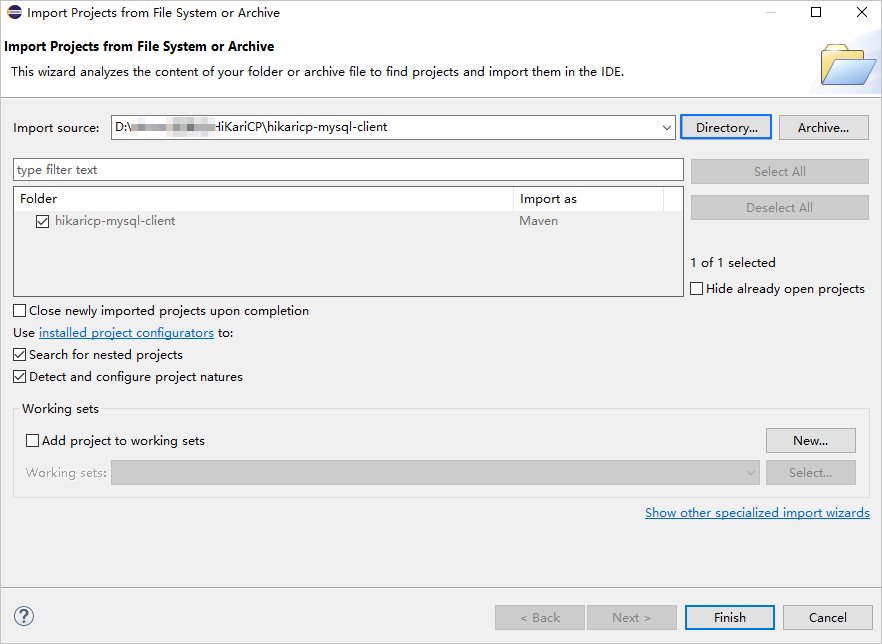
    1

  3. View the project.

    2

Step 2: Obtain the URL of OceanSeek

  1. Contact the deployment personnel or administrator of OceanSeek to obtain the connection string.

    Here is an example:

    obclient -hxxx.xxx.xxx.xxx -P2881 -utest_user001@mysql001 -p****** -Dtest
    

    For more information about connection strings, see Connect to OceanSeek by using OBClient.

  2. Fill in the URL below based on the OceanSeek connection string.

    jdbc:mysql://$host:$port/$database_name?user=$user_name&password=$password&useSSL=false
    

    Parameter description:

    • $host specifies the IP address for connecting to OceanSeek. For connection through OceanBase Database Proxy (ODP), this parameter is the IP address of an ODP. For direct connection, this parameter is the IP address of an OBServer node.

    • $port specifies the port for connecting to OceanSeek. For connection through ODP, the default value is 2883, which can be customized when ODP is deployed. For direct connection, the default value is 2881, which can be customized when OceanSeek is deployed.

    • $database_name specifies the name of the database to be accessed.

      Notice

      The user used to connect to the tenant must have the CREATE, INSERT, DELETE, UPDATE, and SELECT privileges on the database. For more information about user privileges, see Privilege types in MySQL-compatible mode.

    • $user_name specifies the tenant account. For connection through ODP, the tenant account can be in the username@tenant_name#cluster_name or cluster_name:tenant_name:username format. For direct connection, the tenant account is in the username@tenant_name format.

    • $password specifies the password of the account.

    For more information about the connection properties of MySQL Connector/J, see Configuration Properties.

    Here is an example:

    jdbc:mysql://xxx.xxx.xxx.xxx:2881/test?user=test_user001@mysql001&password=******&useSSL=false
    

Step 3: Modify the database connection information in the hikaricp-mysql-client project

Modify the database connection information in the hikaricp-mysql-client/src/main/resources/db.properties file based on the information obtained in Step 2.
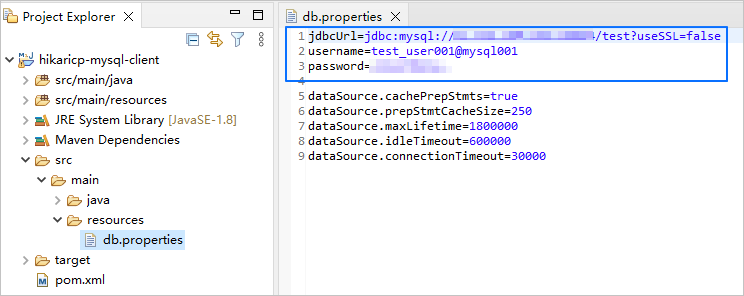
3

Here is an example:

  • The IP address of the OBServer node is xxx.xxx.xxx.xxx.
  • The port is 2881.
  • The name of the database to be accessed is test.
  • The tenant account is test_user001@mysql001, where mysql001 is a user tenant created in OceanSeek, and test_user001 is the username of the mysql001 tenant.
  • The password is ******.

The sample code is as follows:

...
jdbcUrl=jdbc:mysql://xxx.xxx.xxx.xxx:2881/test?useSSL=false
username=test_user001@mysql001
password=******
...

Step 4: Run the hikaricp-mysql-client project

  1. In the project navigation view, locate and expand the src/main/java directory.

  2. Right-click the Main.java file and choose Run As > Java Application.
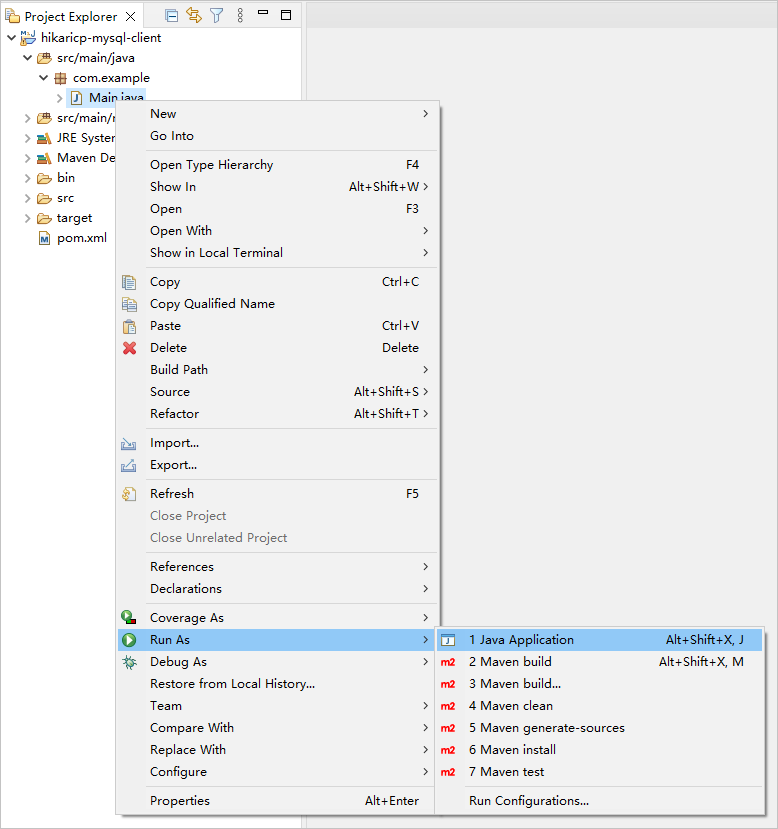
    4

  3. In the console window of Eclipse, view the project's log information and output results.
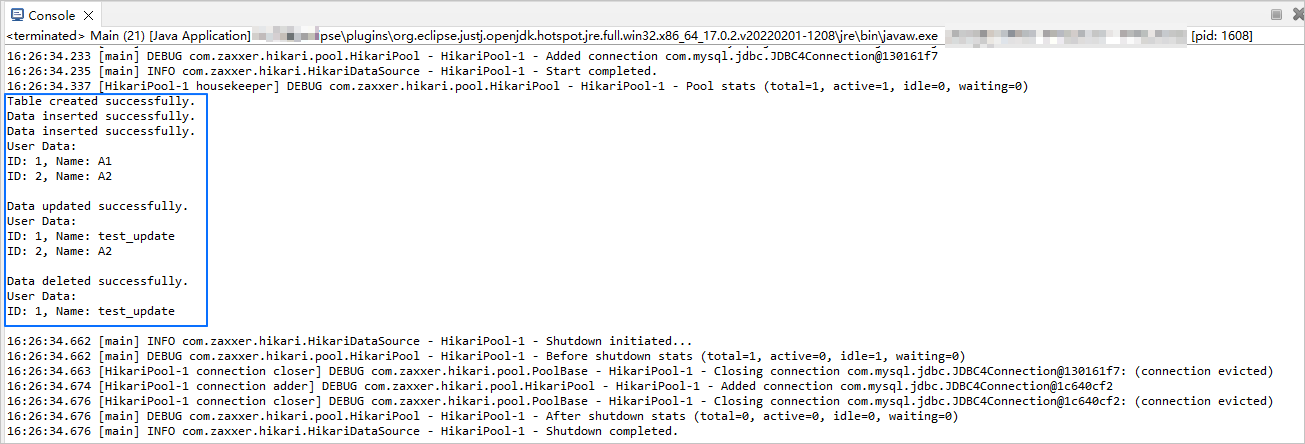
    5

  4. You can also execute the following SQL statement in the OceanBase Client (OBClient) to view the results.

    obclient [(none)]> SELECT * FROM test.test_hikaricp;
    

    The return result is as follows:

    +------+-------------+
    | id   | name        |
    +------+-------------+
    |    1 | test_update |
    +------+-------------+
    1 row in set
    

Project code

Click hikaricp-mysql-client to download the project code, which is a compressed file named hikaricp-mysql-client.zip.

After decompressing it, you will get a folder named hikaricp-mysql-client. The directory structure is as follows:

hikaricp-mysql-client
├── src
│   └── main
│       ├── java
│       │   └── com
│       │       └── example
│       │           └── Main.java
│       └── resources
│           └── db.properties
└── pom.xml

The files and directories are described as follows:

  • src: The root directory for source code.
  • main: The main code directory, containing the application's primary logic.
  • java: The Java source code directory.
  • com: The Java package directory.
  • example: The package directory for the sample project.
  • Main.java: The main class sample file, containing logic for creating tables, and inserting, deleting, updating, and querying data.
  • resources: The resource file directory, containing configuration files.
  • db.properties: The connection pool configuration file, containing relevant database connection parameters.
  • pom.xml: The Maven project configuration file, used to manage project dependencies and build settings.

Code in the pom.xml file

The pom.xml file is a configuration file for Maven projects, which defines the dependencies, plug-ins, and build rules of the projects. Maven is a Java project management tool that can automatically download dependencies, compile, and package the projects.

To configure the pom.xml file, perform the following steps:

  1. Declare the file.

    Declare the file to be an XML file that uses XML standard 1.0 and character encoding UTF-8.

    The sample code is as follows:

    <?xml version="1.0" encoding="UTF-8"?>
    
  2. Configure the namespaces and the POM model version.

    1. xmlns: the default XML namespace, which is set to http://maven.apache.org/POM/4.0.0.
    2. xmlns:xsi: the namespace for XML elements prefixed with xsi, which is set to http://www.w3.org/2001/XMLSchema-instance.
    3. xsi:schemaLocation: the mapping between the XML namespace and its corresponding XML schema definition (XSD) file. The value typically consists of paired strings separated by spaces. Each pair consists of a default XML namespace (http://maven.apache.org/POM/4.0.0) in the first part, and the URI of the corresponding XSD file (http://maven.apache.org/xsd/maven-4.0.0.xsd) in the second part.
    4. <modelVersion>: the POM model version used by the POM file, which is set to 4.0.0.

    The sample code is as follows:

    <project xmlns="http://maven.apache.org/POM/4.0.0"
             xmlns:xsi="http://www.w3.org/2001/XMLSchema-instance"
             xsi:schemaLocation="http://maven.apache.org/POM/4.0.0 http://maven.apache.org/xsd/maven-4.0.0.xsd">
      <modelVersion>4.0.0</modelVersion>
    
     <!-- Other configurations -->
    
    </project>
    
  3. Configure basic information.

    1. Use <groupId> to specify the project's organization as com.example.
    2. Use <artifactId> to specify the project name as hikaricp-mysql-client.
    3. Use <version> to specify the project version as 1.0-SNAPSHOT.

    The sample code is as follows:

        <groupId>com.example</groupId>
        <artifactId>hikaricp-mysql-client</artifactId>
        <version>1.0-SNAPSHOT</version>
    
  4. Configure the properties of the project's source files.

    Specifies the Maven compiler plugin as maven-compiler-plugin and sets both the source and target Java versions to 8. This means the project's source code is written using Java 8 features, and the compiled bytecode will also be compatible with the Java 8 runtime environment. This configuration ensures the project can correctly handle Java 8 syntax and features during compilation and runtime.

    Note

    Java 1.8 and Java 8 are different names for the same version.

    The sample code is as follows:

        <build>
            <plugins>
                <plugin>
                    <groupId>org.apache.maven.plugins</groupId>
                    <artifactId>maven-compiler-plugin</artifactId>
                    <configuration>
                        <source>8</source>
                        <target>8</target>
                    </configuration>
                </plugin>
            </plugins>
        </build>
    
  5. Configure the components on which the project depends.

    1. Add the mysql-connector-java dependency library to interact with the database:

      1. Use <groupId> to specify the dependency's organization as mysql.
      2. Use <artifactId> to specify the dependency name as mysql-connector-java.
      3. Use <version> to specify the dependency version as 5.1.40.

      The sample code is as follows:

              <dependency>
                  <groupId>mysql</groupId>
                  <artifactId>mysql-connector-java</artifactId>
                  <version>5.1.40</version>
              </dependency>
      
    2. Add the HikariCP dependency library to implement a high-performance JDBC connection pool:

      1. Use <groupId> to specify the dependency's organization as com.zaxxer.
      2. Use <artifactId> to specify the dependency name as HikariCP.
      3. Use <version> to specify the dependency version as 3.3.1.

      The sample code is as follows:

              <dependency>
                  <groupId>com.zaxxer</groupId>
                  <artifactId>HikariCP</artifactId>
                  <version>3.3.1</version>
              </dependency>
      
    3. Add the logback-classic dependency library for convenient logging and management:

      1. Use <groupId> to specify the dependency's organization as ch.qos.logback.
      2. Use <artifactId> to specify the dependency name as logback-classic.
      3. Use <version> to specify the dependency version as 1.2.5.

      The sample code is as follows:

              <dependency>
                  <groupId>ch.qos.logback</groupId>
                  <artifactId>logback-classic</artifactId>
                  <version>1.2.5</version>
              </dependency>
      

Code in the db.properties file

db.properties is a sample configuration file of the connection pool. The configuration file contains the URL, username, and password for connecting to the database, and other optional parameters of the connection pool.

To configure the db.properties file, perform the following steps:

  1. Configure database connection parameters.

    1. Specify the URL for connecting to the database, including the host IP address, port number, and database to be accessed.
    2. Specify the username for connecting to the database.
    3. Specify the password for connecting to the database.

    The sample code is as follows:

    jdbcUrl=jdbc:mysql://$host:$port/$database_name?useSSL=false
    username=$user_name
    password=$password
    

    Parameter description:

    • $host specifies the IP address for connecting to OceanSeek. For connection through OceanBase Database Proxy (ODP), this parameter is the IP address of an ODP. For direct connection, this parameter is the IP address of an OBServer node.
    • $port specifies the port for connecting to OceanSeek. For connection through ODP, the default value is 2883, which can be customized when ODP is deployed. For direct connection, the default value is 2881, which can be customized when OceanSeek is deployed.
    • $database_name specifies the name of the database to be accessed.
    • $user_name specifies the tenant account. For connection through ODP, the tenant account can be in the username@tenant_name#cluster_name or cluster_name:tenant_name:username format. For direct connection, the tenant account is in the username@tenant_name format.
    • $password specifies the password of the account.
  2. Configure other connection pool parameters.

    1. Enable caching for precompiled SQL statements.
    2. Set the cache size for precompiled SQL statements to 250.
    3. Set the maximum lifetime of connections to 1,800,000 ms (30 minutes). Connections exceeding the specified lifetime are closed.
    4. Set the timeout value of idle connections to 600,000 ms (10 minutes). Connections that have been idle for the specified period of time are closed.
    5. Set the timeout value for requesting a connection to 30,000 ms (30s). If no connection is obtained when the specified timeout value expires, an exception is thrown.

    The sample code is as follows:

    dataSource.cachePrepStmts=true
    dataSource.prepStmtCacheSize=250
    dataSource.maxLifetime=1800000
    dataSource.idleTimeout=600000
    dataSource.connectionTimeout=30000
    

Notice

The actual parameter configurations depend on the project requirements and database characteristics. We recommend that you adjust and configure the parameters based on the actual situation. For more information about parameters of the HikariCP connection pool, see Configuration.

The following table describes the basic parameters of the HikariCP connection pool.

Category
Parameter
Default value
Description
Required parameters dataSourceClassName N/A The name of the DataSource class provided by the JDBC driver.

Notice

Generally, the dataSourceClassName parameter does not need to be explicitly configured because HikariCP can automatically detect and load an appropriate driver.

jdbcUrl N/A The URL for the JDBC driver to connect to OceanSeek.
username N/A The username for connecting to the database.
password N/A The password for connecting to the database.
Optional parameters autoCommit true Controls the default auto-commit behavior of connections returned by the connection pool.
connectionTimeout 30000 Controls the maximum wait time for a client to obtain a connection from the connection pool. Unit: milliseconds. Default value is 30000 (30 seconds). The minimum acceptable connection timeout is 250 milliseconds.
idleTimeout 600000 Controls the maximum idle time of a connection in the pool. Unit: milliseconds. Default value is 600000 (10 minutes). This setting has the following limitations:
  • It takes effect only when minimumIdle is less than maximumPoolSize.
  • When the number of connections in the pool reaches minimumIdle, idle connections are not reclaimed. Connections are reclaimed only when the pool exceeds minimumIdle.
keepaliveTime 0 Controls the frequency of connection keepalives to prevent connections from being timed out by the database or network infrastructure. Unit: milliseconds. Default value is 0, which disables connection keepalives. This value must be less than the value of the maxLifetime attribute.
  • maxLifetime 1800000 Controls the maximum lifetime of a connection in the connection pool. Used connections are not automatically reclaimed; they are removed from the pool only when the connection is closed. Unit: milliseconds. Default value is 1800000 (30 minutes). Setting maxLifetime to 0 means there is no maximum lifetime limit for connections in the pool, i.e., the connection lifetime is infinite.
    connectionTestQuery N/A The connection test query executed by the connection pool to the database. It is executed before a connection is acquired from the pool to verify that the database connection is still valid.
    minimumIdle N/A Controls the minimum number of idle connections maintained in the pool. If the number of idle connections falls below this value and the total number of connections in the pool is less than maximumPoolSize, HikariCP attempts to quickly and efficiently add additional connections. By default, the value of the minimumIdle attribute is the same as the maximumPoolSize attribute.
    maximumPoolSize 10 Controls the maximum size allowed for the connection pool, including both idle and active connections. This value determines the maximum number of actual connections to the database backend.
    poolName N/A The user-defined name of the connection pool. This name is primarily used for identification and configuration management in logging and the JMX console. By default, a name is automatically generated.

    Code in the Main.java file

    The Main.java file is a part of the sample application. It demonstrates the process of obtaining a database connection from the HikariCP connection pool, executing a series of database operations, such as table creation, data insertion, data deletion, data modification, and data query, and returning the query result.

    To configure the Main.java file, perform the following steps:

    1. Import the required classes and packages.

      1. Define the name of the Java package as com.example, where the package is used for organizing and managing Java classes.
      2. Import the java.sql.Connection class for establishing and managing connections with the database.
      3. Import the java.sql.PreparedStatement class for executing precompiled SQL statements.
      4. Import the java.sql.ResultSet class for processing query result sets.
      5. Import the java.sql.SQLException class for handling SQL exceptions.
      6. Import the HikariConfig class for configuring HikariCP connection pools.
      7. Import the HikariDataSource class for creating and managing HikariCP connection pools.

      The sample code is as follows:

      package com.example;
      
      import java.sql.Connection;
      import java.sql.PreparedStatement;
      import java.sql.ResultSet;
      import java.sql.SQLException;
      import com.zaxxer.hikari.HikariConfig;
      import com.zaxxer.hikari.HikariDataSource;
      
    2. Define the class and methods.

      Define a Main class, with its main method serving as the program's entry point. In the main method, read the db.properties file to configure the HikariCP connection pool and obtain a database connection. Then, call a series of methods in sequence to create a table, insert data, query data, update data, and delete data. If an SQLException exception occurs during the operations, the stack trace of the exception information will be printed. The specific steps are as follows:

      1. Define a public class named Main.
      2. Define the entry method main for the Main class.
      3. Create a HikariConfig object and configure it using the specified db.properties file.
      4. Create a HikariDataSource object and obtain a database connection within a try-with-resources block.
      5. Call a method to create a table, passing the obtained database connection object, to create the test_hikaricp table.
      6. Call a method to insert data, passing the obtained database connection object and data parameters, to insert two rows of data: (1,'A1') and (2,'A2').
      7. Call a method to query data, passing the obtained database connection object, to check the data insertion.
      8. Call a method to update data, passing the obtained database connection object and update parameters, to update the value in the name column of the row with id 1 to test_update.
      9. Call a method to query data, passing the obtained database connection object, to check the data update.
      10. Call a method to delete data, passing the obtained database connection object and deletion parameters, to delete the row with id 2.
      11. Call a method to query data, passing the obtained database connection object, to check the data deletion.
      12. If an SQLException exception occurs in the try block, print the exception's stack trace information.
      13. Define methods for creating a table, inserting data, querying data, updating data, and deleting data.

      The sample code is as follows:

      public class Main {
          public static void main(String[] args) {
              try {
                  HikariConfig config = new HikariConfig("/db.properties");
                  try (HikariDataSource dataSource = new HikariDataSource(config);
                      Connection conn = dataSource.getConnection()) {
                      createTable(conn);
      
                      insertData(conn, 1, "A1");
                      insertData(conn, 2, "A2");
      
                      selectData(conn);
      
                      updateData(conn, "test_update", 1);
                      selectData(conn);
      
                      deleteData(conn, 2);
                      selectData(conn);
                  }
              } catch (SQLException e) {
                  e.printStackTrace();
              }
          }
      
          // Define the method for creating a table.
          // Define the method for inserting data.
          // Define methods for querying data
          // Define a method for updating data.
          // Define a method for deleting data.
      }
      
    3. Define a method for creating a table.

      Define a private static method createTable to create a table named test_hikaricp in the database. This table contains an id column and a name column. The specific steps are as follows:

      1. Define a private static method createTable, which accepts a Connection object as a parameter and declares that it may throw an SQLException exception.
      2. Define an SQL statement string to create a table named test_hikaricp, containing an id column (data type INT) and a name column (data type VARCHAR(50))).
      3. Use the connection object conn to create a precompiled SQL statement object pstmt, and use this object within a try-with-resources block.
      4. Execute the SQL statement to create the table named test_hikaricp.
      5. Print a message to the console indicating that the table has been created successfully.

      The sample code is as follows:

          private static void createTable(Connection conn) throws SQLException {
              String sql = "CREATE TABLE IF NOT EXISTS test_hikaricp (id INT, name VARCHAR(50))";
              try (PreparedStatement pstmt = conn.prepareStatement(sql)) {
                  pstmt.executeUpdate();
                  System.out.println("Table created successfully.");
              }
          }
      
    4. Define a method for inserting data.

      Define a private static method named insertData to insert data into the test_hikaricp table in the database. The specific steps are as follows:

      1. Define a private static method named insertData. This method accepts a Connection object, an integer id parameter, and a string name parameter, and declares that it may throw an SQLException.
      2. Define an SQL statement string for inserting data into the table named test_hikaricp, including the id and name columns.
      3. Create a precompiled SQL statement object pstmt using the connection object conn, and use this object within a try-with-resources block.
      4. Set the value of the first parameter ? in the SQL statement to id.
      5. Set the value of the second parameter ? in the SQL statement to name.
      6. Execute the SQL statement to insert data into the table.
      7. Print a message to the console indicating that the data has been inserted successfully.

      The sample code is as follows:

          private static void insertData(Connection conn, int id, String name) throws SQLException {
              String sql = "INSERT INTO test_hikaricp (id, name) VALUES (?, ?)";
              try (PreparedStatement pstmt = conn.prepareStatement(sql)) {
                  pstmt.setInt(1, id);
                  pstmt.setString(2, name);
                  pstmt.executeUpdate();
                  System.out.println("Data inserted successfully.");
              }
          }
      
    5. Define a method for querying data.

      Define a private static method named selectData to query data from the test_hikaricp table in the database. The specific steps are as follows:

      1. Define a private static method named selectData. This method accepts a Connection object as a parameter and declares that it may throw an SQLException.
      2. Define an SQL statement string to query all data from the table named test_hikaricp.
      3. Create a precompiled SQL statement object pstmt using the connection object conn, and use this object within a try-with-resources block. Also, execute the SQL query by calling the executeQuery() method and return the query result set object rs.
      4. Print a message to the console indicating that user data is being printed.
      5. Traverse the query result set. Use the next() method to check if there is another row of data in the result set. If so, enter the loop.
      6. Retrieve the value of the id column from the result set and assign it to the variable id.
      7. Retrieve the value of the name column from the result set and assign it to the variable name.
      8. Print the id and name values of each row of data to the console.
      9. Print an empty line to the console.

      The sample code is as follows:

          private static void selectData(Connection conn) throws SQLException {
              String sql = "SELECT * FROM test_hikaricp";
              try (PreparedStatement pstmt = conn.prepareStatement(sql);
                  ResultSet rs = pstmt.executeQuery()) {
                  System.out.println("User Data:");
                  while (rs.next()) {
                      int id = rs.getInt("id");
                      String name = rs.getString("name");
                      System.out.println("ID: " + id + ", Name: " + name);
                  }
                  System.out.println();
              }
          }
      
    6. Define a method for updating data.

      Define a private static method named updateData to update data in the test_hikaricp table in the database. The specific steps are as follows:

      1. Define a private static method named updateData. This method accepts a Connection object, a string name parameter, and an integer id parameter, and declares that it may throw an SQLException.
      2. Define an SQL statement string to update data in the table named test_hikaricp. Update the value of the name column to the specified name if the value of the id column equals the specified id.
      3. Create a precompiled SQL statement object pstmt using the connection object conn, and use this object within a try-with-resources block.
      4. Set the value of the first parameter ? in the SQL statement to name.
      5. Set the value of the second parameter ? in the SQL statement to id.
      6. Execute the SQL statement to update the data in the table.
      7. Print a message to the console indicating that the data has been updated successfully.

      The sample code is as follows:

          private static void updateData(Connection conn, String name, int id) throws SQLException {
              String sql = "UPDATE test_hikaricp SET name = ? WHERE id = ?";
              try (PreparedStatement pstmt = conn.prepareStatement(sql)) {
                  pstmt.setString(1, name);
                  pstmt.setInt(2, id);
                  pstmt.executeUpdate();
                  System.out.println("Data updated successfully.");
              }
          }
      
    7. Define a method for deleting data.

      Define a private static method named deleteData to delete data that meets the specified conditions from the test_hikaricp table in the database. The specific steps are as follows:

      1. Define a private static method named deleteData. This method accepts a Connection object and an integer parameter id, and declares that it may throw a SQLException exception.
      2. Define an SQL statement string to delete data that meets the condition id = ? from the table named test_hikaricp.
      3. Use the connection object conn to create a precompiled SQL statement object pstmt, and use this object within a try-with-resources block.
      4. Set the value of the first parameter ? in the SQL statement to id.
      5. Execute the SQL statement to delete the data that meets the conditions from the table.
      6. Print a message to the console indicating that the data has been deleted successfully.

      The sample code is as follows:

          private static void deleteData(Connection conn, int id) throws SQLException {
              String sql = "DELETE FROM test_hikaricp WHERE id = ?";
              try (PreparedStatement pstmt = conn.prepareStatement(sql)) {
                  pstmt.setInt(1, id);
                  pstmt.executeUpdate();
                  System.out.println("Data deleted successfully.");
              }
          }
      

    Complete code examples

    pom.xml
    db.properties
    Main.java
    <?xml version="1.0" encoding="UTF-8"?>
    <project xmlns="http://maven.apache.org/POM/4.0.0"
             xmlns:xsi="http://www.w3.org/2001/XMLSchema-instance"
             xsi:schemaLocation="http://maven.apache.org/POM/4.0.0 http://maven.apache.org/xsd/maven-4.0.0.xsd">
        <modelVersion>4.0.0</modelVersion>
    
        <groupId>com.oceanbase</groupId>
        <artifactId>hikaricp-mysql-client</artifactId>
        <version>1.0-SNAPSHOT</version>
        <build>
            <plugins>
                <plugin>
                    <groupId>org.apache.maven.plugins</groupId>
                    <artifactId>maven-compiler-plugin</artifactId>
                    <configuration>
                        <source>8</source>
                        <target>8</target>
                    </configuration>
                </plugin>
            </plugins>
        </build>
    
        <dependencies>
            <dependency>
                <groupId>mysql</groupId>
                <artifactId>mysql-connector-java</artifactId>
                <version>5.1.40</version>
            </dependency>
            <dependency>
                <groupId>com.zaxxer</groupId>
                <artifactId>HikariCP</artifactId>
                <version>3.3.1</version>
            </dependency>
            <dependency>
                <groupId>ch.qos.logback</groupId>
                <artifactId>logback-classic</artifactId>
                <version>1.2.5</version>
            </dependency>
        </dependencies>
    </project>
    
    jdbcUrl=jdbc:mysql://$host:$port/$database_name?useSSL=false
    username=$user_name
    password=$password
    
    dataSource.cachePrepStmts=true
    dataSource.prepStmtCacheSize=250
    dataSource.maxLifetime=1800000
    dataSource.idleTimeout=600000
    dataSource.connectionTimeout=30000
    
    package com.example;
    
    import java.sql.Connection;
    import java.sql.PreparedStatement;
    import java.sql.ResultSet;
    import java.sql.SQLException;
    import com.zaxxer.hikari.HikariConfig;
    import com.zaxxer.hikari.HikariDataSource;
    
    public class Main {
        public static void main(String[] args) {
            try {
                HikariConfig config = new HikariConfig("/db.properties");
                try (HikariDataSource dataSource = new HikariDataSource(config);
                     Connection conn = dataSource.getConnection()) {
                    createTable(conn);
    
                    insertData(conn, 1, "A1");
                    insertData(conn, 2, "A2");
    
                    selectData(conn);
    
                    updateData(conn, "test_update", 1);
                    selectData(conn);
    
                    deleteData(conn, 2);
                    selectData(conn);
                }
            } catch (SQLException e) {
                e.printStackTrace();
            }
        }
    
        private static void createTable(Connection conn) throws SQLException {
            String sql = "CREATE TABLE IF NOT EXISTS test_hikaricp (id INT, name VARCHAR(50))";
            try (PreparedStatement pstmt = conn.prepareStatement(sql)) {
                pstmt.executeUpdate();
                System.out.println("Table created successfully.");
            }
        }
    
        private static void insertData(Connection conn, int id, String name) throws SQLException {
            String sql = "INSERT INTO test_hikaricp (id, name) VALUES (?, ?)";
            try (PreparedStatement pstmt = conn.prepareStatement(sql)) {
                pstmt.setInt(1, id);
                pstmt.setString(2, name);
                pstmt.executeUpdate();
                System.out.println("Data inserted successfully.");
            }
        }
    
        private static void selectData(Connection conn) throws SQLException {
            String sql = "SELECT * FROM test_hikaricp";
            try (PreparedStatement pstmt = conn.prepareStatement(sql);
                 ResultSet rs = pstmt.executeQuery()) {
                System.out.println("User Data:");
                while (rs.next()) {
                    int id = rs.getInt("id");
                    String name = rs.getString("name");
                    System.out.println("ID: " + id + ", Name: " + name);
                }
                System.out.println();
            }
        }
    
        private static void updateData(Connection conn, String name, int id) throws SQLException {
            String sql = "UPDATE test_hikaricp SET name = ? WHERE id = ?";
            try (PreparedStatement pstmt = conn.prepareStatement(sql)) {
                pstmt.setString(1, name);
                pstmt.setInt(2, id);
                pstmt.executeUpdate();
                System.out.println("Data updated successfully.");
            }
        }
    
        private static void deleteData(Connection conn, int id) throws SQLException {
            String sql = "DELETE FROM test_hikaricp WHERE id = ?";
            try (PreparedStatement pstmt = conn.prepareStatement(sql)) {
                pstmt.setInt(1, id);
                pstmt.executeUpdate();
                System.out.println("Data deleted successfully.");
            }
        }
    }
    

    References

    • For more information about MySQL Connector/J, see Overview of MySQL Connector/J.
    • For more information about the HikariCP connection pool, see HikariCP.

    Previous topic

    Proxool
    Last

    Next topic

    DBCP
    Next
    on this page
    Prerequisites
    Procedure
    Step 1: Import the hikaricp-mysql-client project into Eclipse
    Step 2: Obtain the URL of OceanSeek
    Step 3: Modify the database connection information in the hikaricp-mysql-client project
    Step 4: Run the hikaricp-mysql-client project
    Project code
    Code in the pom.xml file
    Code in the db.properties file
    Code in the Main.java file
    Complete code examples
    References