
This topic describes how to use OceanBase Migration Service (OMS) to migrate data from a PolarDB-X 1.0 database to a MySQL-compatible tenant of OceanBase Database.
Background information
PolarDB-X 1.0 is a cloud-native distributed database independently developed by Alibaba Group. It is compatible with MySQL interaction protocols and supports core capabilities and features of distributed databases, such as database and table sharding, smooth scaling, service upgrading and downgrading, and transparent read/write splitting.
After a task that migrates data from a PolarDB-X 1.0 database to a MySQL-compatible tenant of OceanBase Database is successfully started, the task is automatically deleted. OMS automatically creates tasks to migrate data from the MySQL databases mounted to the PolarDB-X 1.0 database to the MySQL-compatible tenant of OceanBase Database. The number of tasks depends on the number of underlying MySQL instances in the PolarDB-X 1.0 database. OMS supports a maximum of 512 instances.
We recommend that you filter the tasks by tag or task name for operations such as batch start, batch pause, and batch start forward switchover. For more information about batch operations, see Perform batch operations on data migration tasks.
Prerequisites
Ensure that the OMS and the physical instance of RDS are connected to each other.
You have created dedicated database users for data migration in the source PolarDB-X 1.0 database and the target MySQL-compatible tenant of OceanBase Database and granted the corresponding privileges to the users. For more information, see Create a database user.
Limitations
Limitations on the source database
Do not perform DDL operations for database or schema changes during full data migration. Otherwise, data migration tasks may be interrupted.
You can migrate data from a PolarDB-X 1.0 database to a MySQL-compatible tenant of OceanBase Database only in Apsara Stack scenarios.
OMS supports PolarDB-X 1.0 databases of versions 5.2.8, 5.4.2, 5.4.9, and 5.4.12, as well as MySQL databases of versions 5.5, 5.6, 5.7, and 8.0 mounted to PolarDB-X 1.0 databases.
OMS supports the migration of only objects whose database name, table name, and column name are ASCII-encoded and do not contain special characters. The special characters are spaces line breaks, and the following characters:
| " ' ` ( ) = ; / & \.When you migrate data from a PolarDB-X 1.0 database to a MySQL-compatible tenant of OceanBase Database, OMS does not support the following cases:
Schema migration or reverse incremental migration
View migration
Inconsistency of the username or password of the MySQL database instance mounted to the source PolarDB-X 1.0 database
OceanBase Database supports the UTF8MB4, GBK, GB18030, binary, and UTF-16 character sets.
Considerations
For the migration of tables without unique keys (tables with primary keys or NOT NULL unique keys), when you restart or resume full migration, OMS automatically truncates the destination tables that have been synchronized before a restart or a resumption. However, for the migration of tables without unique keys in a data migration task from a MySQL database mounted to the PolarDB-X 1.0 database to a MySQL-compatible tenant of OceanBase Database, OMS does not automatically truncate the destination tables when you restart or resume full migration.
If you do not specify mappings for objects of the PolarDB-X 1.0 database, all data of physical tables is synchronized to physical tables with the same names at the destination. The number of physical tables at the source is the same as that at the destination.
A difference between the source and destination table schemas may result in data consistency. Some known scenarios are described as follows:
When you manually create a table schema at the destination, if the data types of any columns are not supported by OMS, implicit data type conversion may occur at the destination, which causes inconsistent column types between the source and destination.
If the length of a column at the destination is shorter than that at the source, the data of this column may be automatically truncated, which causes data inconsistency between the source and destination.
If you select only Incremental Synchronization when you create the data migration task, OMS requires that the archive logs in the source database be retained for more than 48 hours.
If you select Full Data Migration and Incremental Synchronization when you create the data migration task, OMS requires that the archive logs in the source database be retained for at least 7 days. Otherwise, the data migration task may fail or the data in the source and target databases may be inconsistent because OMS Community Edition cannot obtain incremental logs.
If the source and destination table objects differ only in capitalization of their names, the data migration result may not be as expected because the object names in the source and destination are case-insensitive.
Procedure
Create a data migration task.
Log in to the OMS console.
In the left-side navigation pane, click Data Migration.
On the Data Migration page, click Create Migration Task in the upper-right corner.
On the Select Source and Target page, configure the parameters.
ParameterDescriptionData Migration Task Name We recommend that you set it to a combination of digits and letters. It must not contain any spaces and cannot exceed 64 characters in length.
Notice
The task name must be a unique identifier in the OMS system.Source If you have created a PolarDB-X 1.0 data source, select it from the drop-down list. If not, click New Data Source in the drop-down list and create one in the dialog box that appears on the right. For more information about the parameters, see Create a PolarDB-X 1.0 data source. Target If you have created a physical data source for the MySQL-compatible tenant of OceanBase Database, select it from the drop-down list. If not, click New Data Source in the drop-down list and create one in the dialog box that appears on the right. For more information, see Create a physical OceanBase data source. Tag Click the field and select a tag from the drop-down list. You can also click Manage Tags to create, modify, and delete tags. For more information, see Use tags to manage data migration tasks. Note
After the task that migrates data from a PolarDB-X 1.0 database to a MySQL-compatible tenant of OceanBase Database is successfully started, the task is automatically deleted. You need to add a proper tag to the task.
On the Select Migration Type page, configure the parameters.
Options for Migration Type are Full Data Migration, Incremental Synchronization, and Full Verification.
Migration typeLimitationsFull data migration After a full data migration task is started, OMS migrates existing data of tables in the source database to corresponding tables in the destination database. Incremental synchronization Changed data in the source database is synchronized to the corresponding tables in the destination database after an incremental synchronization task starts. Supported data changes are data addition, modification, and deletion.
Options for DML Synchronization in the Incremental Synchronization section includeInsert,Delete, andUpdate. You can select the operations as needed. For more information, see DML filtering.Full verification After the full data migration and incremental data synchronization are completed, OMS automatically initiates a full data verification task to verify the data tables in the source and destination databases. - If you select Incremental Synchronization but do not select all DML operations in the DML Synchronization section, you cannot select Full Verification.
- Before data migration, assess the performance of the source and destination databases. We recommend that you perform data migration in off-peak hours. During full verification, the data transmission service consumes some read resources in the source and destination databases. This may increase the loads of the databases.
Click Next. On the Select Migration Objects page, select the migration objects and migration scope.
At present, you can select migration objects only by using the Specify Objects option. Select the objects to be migrated on the left, and click > to add them to the list on the right. You can select tables of one or more databases as the migration objects.
OMS allows you to import objects from text files, rename destination objects, set row filters, view column information, and remove a single migration object or all migration objects.
OperationDescriptionImport objects - In the list on the right of the Specify Migration Scope section, click Import Objects in the upper-right corner.
- In the dialog box that appears, click OK.
Notice
This operation will overwrite previous selections. Proceed with caution. - In the Import Objects dialog box, import the objects to be migrated.
You can import CSV files to rename databases/tables and set row filtering conditions. For more information, see Download and import the settings of migration objects. - Click Validate.
- After the validation succeeds, click OK.
Rename objects OMS allows you to rename migration objects. For more information, see Rename a database table. Configure settings OMS allows you to filter rows by using WHEREconditions. For more information, see Use SQL conditions to filter data.
You can also view column information of the migration objects in the View Column section.Remove one or all objects OMS allows you to remove a single object or all objects to be migrated to the destination database during data mapping. - To remove a single migration object:
In the list on the right of the Specify Migration Scope section, move the pointer over the target object and click Remove. - To remove all migration objects:
In the list on the right of the Specify Migration Scope section, click Remove All in the upper-right corner. In the dialog box that appears, click OK.
Click Next. On the Migration Options page, configure the parameters.
Full data migration
The following parameters are displayed only if you have selected Full Data Migration on the Select Migration Type page.
ParameterDescriptionFull Migration Resource Configuration You can select Small, Medium, or Large to use the corresponding default values of Read Concurrency, Write Concurrency, and Memory. You can also customize the resource configurations for full migration. Through resource configuration for the Full-Import component, you can limit the resource consumption of a task in the full migration phase. Notice
In the case of custom configurations, the minimum value is
1, and only integers are supported.Handle Non-empty Tables in Target Database Valid values are Ignore and Stop Migration. - If you select Ignore, when the data to be inserted conflicts with the existing data of a destination table, OMS retains the existing data and records the conflict data.
Notice
If you select Ignore, data is pulled in IN mode for full verification. In this case, the scenario where the destination contains more data than the source cannot be verified, and the verification efficiency is decreased.
- If you select Stop Migration and a destination table contains data, an error is returned during full data migration, indicating that the migration is not allowed. In this case, you must clear the data in the destination table before you can continue with the migration.
Notice
After an error is returned, if you click Resume in the dialog box, OMS ignores this error and continues to migrate data. Proceed with caution.
- If you select Ignore, when the data to be inserted conflicts with the existing data of a destination table, OMS retains the existing data and records the conflict data.
Incremental synchronization
The following parameters are displayed only if you have selected Incremental Synchronization on the Select Migration Type page.
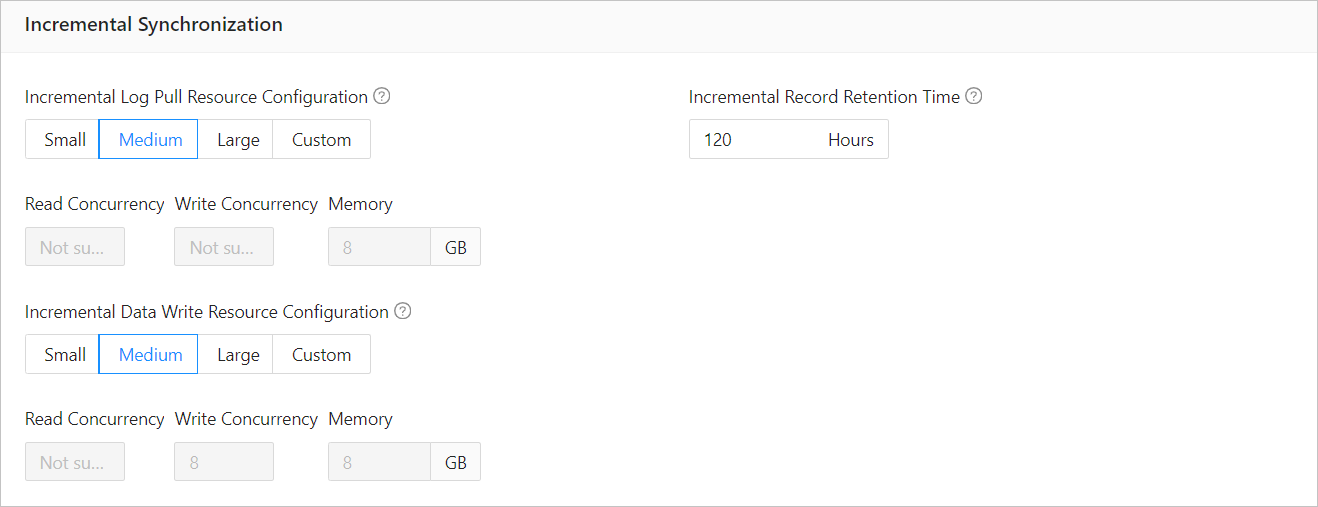 ParameterDescription
Incremental Log Pull Resource Configuration You can select Small, Medium, or Large to use the corresponding default value of Memory. You can also customize the resource configurations for incremental log pull. Through resource configuration for the Store component, you can limit the resource consumption of a task in log pull in the incremental synchronization phase. Notice
In the case of custom configurations, the minimum value is
1, and only integers are supported.Incremental Data Write Resource Configuration You can select Small, Medium, or Large to use the corresponding default values of Write Concurrency and Memory. You can also customize the resource configurations for incremental data write. Through resource configuration for the Incr-Sync component, you can limit the resource consumption of a task in data writes in the incremental synchronization phase. Notice
In the case of custom configurations, the minimum value is
1, and only integers are supported.Incremental Record Retention Time The duration that incremental parsed files are cached in OMS. A longer retention period results in more disk space occupied by the Store component. Incremental Synchronization Start Timestamp - If you have set the migration type to Full Data Migration, this parameter is not displayed.
- If you have selected Incremental Synchronization but not Full Data Migration, specify a point in time after which the data is to be synchronized. The default value is the current system time. For more information, see Set an incremental synchronization timestamp.
Full verification
The following parameters are displayed only if you have selected Full Verification on the Select Migration Type page.
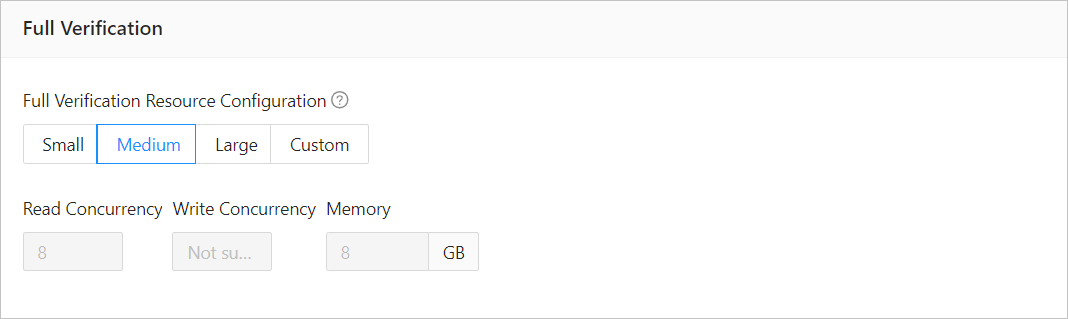 ParameterDescription
Full Verification Resource Configuration You can select Small, Medium, or Large to use the corresponding default values of Read Concurrency and Memory. You can also customize the resource configurations for full verification. Through resource configuration for the Full-Verification component, you can limit the resource consumption of a task in the full verification phase. Notice
In the case of custom configurations, the minimum value is
1, and only integers are supported.
If the parameter settings on the page cannot meet your requirements, you can click Parameter Configuration in the lower part of the page to configure more specific settings. You can also reference an existing task or component template.
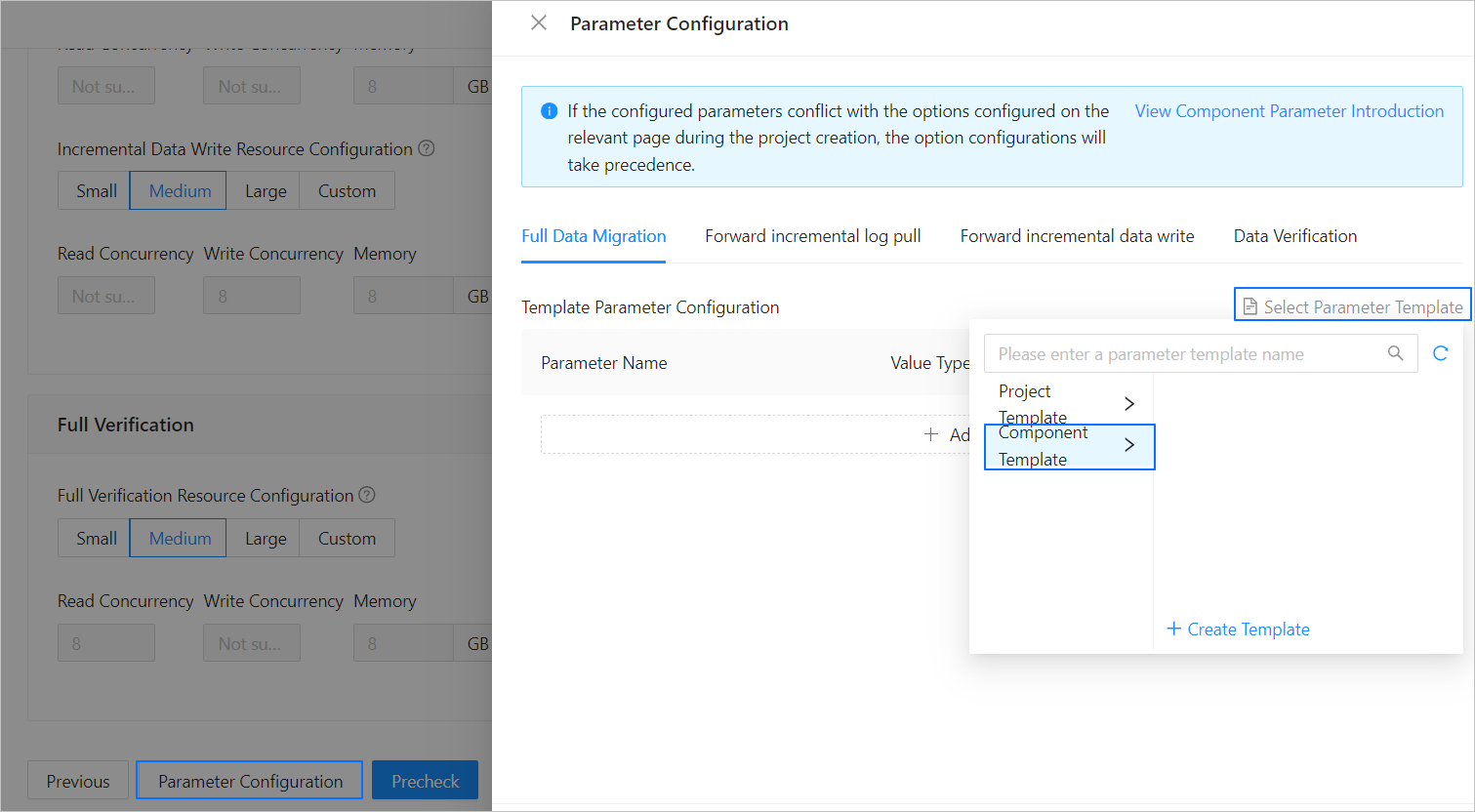
Click Precheck to start a precheck on the data migration task.
During the precheck, OMS checks the read and write privileges of the database users and the network connectivity of the databases. A data migration task can be started only after it passes all check items. If an error is returned during the precheck, you can perform the following operations:
Identify and troubleshoot the problem and then perform the precheck again.
Click Skip in the Actions column of a failed precheck item. In the dialog box that prompts the consequences of the operation, click OK.
After the precheck succeeds, click Start Task.
If you do not need to start the task now, click Save. After that, you can only manually start the task or start it in a batch operation on the Migration Tasks page. For more information about batch operations, see Perform batch operations on data migration tasks.
After the task is started, the task for data migration from the PolarDB-X 1.0 database to the MySQL-compatible tenant of OceanBase Database is automatically deleted. OMS retains the tasks for data migration from the databases mounted to the PolarDB-X 1.0 database to the MySQL-compatible tenant of OceanBase Database and automatically creates the corresponding data sources. In the dialog box that appears, you can click Export CSV to save the related information as a CSV file.
Then, click OK. On the Migration Tasks page, you can start one or more tasks for data migration from the MySQL database to the MySQL-compatible tenant of OceanBase Database.
OMS allows you to modify the migration objects when the data migration task is running. For more information, see View and modify migration objects. After the data migration task is started, it is be executed based on the selected migration types. For more information, see the View migration details section in the View details of a data migration task topic.