
This topic describes how to use OceanBase Migration Service (OMS) to migrate data from an Oracle database to a MySQL-compatible tenant of OceanBase Database, which can be a physical data source or a public cloud OceanBase data source.
Background information
You can create a data migration task in the OMS console to seamlessly migrate the existing business data and incremental data from an Oracle database to a MySQL-compatible tenant of OceanBase Database through schema migration, full migration, and incremental synchronization.
The Oracle database supports the following modes: primary database only, standby database only, and primary/standby databases. The following table describes the data migration operations supported by each mode.
Mode |
Supported operation |
|---|---|
| Primary database only | Schema migration, full migration, incremental synchronization, full verification, and reverse increment. |
| Standby database only | Schema migration, full migration, incremental synchronization, and full verification. |
| Primary/Standby databases | Primary database: reverse increment. Standby database: schema migration, full migration, incremental synchronization, and full verification. |
Prerequisites
You have created a corresponding schema in the target MySQL-compatible tenant of OceanBase Database.
You have enabled ARCHIVELOG for the source Oracle instance and switched the logfile before OMS starts incremental data replication.
You have installed LogMiner in the source Oracle instance, and LogMiner runs properly.
LogMiner enables you to obtain data from the archive logs of the Oracle instance.
You have enabled the database-level or table-level supplemental logging feature for the Oracle instance. For more information, see Oracle database supplemental logging.
Clock synchronization (such as the NTP service) is required between an Oracle server and the OMS server to avoid data risks. For Oracle Real Application Clusters (RAC), clock synchronization is also required between Oracle instances.
Limitations
Limitations on the source database
Do not perform DDL operations that modify database or table schemas during schema migration or full migration. Otherwise, the data migration task may be interrupted.
At present, Oracle Database 10g, 11g, 12c, 18c, and 19c are supported. Oracle Database 12c and later provide container databases (CDBs) and pluggable databases (PDBs).
When you use OMS to migrate data from an Oracle database to a MySQL-compatible tenant of OceanBase Database, DDL synchronization is not supported.
OMS does not support triggers in the target database. If triggers exist in the target database, the data migration may fail.
Data source identifiers and user accounts must be globally unique in OMS.
OMS supports the migration of only objects whose database name, table name, and column name are ASCII-encoded and do not contain special characters. The special characters are line breaks, spaces, and the following characters:
. | " ' ` ( ) = ; / & \.In reverse increment from an Oracle database to a MySQL-compatible tenant of OceanBase Database, a database name or table name in the source database cannot contain a lowercase letter. Otherwise, the check items of the reverse increment will fail the precheck.
OMS can parse up to 5 TB of incremental logs of Oracle databases per day.
You cannot create a database object whose name exceeds 30 bytes in length in an Oracle database of version 11g or earlier. Note that you cannot create a database object that exceeds this limit in a MySQL-compatible tenant of OceanBase Database during reverse increment.
OMS does not support the migration of database objects, such as schemas, tables, and columns, whose names exceed 30 bytes in length from an Oracle database of version 12c or later.
OMS does not support some
UPDATEstatements in the source Oracle database. For example, the followingUPDATEstatement is not supported:UPDATE TABLE_NAME SET KEY=KEY+1;In the preceding example,
TABLE_NAMEis the table name, andKEYis a primary key column of the NUMERIC type.
Considerations
When the Oracle database is in standby database only or primary/standby databases mode, if the number of instances that run in the primary Oracle database differs from that in the standby database, incremental logs of some instances may not be pulled. You need to manually set the parameters of the Store component to specify the instances for which incremental logs are to be pulled from the standby database. The procedure is as follows:
Stop the Store component as soon as it starts.
On the Update Configuration page of the Store component, add the
deliver2store.logminer.instance_threadsparameter and specify the instances for which logs are to be pulled.Separate multiple threads with vertical bars (|), such as 1|2|3.
Restart the Store component.
Wait 5 minutes, and then run the
grep 'log entries from' connector/connector.logcommand to check the instances for which logs are pulled. Thethreadfield indicates the instances for which logs are pulled.
If you need to synchronize incremental data from an Oracle database, we recommend that you restrict the size of a single archive file in the Oracle database to within 2 GB. An excessively large archive file may incur the following risks:
The log pulling time increases not in proportion to the size of a single archive file, but much more sharply.
When the Oracle database is in standby database only or primary/standby databases mode, the incremental data is pulled from the standby database. In this case, only archive files can be pulled. An archive file is pulled after it is generated. A larger archive file means a longer delay before the archive file is processed, and a longer time for processing the archive file.
A larger size of a single archive file means larger memory required by the Store component under the same data pulling concurrency.
The archive files must be stored for more than two days in the Oracle database. Otherwise, in the case of a sharp increase in the number of archive files or an exception in the Store component, restoration may fail due to the lack of required archive files.
If the source Oracle database is sensitive to trailing spaces, right-trimming is forcibly performed on data of the CHAR or VARCHAR type in the target MySQL-compatible tenant of OceanBase Database, which results in data inconsistency.
If a DML operation is performed to exchange primary keys in the source Oracle database, errors occur when OMS parses logs. This causes data loss when data is migrated to the target database. Here is a sample DML statement that exchanges primary keys:
UPDATE test SET c1=(CASE WHEN c1=1 THEN 2 WHEN c1=2 THEN 1 END) WHERE c1 IN (1,2);OMS allows you to migrate data from an Oracle instance whose character set is AL32UTF8, AL16UTF16, ZHS16GBK, or GB18030. If the UTF-8 character set is used in the source database, we recommend that you use a compatible character set, such as UTF-8 or UTF-16, in the target database to avoid garbled characters.
If you select a migration mode that supports incremental synchronization and reverse increment, and an exception occurs when OMS pulls the incremental data from a standby Oracle database, you can execute the
ALTER SYSTEM SWITCH LOGFILEstatement in the primary database to handle the exception.If the clocks between nodes or between the client and the server are out of synchronization, the latency may be inaccurate during incremental synchronization or reverse increment.
For example, if the clock is earlier than the standard time, the latency can be negative. If the clock is later than the standard time, the latency can be positive.
When you migrate data from an Oracle database to a MySQL-compatible tenant of OceanBase Database, do not perform, on any table in the Oracle database, any operations that may change the ROWID, such as data import and export, ALTER TABLE, FLASHBACK TABLE, and partition splitting or compaction.
In a task for reverse increment from an Oracle database to a MySQL-compatible tenant of OceanBase Database of a version earlier than V3.2.x, if the source table is a multi-partition table with a global unique index and you update the values of the partitioning key of the table, data may be lost during migration.
If the primary key or unique key, which serves as a verification field, contains data of the INTERVAL type, you must set
filter.verify.inmod.tablesto theinmode for the table. Otherwise, the verification result is inaccurate.You can set or update the value of the
filter.verify.inmod.tablesparameter of the Full-Verification component to.*;.*;.*. For more information, see Update the configurations of a Full-Verification component.If a function similar to
update current_timestampis used to update time type fields in a MySQL-compatible tenant of OceanBase Database, data inconsistency will occur between the source and target databases.Check whether the migration precision of OMS for columns of data types such as FLOAT and DOUBLE is as expected. If the precision of the target field type is lower than that of the source field type, the value with a higher precision may be truncated. This may result in data inconsistency between the source and target fields.
If you change the unique index in the target database, you must restart the Incr-Sync component. Otherwise, the data in the source and target databases may be inconsistent.
If forward switchover is disabled for a data migration task, drop the unique indexes and pseudocolumns from the target database. If you do not drop the unique indexes and pseudocolumns, data cannot be written, and pseudocolumns will be generated again when data is imported to the downstream system, causing conflicts with the pseudocolumns in the source database.
If forward switchover is enabled for the data migration task, OMS automatically drops hidden columns and unique indexes based on the type of the migration task. For more information, see Hidden column mechanisms.
By default,
lower_table_case_namesis set to1in the target database, and the target database objects are created with lowercase names.Take note of the following considerations in a scenario where database or table aggregation is enabled:
We recommend that you configure the mappings between the source and target databases by specifying matching rules.
We recommend that you manually create schemas in the target database. If you use OMS to create schemas, skip failed objects in the schema migration step.
A difference between the source and target table schemas may result in data consistency. Some known scenarios are described as follows:
When you manually create a table schema in the target database, if the data types of any columns are not supported by OMS, implicit data type conversion may occur in the target database, which causes inconsistent column types between the source and target databases.
If the length of a column in the target database is shorter than that in the source database, the data of this column may be automatically truncated, which causes data inconsistency between the source and target databases.
If you select only Incremental Synchronization when you create the data migration task, OMS requires that the archive logs in the source database be retained for more than 48 hours.
If you select Full Migration and Incremental Synchronization when you create the data migration task, OMS requires that the archive logs in the source database be retained for at least 7 days. Otherwise, the data migration task may fail or the data in the source and target databases may be inconsistent because OMS cannot obtain incremental logs.
If the source and target table objects differ only in capitalization of their names, the data migration result may not be as expected because the object names in the source or target database are case-insensitive.
For incremental synchronization tasks whose source is an Oracle database (excluding those that obtain incremental data through Kafka), if a single transaction spans multiple archive logs, LogMiner may fail to return complete data information for the transaction, leading to data loss. We recommend that you configure full data verification and data correction to ensure data consistency.
Check and modify the system configurations of the Oracle instance
Perform the following operations:
Enable ARCHIVELOG for the source Oracle database.
Enable supplemental logging for the source Oracle database.
(Optional) Set the system parameters of the Oracle database.
Enable ARCHIVELOG for the source Oracle database
SELECT log_mode FROM v$database;
The value of the log_mode field must be archivelog. Otherwise, perform the following steps to change it:
Execute the following statements to enable ARCHIVELOG:
SHUTDOWN IMMEDIATE;
STARTUP MOUNT;
ALTER DATABASE ARCHIVELOG;
ALTER DATABASE OPEN;
Execute the following statement to query the path and quota of archive logs.
View the path and quota of the recovery file. We recommend that you set the
db_recovery_file_dest_sizeparameter to a relatively large value. After you enable ARCHIVELOG, you need to regularly clear the archive logs by using Recovery Manager (RMAN) or other methods.SHOW PARAMETER db_recovery_file_dest;Change the quota of archive logs as needed.
ALTER SYSTEM SET db_recovery_file_dest_size =50G SCOPE = BOTH;
Enable supplemental logging for the source Oracle database
LogMiner Reader allows you to enable only table-level supplemental logging for an Oracle database. If you create a table in the source Oracle database during the migration and the table needs to be migrated, you must enable supplemental logging for the primary key and unique key before you perform DML operations. Otherwise, OMS returns an exception indicating incomplete logs.
Notice
You need to enable supplemental logging in the primary Oracle database.
If the indexes are inconsistent between the source and target databases, the extract-transform-load (ETL) results are not as expected, or the migration performance of partitioned tables deteriorates, you need to perform the following operations:
Add the database-level or table-level
supplemental_log_data_pkandsupplemental_log_data_uiparameters.Enable supplemental logging for columns.
Add all columns involved by the primary keys or unique keys in the source and target databases to resolve the problem of index inconsistency between the source and target databases.
If an ETL exists, add the ETL column to resolve the problem that the ETL does not meet the expectation.
If the target table is partitioned, add a partitioning column to resolve the problem that the write performance deteriorates because partition pruning cannot be performed.
You can execute the following statement to check the addition result:
SELECT log_group_type FROM all_log_groups WHERE OWNER = '<schema_name>' AND table_name = '<table_name>';If the check result contains
ALL COLUMN LOGGING, the check is passed. Otherwise, check whether theALL_LOG_GROUP_COLUMNStable contains all preceding columns.Here is a sample statement for enabling supplemental logging for columns:
ALTER TABLE <table_name> ADD SUPPLEMENTAL LOG GROUP <table_name_group> (c1, c2) ALWAYS;
The following table describes the possible risks and solutions when you perform DDL operations in a running data migration task.
Operation |
Risk |
Solution |
|---|---|---|
| CREATE TABLE (table to be synchronized) | If the table in the target database is partitioned, the table indexes in the source and target databases are inconsistent, or ETL is required, the data migration performance may be affected and ETL may not meet the expectation. | Database-level supplemental logging for primary keys and unique keys must be enabled. Manually enable supplemental logging for the involved columns. |
| Add, drop, or modify the primary key, unique key, or partitioning column, or modify the ETL column | This violates the rule that supplemental logging must be enabled upon startup and may result in data inconsistency or migration performance deterioration. | Enable supplemental logging based on the preceding rules. |
LogMiner Reader uses one of the following two methods to check whether supplemental logging is enabled. If not, LogMiner Reader exits.
Enable
supplemental_log_data_pkandsupplemental_log_data_uiat the database level.Execute the following statements to check whether the supplemental logging feature is enabled. If the returned values are both
YES, supplemental logging is enabled.SELECT supplemental_log_data_pk, supplemental_log_data_ui FROM v$database;Otherwise, perform the following steps:
Execute the following statement to enable the supplemental logging feature.
ALTER DATABASE ADD supplemental log DATA(PRIMARY KEY, UNIQUE) columns;After you enable supplemental logging, perform switchover to the ARCHIVELOG mode twice and wait more than 5 minutes before you start a task. For Oracle RAC, perform a switchover for the instances alternately.
ALTER SYSTEM SWITCH LOGFILE;The reason for performing a switchover to the ARCHIVELOG mode twice is as follows:
When the Store component locates the start time for pulling log files, the database is rolled back by zero to two archive logs based on the specified timestamp. Therefore, after you enable the supplemental log feature, you need to perform a switchover to the ARCHIVELOG mode twice to prevent the Store component from pulling the logs that are generated before the specified timestamp. Otherwise, the Store component exits unexpectedly.
The reason for alternately performing the ARCHIVELOG switchover among multiple instances in an Oracle RAC system:
In an Oracle RAC system, if you perform the ARCHIVELOG switchover multiple times on one instance, when you perform the ARCHIVELOG switchover on the next instance, the latter instance may pull the logs that are generated before supplemental logging is enabled.
Enable
supplemental_log_data_pkandsupplemental_log_data_uiat the table level.Execute the following statement to check whether
supplemental_log_data_minis enabled at the database level:SELECT supplemental_log_data_min FROM v$database;If the returned value is
YESorIMPLICIT, supplemental logging is enabled.Execute the following statement to check whether the table-level supplemental logging is enabled for the tables to be synchronized:
SELECT log_group_type FROM all_log_groups WHERE OWNER = '<schema_name>' AND table_name = '<table_name>';Each type of supplemental logging returns one row. The results must contain
ALL COLUMN LOGGINGor bothPRIMARY KEY LOGGINGandUNIQUE KEY LOGGING.If the table-level supplemental logging is not enabled, execute the following statement.
ALTER TABLE table_name ADD SUPPLEMENTAL LOG DATA (PRIMARY KEY, UNIQUE) COLUMNS;After you enable supplemental logging, perform switchover to the ARCHIVELOG mode twice and wait more than 5 minutes before you start a task. For Oracle RAC, perform a switchover for the instances alternately.
ALTER SYSTEM SWITCH LOGFILE;
(Optional) Set the system parameters of the Oracle database
We recommend that you set the _log_parallelism_max parameter of the Oracle database to 1. The default value is 2.
Query the value of the
_log_parallelism_maxparameter by using either of the following methods:Method 1
SELECT NAM.KSPPINM,VAL.KSPPSTVL,NAM.KSPPDESC FROM SYS.X$KSPPI NAM,SYS.X$KSPPSV VAL WHERE NAM.INDX= VAL.INDX AND NAM.KSPPINM LIKE '_%' AND UPPER(NAM.KSPPINM) LIKE '%LOG_PARALLEL%';Method 2
SELECT VALUE FROM v$parameter WHERE name = '_log_parallelism_max';
Change the value of the
_log_parallelism_maxparameter. You can execute either of the following statements as needed:Oracle RAC
ALTER SYSTEM SET "_log_parallelism_max" = 1 SID = '*' SCOPE = spfile;Non-Oracle RAC
ALTER SYSTEM SET "_log_parallelism_max" = 1 SCOPE = spfile;
When you change the value of the
_log_parallelism_maxparameter in Oracle 10g, if the error messagewrite to SPFILE requested but no SPFILE specified at startupis returned, execute the following statements:CREATE SPFILE FROM PFILE; SHUTDOWN IMMEDIATE; STARTUP; SHOW PARAMETER SPFILE;After you change the value of the
_log_parallelism_maxparameter, restart the instance, perform switchover to the ARCHIVELOG mode twice, and wait more than 5 minutes before you start a task.
Data type mappings
Data type in an Oracle database |
Data type in a MySQL-compatible tenant of OceanBase Database |
|---|---|
| CHAR(n) | CHAR(n) |
| CHAR(n CHAR) | VARCHAR(n) |
| CHAR(n BYTE) | CHAR(n) |
| NCHAR(n) | VARCHAR(n) |
| VARCHAR2 | VARCHAR |
| NVARCHAR2 | VARCHAR |
| NUMBER (p, s) | DECIMAL(p, s)/NUMERIC(p, s) If (p, s) is not specified for NUMBER, the default value (65, 30) applies. |
| LONG | LONGTEXT |
| RAW | VARBINARY |
| CLOB | LONGTEXT |
| NCLOB | LONGTEXT |
| BLOB | LONGBLOB |
| FLOAT | DOUBLE |
| BINARY_FLOAT | DOUBLE |
| BINARY_DOUBLE | DOUBLE/DOUBLE PRECISION |
| DATE | DATETIME |
| TIMESTAMP(n) | DATETIME(n) |
| TIMESTAMP WITH TIME ZONE | VARCHAR(50) |
| TIMESTAMP WITH LOCAL TIME ZONE | TIMESTAMP |
| INTERVAL YEAR(p) TO MONTH | VARCHAR(50) |
| INTERVAL DAY(p) TO SECOND | VARCHAR(50) |
| BFILE | BLOB |
| LONG RAW | LONGBLOB |
Procedure
Create a data migration task.
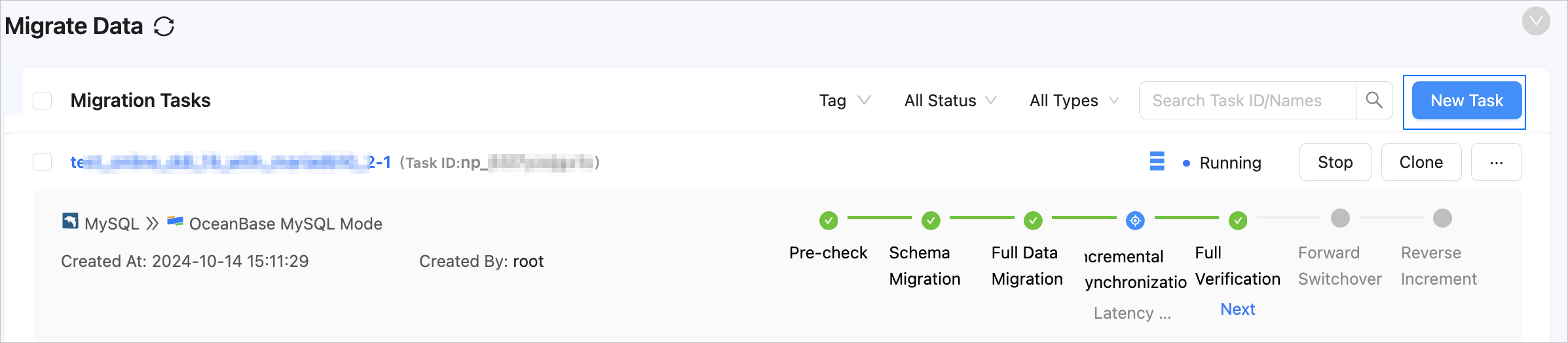
Log in to the OMS console.
In the left-side navigation pane, click Data Migration.
On the Data Migration page, click New Task in the upper-right corner.
On the Select Source and Target page, configure the parameters.
ParameterDescriptionData Migration Task Name We recommend that you set it to a combination of digits and letters. It must not contain any spaces and cannot exceed 64 characters in length. Source If you have created an Oracle data source, select it from the drop-down list. If not, click New Data Source in the drop-down list and create one in the dialog box that appears on the right. For more information about the parameters, see Create an Oracle data source. Target If you have created a data source for the MySQL-compatible tenant of OceanBase Database, which can be a physical data source or a public cloud OceanBase data source, select it from the drop-down list. If not, click New Data Source in the drop-down list and create one in the dialog box that appears on the right. For more information about the parameters, see Create a physical OceanBase data source or Create a public cloud OceanBase data source. Tag (Optional) Click the text box and select a tag from the drop-down list. You can also click Manage Tags to create, modify, and delete tags. For more information, see Use tags to manage data migration tasks. Click Next. On the Select Migration Type page, configure the parameters.

Options for Migration Type are Schema Migration, Full Migration, Incremental Synchronization, Full Verification, and Reverse Increment.
Migration typeDescriptionSchema migration The definitions of data objects, such as tables, indexes, constraints, comments, and views, are migrated from the source database to the target database. Temporary tables are automatically filtered out. The limitations on schema migration are as follows: - The data of the NUMERIC type in the MySQL-compatible tenant of OceanBase Database cannot serve as a partitioning key. During schema migration of a partitioned table without a primary key, the data of the NUMBER or INT type in the partitioning column of the Oracle database is converted to data of the NUMERIC type, resulting in an error.
- During schema migration, the data of the TIMESTAMP type (with a precision of 9) in the Oracle database is converted to data of the DATETIME type (with a precision of 6) in the MySQL-compatible tenant of OceanBase Database. Precision loss occurs.
- During schema migration, the data of the BINARY_FLOAT type in the Oracle database is converted to data of the DOUBLE type in the MySQL-compatible tenant of OceanBase Database. Precision loss may occur during reverse increment.
Full migration After a full migration task is started, OMS migrates existing data of tables in the source database to corresponding tables in the target database. If you select Full Migration, we recommend that you use the GATHER_SCHEMA_STATSorGATHER_TABLE_STATSstatement to collect the statistics of the Oracle database before data migration.Incremental synchronization Changed data in the source database is synchronized to the corresponding tables in the target database after an incremental synchronization task starts. Supported data changes are data addition, modification, and deletion.
Options for DML Synchronization in the Incremental Synchronization section includeINSERT,DELETE, andUPDATE. Select the options based on your business needs. For more information, see Configure DDL/DML synchronization.
If the data in all columns in the tables of the Oracle database to be migrated are of a LOB type (BLOB, CLOB, or NCLOB), Incremental Synchronization is not supported.Full verification After the full migration and incremental synchronization are completed, OMS automatically initiates a full verification task to verify the data tables in the source and target databases. - If you select Full Verification, we recommend that you collect the statistics of the Oracle database and the MySQL-compatible tenant of OceanBase Database before full verification. For more information about how to collect statistics of a MySQL-compatible tenant of OceanBase Database, see Manual statistics collection.
- If you have selected Incremental Synchronization but did not select all DML statements in the DML Synchronization section, OMS does not support full verification.
Reverse increment When a reverse increment task starts, OMS migrates the data changed in the target database after the business switchover back to the source database in real time.
Generally, incremental synchronization configurations are reused for reverse increment. You can also customize the configurations for reverse increment as needed. You cannot select Reverse Increment in the following cases:- Multi-table aggregation is enabled.
- Multiple source schemas map to the same target schema.
Click Next. On the Select Migration Objects page, select the migration objects and migration scope.
You can select Specify Objects or Match Rules to specify the migration objects. The following procedure describes how to specify migration objects by using the Specify Objects option. For information about the procedure for specifying migration objects by using the Match Rules option, see Configure matching rules.
Notice
The names of tables to be migrated, as well as the names of columns in the tables, must not contain Chinese characters.
If a database or table name contains double dollar signs ("$$"), you cannot create the migration task.
OMS automatically filters out unsupported objects. For information about the SQL statements for querying objects, see SQL statements for querying database objects.
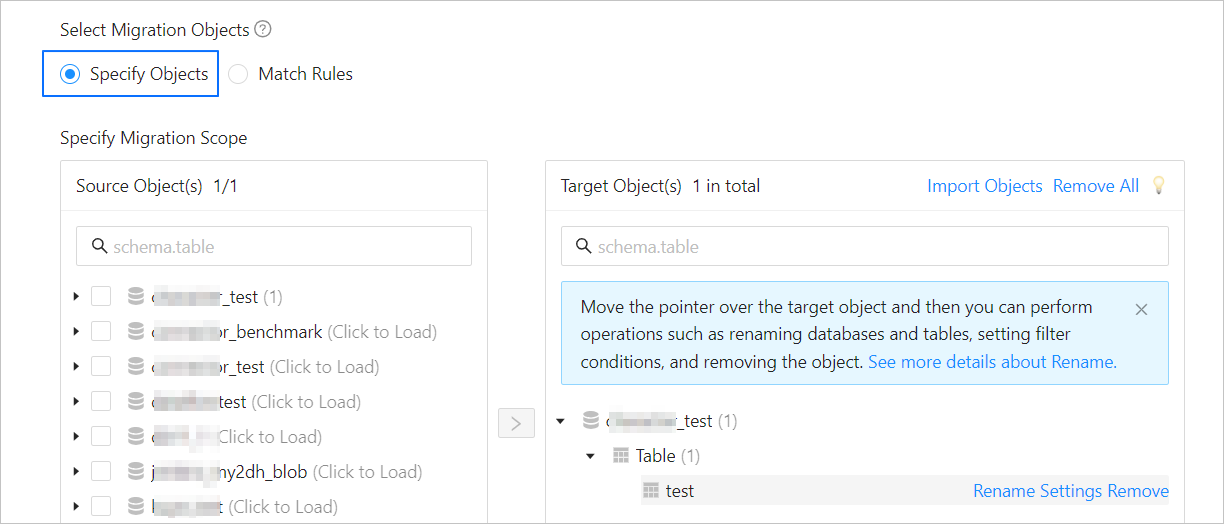
In the Select Migration Objects section, select Specify Objects.
In the Specify Migration Scope section, select the objects to be migrated from the Source Object(s) list. You can select tables and views of one or more databases as the migration objects.
Click > to add the selected objects to the Target Object(s) list.
OMS also allows you to import objects from text, rename objects, set row filters, view column information, and remove a single object or all objects to be migrated.
Note
When you select Match Rules to specify migration objects, object renaming is implemented based on the syntax of the specified matching rules. In the operation area, you can only set filter conditions. For more information, see Configure matching rules.
OperationDescriptionImport objects - In the list on the right of the Specify Migration Scope section, click Import Objects in the upper-right corner.
- In the dialog box that appears, click OK.
Notice
This operation will overwrite previous selections. Proceed with caution. - In the Import Objects dialog box, import the objects to be migrated.
You can import CSV files to rename databases/tables and set row filtering conditions. For more information, see Download and import the settings of migration objects. - Click Validate.
- After the validation succeeds, click OK.
Rename objects OMS allows you to rename migration objects. For more information, see Rename a migration or synchronization object. Configure settings OMS allows you to filter rows by using WHEREconditions. For more information, see Use SQL conditions to filter data.
You can also view column information of the migration objects in the View Column section.Remove one or all objects OMS allows you to remove a single object or all objects to be migrated to the target database during data mapping. - To remove a single migration object:
In the list on the right of the Specify Migration Scope section, move the pointer over the target object and click Remove. - To remove all migration objects:
In the list on the right of the Specify Migration Scope section, click Remove All in the upper-right corner. In the dialog box that appears, click OK.
When the source database is an Oracle database, if row filtering is enabled for columns other than the primary key and unique key columns, enable supplemental logging for the corresponding columns or all columns.
Execute the following statement to enable supplemental logging for the corresponding columns:
ALTER TABLE table_name ADD SUPPLEMENTAL LOG GROUP log_group_name (column1, column2, column3) ALWAYS;Execute the following statement to enable supplemental logging for all columns:
-- Enable database-level supplemental logging:
ALTER DATABASE ADD SUPPLEMENTAL LOG DATA (ALL) COLUMNS;
-- Enable table-level supplemental logging:
ALTER TABLE table_name ADD SUPPLEMENTAL LOG DATA (ALL) COLUMNS;
Click Next. On the Migration Options page, configure the following parameters.
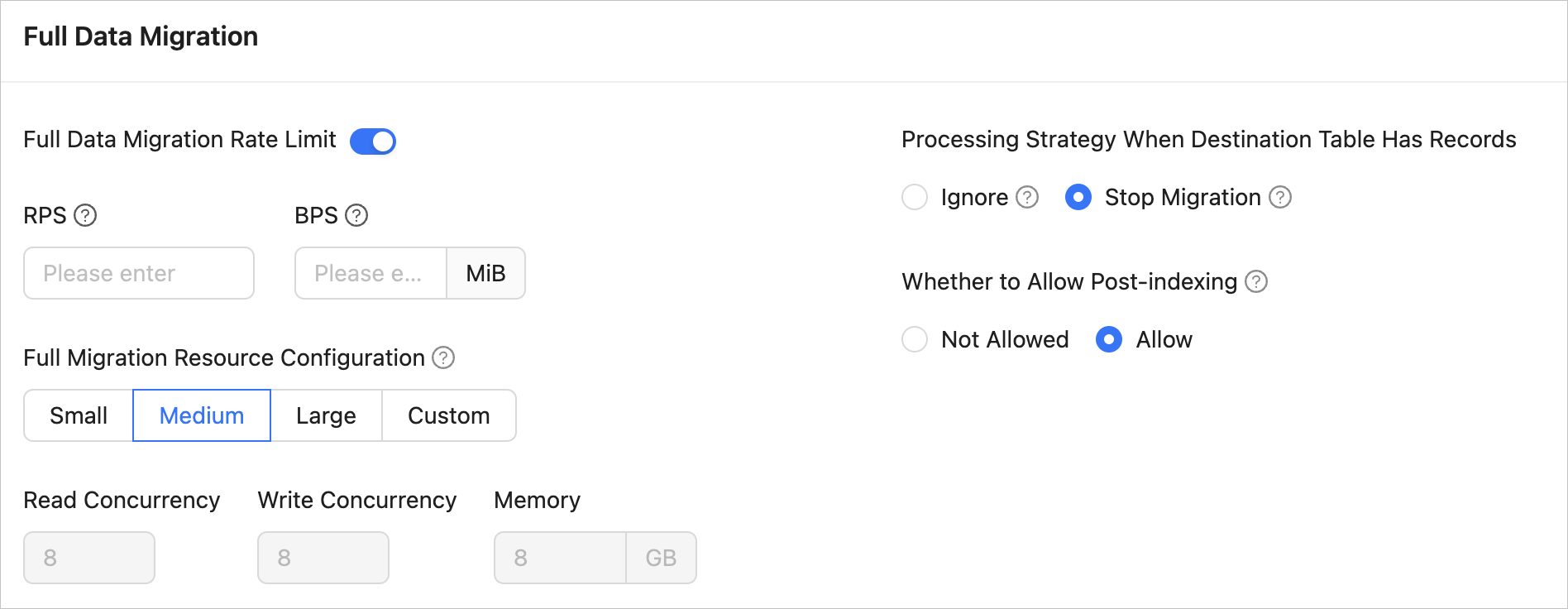
Full migration
The following parameters are displayed only if you have selected Full Migration on the Select Migration Type page.
 ParameterDescription
Full Migration Rate Limit You can choose whether to limit the full migration rate as needed. If you choose to limit the full migration rate, you must specify the records per second (RPS) and bytes per second (BPS). The RPS specifies the maximum number of data rows migrated to the target database per second during full migration, and the BPS specifies the maximum amount of data in bytes migrated to the target database per second during full migration. Note
The RPS and BPS values specified here are only for throttling. The actual full migration performance is subject to factors such as the settings of the source and target databases and the instance specifications.
Full Migration Resource Configuration You can select Small, Medium, or Large to use the corresponding default values of Read Concurrency, Write Concurrency, and Memory. You can also customize the resource configurations for full migration. Through resource configuration for the Full-Import component, you can limit the resource consumption of a task in the full migration stage. Notice
In the case of custom configurations, the minimum value is
1, and only integers are supported.Handle Non-empty Tables in Target Database Valid values: Skip and Stop Migration. - If you select Skip, when the data to be inserted conflicts with the existing data of a target table, OMS retains the existing data and records the conflict data.
Notice
If you select Ignore, data is pulled in IN mode for full verification. In this case, the scenario where the target table contains more data than the source table cannot be verified, and the verification efficiency will be decreased.
- If you select Stop Migration and a target table contains data, an error is returned during full migration, indicating that the migration is not allowed. In this case, you must clear the data in the target table before you can continue with the migration.
Notice
After an error is returned, if you click Resume in the dialog box, OMS ignores this error and continues to migrate data. Proceed with caution.
Post-Indexing Specifies whether to create indexes after the full migration is completed. Post-indexing can shorten the time required for full migration. For more information about the considerations on post-indexing, see the description below. Notice
This feature is supported only if you have selected both Schema Migration and Full Migration on the Select Migration Type page.
- Only non-unique key indexes can be created after the migration is completed.
- OceanBase Database V1.x does not support the post-indexing feature.
If post-indexing is allowed, we recommend that you adjust the parameters based on the hardware conditions of your OceanBase Database and the current business traffic.
If you use OceanBase Database V4.x, adjust the following parameters of the
systenant and business tenants by using a CLI client.Adjust the parameters of the
systenant// parallel_servers_target specifies the queuing conditions for parallel queries on each server. // To maximize performance, we recommend that you set this parameter to a value greater than, for example, 1.5 times, the number of physical CPU cores. In addition, make sure that the value does not exceed 64, to prevent database kernels from contending for locks. set global parallel_servers_target = 64;Adjust the parameters of a business tenant
// Specify the limit on the file memory buffer size.
alter system set _temporary_file_io_area_size = '10' tenant = 'xxx';
// Disable throttling in V4.x.
alter system set sys_bkgd_net_percentage = 100;
If you use OceanBase Database V2.x or V3.x, adjust the following parameters of the
systenant by using a CLI client.// parallel_servers_target specifies the queuing conditions for parallel queries on each server. // To maximize performance, we recommend that you set this parameter to a value greater than, for example, 1.5 times, the number of physical CPU cores. In addition, make sure that the value does not exceed 64, to prevent database kernels from contending for locks. set global parallel_servers_target = 64; // `data_copy_concurrency` specifies the maximum number of concurrent data migration and replication tasks allowed in the system. alter system set data_copy_concurrency = 200;
- If you select Skip, when the data to be inserted conflicts with the existing data of a target table, OMS retains the existing data and records the conflict data.
Incremental synchronization
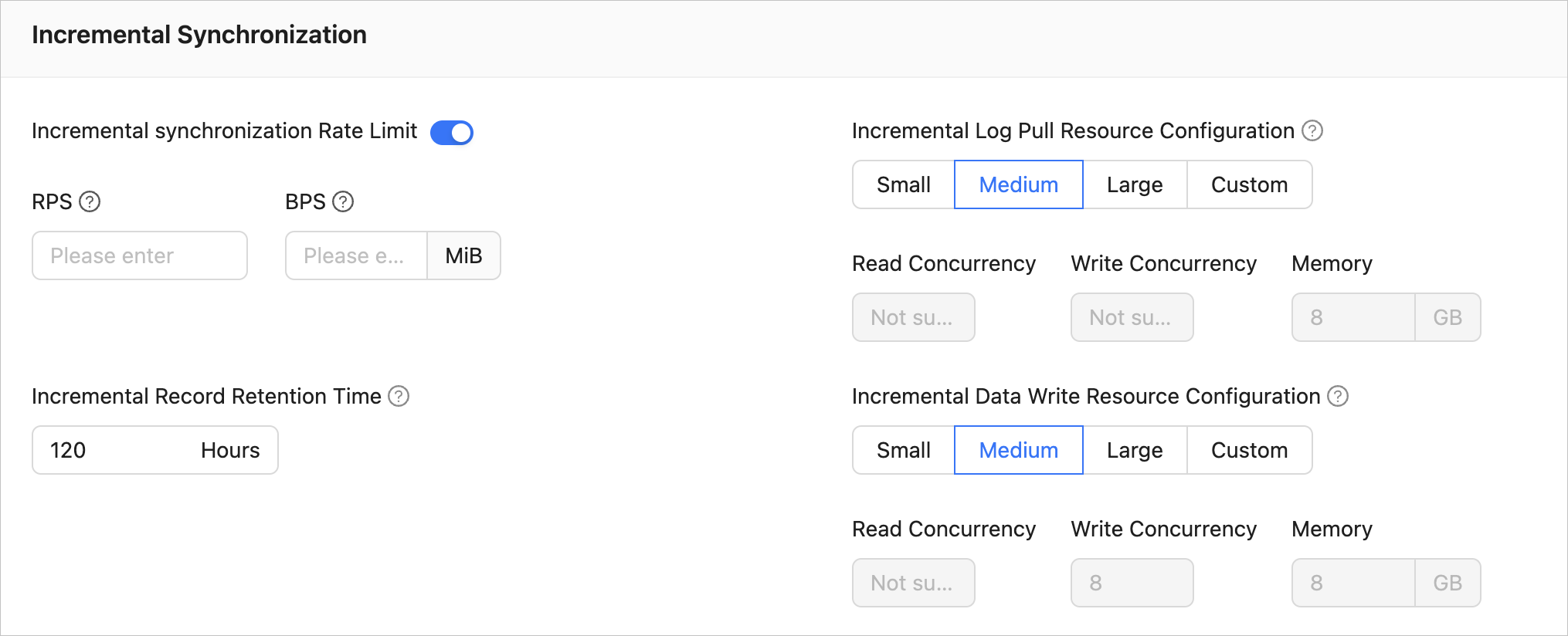
The following parameters are displayed only if you have selected Incremental Synchronization on the Select Migration Type page.
 ParameterDescription
Incremental Synchronization Rate Limit You can choose whether to limit the incremental synchronization rate as needed. If you choose to limit the incremental synchronization rate, you must specify the records per second (RPS) and bytes per second (BPS). The RPS specifies the maximum number of data rows synchronized to the target database per second during incremental synchronization, and the BPS specifies the maximum amount of data in bytes synchronized to the target database per second during incremental synchronization. Note
The RPS and BPS values specified here are only for throttling. The actual incremental synchronization performance is subject to factors such as the settings of the source and target databases and the instance specifications.
Incremental Log Pull Resource Configuration You can select Small, Medium, or Large to use the corresponding default value of Memory. You can also customize the resource configurations for incremental log pull. Through resource configuration for the Store component, you can limit the resource consumption of a task in log pull in the incremental synchronization stage. Notice
In the case of custom configurations, the minimum value is
1, and only integers are supported.Incremental Data Write Resource Configuration You can select Small, Medium, or Large to use the corresponding default values of Write Concurrency and Memory. You can also customize the resource configurations for incremental data writes. Through resource configuration for the Incr-Sync component, you can limit the resource consumption of a task in data writes in the incremental synchronization stage. Notice
In the case of custom configurations, the minimum value is
1, and only integers are supported.Incremental Record Retention Time The duration that incremental parsed files are cached in OMS. A longer retention period results in more disk space occupied by the Store component. Incremental Synchronization Start Timestamp - If you have selected Full Migration as the migration type, this parameter is not displayed.
- If you have selected Incremental Synchronization but not Full Migration, specify a point in time after which the data is to be synchronized. The default value is the current system time. For more information, see Set an incremental synchronization timestamp.
Reverse increment
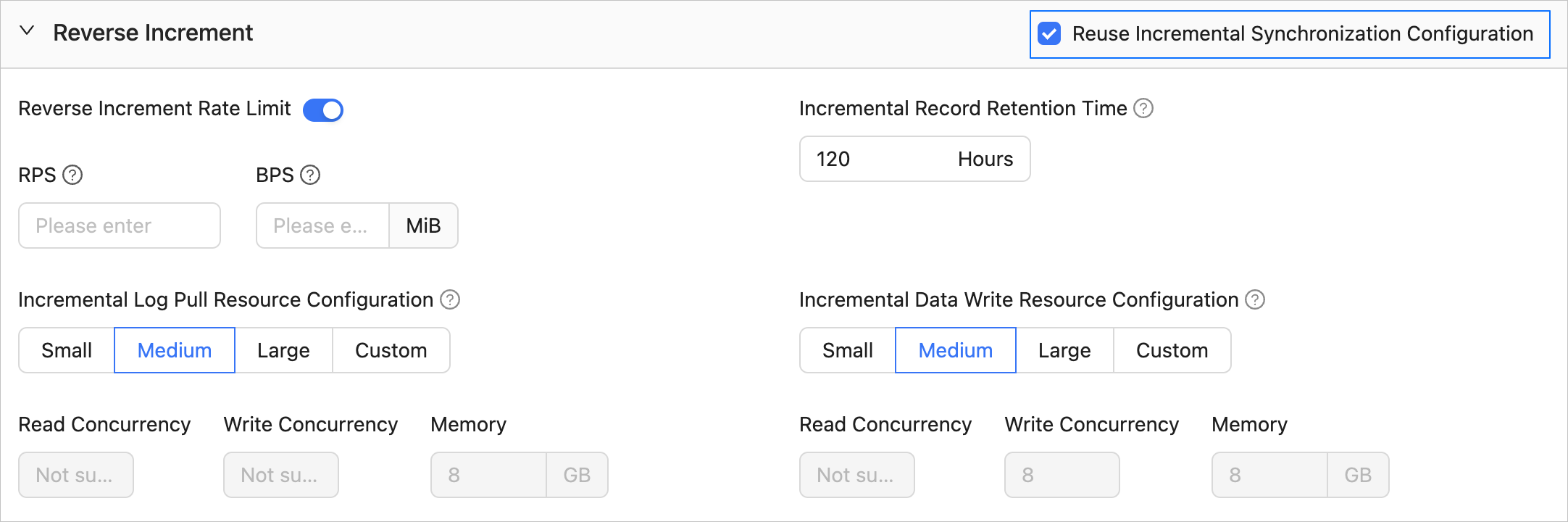
The following parameters are displayed only if you have selected Reverse Increment on the Select Migration Type page. The parameters for reverse increment are consistent with those for incremental synchronization. You can select Reuse Incremental Synchronization Configuration in the upper-right corner.
Full verification
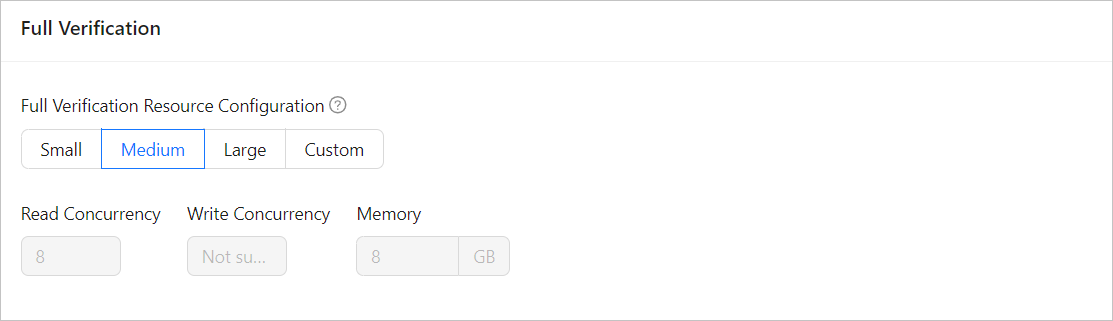
The following parameters are displayed only if you have selected Full Verification on the Select Migration Type page.
 ParameterDescription
Full Verification Resource Configuration You can select Small, Medium, or Large to use the corresponding default values of Read Concurrency and Memory. You can also customize the resource configurations for full verification. Through resource configuration for the Full-Verification component, you can limit the resource consumption of a task in the full verification stage. Notice
In the case of custom configurations, the minimum value is
1, and only integers are supported.Advanced options
This section is displayed only if the target is a MySQL-compatible tenant of OceanBase Database V4.3.0 or later and you have selected Schema Migration on the Select Migration Type page.
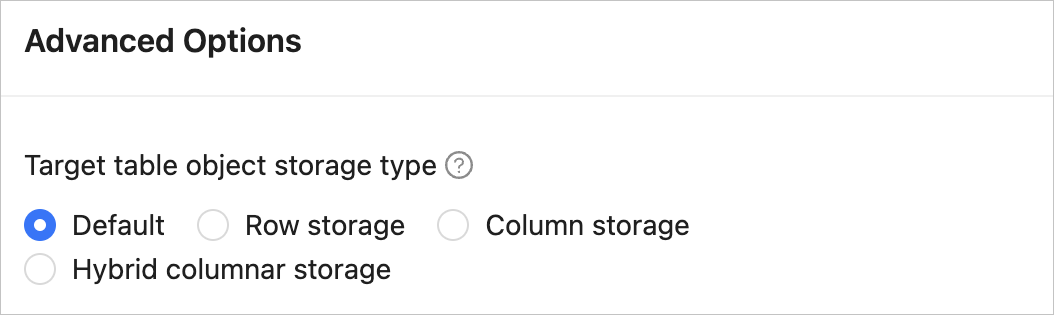
This parameter specifies the storage type for target table objects during schema migration or incremental synchronization. The storage types supported for target table objects are Default, Row storage, Column storage, and Hybrid columnar storage. For more information, see default_table_store_format.
Note
The value Default means that other parameters are automatically set based on the parameter configurations of the target database. Table objects in schema migration are written to corresponding schemas based on the specified storage type.
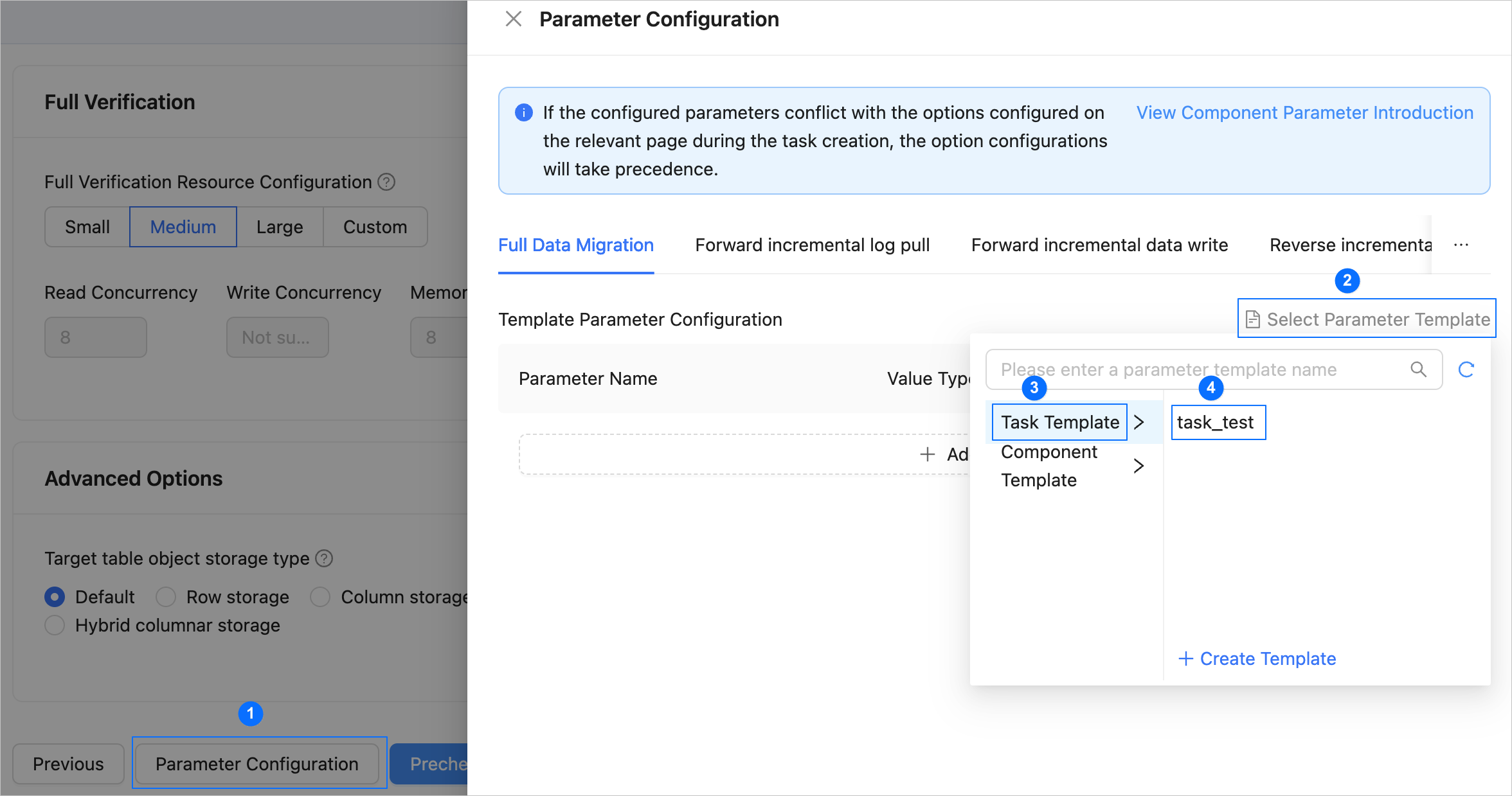
If the parameter settings on the page cannot meet your requirements, you can click Parameter Configuration in the lower part of the page to configure more specific settings. You can also reference an existing task or component template.
Click Precheck to start a precheck on the data migration task.
During the precheck, OMS checks the read and write privileges of the database users and the network connectivity of the databases. A data migration task can be started only after it passes all check items.
Identify and troubleshoot the issue and then perform the precheck again.
Click Skip in the Actions column of a failed precheck item. In the dialog box that prompts the consequences of the operation, click OK.
Click Start Task. If you do not need to start the task now, click Save to go to the details page of the task. You can start the task later as needed.
OMS allows you to modify the migration objects when the data migration task is running. For more information, see View and modify migration objects. After the data migration task is started, it is executed based on the selected migration types. For more information, see the View migration details section in View details of a data migration task.