
This topic describes how to use OceanBase Migration Service (OMS) to migrate data from an Oracle-compatible tenant of OceanBase Database, which can be a physical data source or an ApsaraDB for OceanBase data source, to an Oracle database.
Background information
You can create a data migration task in the OMS console to seamlessly migrate the existing business data and incremental data from an Oracle-compatible tenant of OceanBase Database to an Oracle database through schema migration, full migration, and incremental synchronization.
OMS allows you to merge the data of multiple tables of an Oracle-compatible tenant of OceanBase Database to the same table in an Oracle database without schema migration. You only need to perform full migration and incremental synchronization. The merging and synchronization feature has the following limitations:
For full migration and incremental synchronization, the target table must contain all columns that exist in the source table. Otherwise, OMS returns an error.
The source table must contain a primary key column.
The target table can contain a column that does not exist in the source table.
Prerequisites
You have created the corresponding schema in the target Oracle database.
You have created dedicated database users in the source Oracle-compatible tenant of OceanBase Database and the target Oracle database for data migration and granted the required privileges to the users. For more information, see Create a database user.
If you want to migrate tables without primary keys, create the
__oceanbase_inner_drc_useruser in the corresponding tenant and grant privileges to the user before you perform the data migration task. For more information, see Create the __oceanbase_inner_drc_user user.
Limitations
Limitations on the source database
Do not perform DDL operations that modify database or table schemas during schema migration or full migration. Otherwise, the data migration task may be interrupted.
At present, Oracle Database 10g, 11g, 12c, 18c, and 19c are supported. Oracle Database 12c and later provide container databases (CDBs) and pluggable databases (PDBs).
Incremental data migration is not supported for a table whose data in all columns is of the following three large object (LOB) types: BLOB, CLOB, and NCLOB.
You cannot migrate data from a non-template-based subpartitioned table in an Oracle-compatible tenant of OceanBase Database to an Oracle database.
You can merge only tables with primary keys.
OMS does not support expression-based indexes.
If the target is an Oracle database, OMS does not support triggers in the target database. If triggers exist in the target database, the data migration may fail.
OMS does not support primary keys that contain data of the FLOAT or DOUBLE type.
Data source identifiers and user accounts must be globally unique in OMS.
You cannot create a database object whose name exceeds 30 bytes in length in an Oracle database of version 11g or earlier. When you migrate data from an Oracle-compatible tenant of OceanBase Database to an Oracle database, do not create objects whose names are more than 30 bytes in length in the source database.
OMS supports the migration of only objects whose database name, table name, and column name are ASCII-encoded and do not contain special characters. The special characters are line breaks, spaces, and the following characters:
. | " ' ` ( ) = ; / & \.OMS does not support a standby OceanBase database as the source.
Considerations
Take note of the following considerations for reverse incremental migration from an Oracle-compatible tenant of OceanBase Database to an Oracle database:
When the Oracle database is in standby database only or primary/standby databases mode, if the number of instances that run in the primary Oracle database differs from that in the standby database, incremental logs of some instances may not be pulled. You need to manually set the parameters of the Store component to specify the instances for which incremental logs are to be pulled from the standby database. The procedure is as follows:
Stop the Store component as soon as it starts.
On the Update Configuration page of the Store component, add the
deliver2store.logminer.instance_threadsparameter and specify the instances for which logs are to be pulled.Separate multiple threads with vertical bars (|), for example, 1|2|3. For more information about how to update the Store component, see Archive logs are lost when OMS synchronizes incremental data from a standby Oracle database.
Restart the Store component.
Wait 5 minutes, and then run the
grep 'log entries from' connector/connector.logcommand to check the instances for which logs are pulled. Thethreadfield indicates the instances for which logs are pulled.
If you need to synchronize incremental data from an Oracle database, we recommend that you restrict the size of a single archive file in the Oracle database to within 2 GB. An excessively large archive file may incur the following risks:
The log pulling time increases not in proportion to the size of a single archive file, but much more sharply.
When the Oracle database is in standby database only or primary/standby databases mode, the incremental data is pulled from the standby database. In this case, only archive files can be pulled. An archive file is pulled after it is generated. A larger archive file means a longer delay before the archive file is processed, and a longer time for processing the archive file.
A larger size of a single archive file means larger memory required by the Store component under the same data pulling concurrency.
The archive files must be stored for more than two days in the Oracle database. Otherwise, in the case of a sharp increase in the number of archive files or an exception in the Store component, restoration may fail due to the lack of required archive files.
OMS can parse up to 5 TB of incremental logs of Oracle databases per day.
In a task for migrating data from an Oracle-compatible tenant of OceanBase Database to an Oracle database of version 12c or later, OMS does not support the migration of database objects, such as schemas, tables, and columns, whose names exceed 30 bytes in length in the reverse incremental migration step. For more information about how to migrate a database object whose name exceeds 30 bytes in length, see How do I migrate an Oracle database object whose name exceeds 30 bytes in length?
OMS does not support some
UPDATEstatements in the Oracle database. For example, the followingUPDATEstatement is not supported:UPDATE TABLE_NAME SET KEY=KEY+1;In the preceding example,
TABLE_NAMEis the table name, andKEYis a primary key column of the NUMERIC type.If a table does not have a primary key but contains data of a LOB type, the reverse incremental migration of the table can suffer poor data quality.
If you use OceanBase Database V4.x, we recommend that you enable log archiving. If you enable log archiving, OMS implements incremental synchronization by consuming archive logs after clogs are recycled. For more information about how to enable log archiving, see Preparations.
If the UTF-8 character set is used in the source database, we recommend that you use a compatible character set, such as UTF-8 or UTF-16, in the target database to avoid garbled characters.
If the clocks between nodes or between the client and the server are out of synchronization, the latency may be inaccurate during incremental synchronization or reverse incremental migration.
For example, if the clock is earlier than the standard time, the latency can be negative. If the clock is later than the standard time, the latency can be positive.
When the Oracle database and the Oracle-compatible tenant of OceanBase Database use different character sets, the field length varies based on the type of the data migration task.
To migrate data from a table without a primary key, you must add a hidden column to the target table. However, if the version of the target Oracle database is earlier than 12c, you must add a non-hidden column to the target table.
OMS does not support the migration of tables without primary keys when OceanBase Database is of a version earlier than V2.2.30.
A table containing a primary key or a non-null unique key, which must not be a function-based unique key, is considered a table with a primary key.
If the source OceanBase Database is of a version earlier than V2.2.77 or a source table contains a function-based unique key on a virtual column, OMS may fail to accurately identify whether the table contains a function-based unique key, which may lead to misjudgment of the table with a primary key. This may slow down full migration and full verification and cause data inconsistency in incremental synchronization.
If the source table contains the OMS_PK_INCRMT field, the Java Database Connectivity (JDBC) connector exits when a DML operation is performed during incremental synchronization of the table. The incremental synchronization process is interrupted and cannot be recovered.
In a task for migrating data from an Oracle-compatible tenant of OceanBase Database of a version earlier than V3.2.x to an Oracle database, if the source table is a multi-partition table with a global unique index and you update the values of the partitioning key of the table, data may be lost during migration.
When DDL synchronization is disabled, if you change the unique index in the target database, you must restart the Incr-Sync component. Otherwise, the data may be inconsistent.
If forward switchover is disabled for a data migration task, drop the unique indexes and pseudocolumns from the target database. If you do not drop the unique indexes and pseudocolumns, data cannot be written, and pseudocolumns will be generated again when data is imported to the downstream system, causing conflicts with the pseudocolumns in the source database.
If forward switchover is enabled for the data migration task, OMS automatically drops hidden columns and unique indexes based on the type of the migration task. For more information, see Hidden column mechanisms.
Take note of the following considerations if you want to perform data merge migration:
We recommend that you configure the mappings between the source and target databases by specifying matching rules.
We recommend that you manually create schemas in the target database. If you use OMS to create schemas, skip failed objects in the schema migration step.
Check the objects in the recycle bin of the Oracle-compatible tenant of OceanBase Database. If the recycle bin contains more than 100 objects, internal table queries may time out. You must clear the objects in the recycle bin.
Query whether the recycle bin is enabled.
SELECT Value FROM V$parameter WHERE Name = 'recyclebin';Query the number of objects in the recycle bin.
SELECT count(*) FROM RECYCLEBIN;
If you skip the "source-primary-database ROW_MOVEMENT check" precheck item during the migration, data inconsistency is expected during the synchronization of a table whose
ROW_MOVEMENTvalue isenable.In a data migration task where the source is OceanBase Database and DDL synchronization is enabled, if a
RENAMEoperation is performed on a table in the source database, we recommend that you restart the task to avoid data loss during incremental synchronization.If you select only Incremental Synchronization when you create the data migration task, OMS requires that the archive logs in the source database be retained for more than 48 hours.
If you select Full Migration and Incremental Synchronization when you create the data migration task, OMS requires that the archive logs in the source database be retained for at least 7 days. Otherwise, the data migration task may fail or the data in the source and target databases may be inconsistent because OMS cannot obtain incremental logs.
If the source and target table objects differ only in capitalization of their names, the data migration result may not be as expected because the object names in the source and target databases are case-insensitive.
Data type mappings
Oracle-compatible tenant of OceanBase Database |
Oracle database |
|---|---|
| CHAR(n CHAR) | CHAR(n CHAR) |
| CHAR(n BYTE) | CHAR(n BYTE) |
| NCHAR(n) | NCHAR(n) |
| NCHAR(n BYTE) | NCHAR(n) |
| VARCHAR2(n) | VARCHAR2(n) |
| NVARCHAR2(n) | NVARCHAR2(n) |
| NVARCHAR2(n BYTE) | NVARCHAR2(n) |
| NUMBER(n) | NUMBER(n) |
| NUMBER(p, s) | NUMBER(p,s) |
| RAW | RAW |
| CLOB | CLOB |
| BLOB | BLOB |
| FLOAT(n) | FLOAT (n) |
| BINARY_FLOAT | BINARY_FLOAT |
| BINARY_DOUBLE | BINARY_DOUBLE |
| DATE | DATE |
| TIMESTAMP | TIMESTAMP |
| TIMESTAMP WITH TIME ZONE | TIMESTAMP WITH TIME ZONE |
| TIMESTAMP WITH LOCAL TIME ZONE | TIMESTAMP WITH LOCAL TIME ZONE |
| INTERVAL YEAR(p) TO MONTH | INTERVAL YEAR(p) TO MONTH |
| INTERVAL DAY(p) TO SECOND | INTERVAL DAY(p) TO SECOND |
| ROWID | ROWID Notice This data type is supported only for Oracle-compatible tenants of OceanBase Database V2.2.70 and later. |
| UROWID | UROWID Notice This data type is supported only for Oracle-compatible tenants of OceanBase Database V2.2.70 and later. |
Procedure
Create a data migration task.
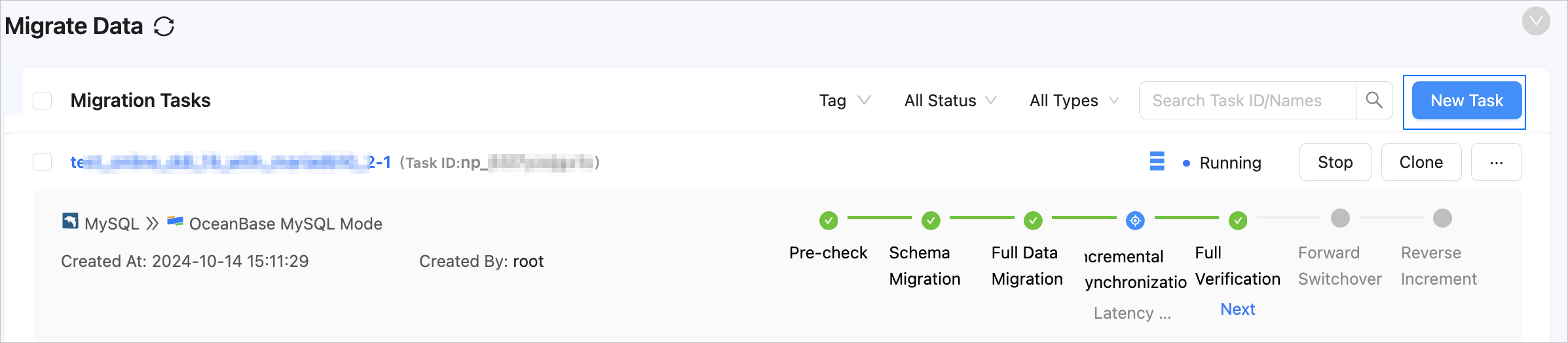
Log in to the OMS console.
In the left-side navigation pane, click Data Migration.
On the Data Migration page, click Create Migration Task in the upper-right corner.
On the Select Source and Target page, configure the parameters.
ParameterDescriptionData Migration Task Name We recommend that you set it to a combination of digits and letters. It must not contain any spaces and cannot exceed 64 characters in length. Source If you have created a data source for the Oracle-compatible tenant of OceanBase Database, which can be a physical data source or an ApsaraDB for OceanBase data source, select it from the drop-down list. If not, click New Data Source in the drop-down list and create one in the dialog box that appears on the right. For more information about the parameters, see Create a physical OceanBase data source or Create an ApsaraDB for OceanBase data source. Target If you have created an Oracle data source, select it from the drop-down list. If not, click New Data Source in the drop-down list and create one in the dialog box that appears on the right. For more information about the parameters, see Create an Oracle data source.
You can select an Oracle data source in primary database only mode or primary/standby databases mode. An Oracle data source in standby database only mode cannot serve as the target for data migration. This topic uses a data source in primary/standby databases mode as an example.Tag (Optional) Click the field and select a tag from the drop-down list. You can also click Manage Tags to create, modify, and delete tags. For more information, see Use tags to manage data migration tasks. Click Next. On the Select Migration Type page, configure the parameters.

Options for Migration Type are Schema Migration, Full Migration, Incremental Synchronization, Full Verification, and Reverse Increment.
Migration typeDescriptionSchema migration The definitions of data objects, such as tables, indexes, constraints, comments, and views, are migrated from the source database to the target database. Temporary tables are automatically filtered out. Full migration After a full migration task is started, OMS migrates existing data of tables in the source database to corresponding tables in the target database. If you select Full Migration, we recommend that you collect the statistics of the Oracle-compatible tenant of OceanBase Database before the data migration. For more information, see Manual statistics collection. Incremental synchronization Changed data in the source database is synchronized to the corresponding tables in the target database after an incremental synchronization task starts. Supported data changes are data addition, modification, and deletion.
Options for Incremental Synchronization are DML Synchronization and DDL Synchronization. Select the options based on your business needs. For more information, see Configure DDL/DML synchronization. Incremental Synchronization has the following limitations:- If the source and target databases use different character sets, OMS does not support modifications of schema fields.
- If you select DDL Synchronization, when you perform a DDL operation that cannot be synchronized by OMS in the source database, data migration may be interrupted.
- If the DDL operation creates a new column, we recommend that you set the column to NULL. Otherwise, data migration may be interrupted.
Full verification After the full migration and incremental synchronization are completed, OMS automatically initiates a full verification task to verify the data tables in the source and target databases. - If you select Full Verification, we recommend that you collect the statistics of the Oracle-compatible tenant of OceanBase Database and use the
GATHER_SCHEMA_STATSorGATHER_TABLE_STATSstatement to collect the statistics of the Oracle database before full verification. - If you have selected Incremental Synchronization but did not select all DML statements in the DML Synchronization section, OMS does not support full verification.
Reverse incremental migration When a reverse incremental migration task starts, OMS migrates the data changed in the target database after the business switchover back to the source database in real time.
Generally, incremental synchronization configurations are reused for reverse incremental migration. You can also customize the configurations for reverse incremental migration as needed. You cannot select Reverse Increment in the following cases:- Data merge migration that involves multiple tables is enabled.
- Multiple source schemas map to the same target schema.
(Optional) Click Next.
If you have selected Schema Migration or Incremental Synchronization without configuring the required parameters for the source Oracle-compatible tenant of OceanBase Database, the More About Data Sources dialog box appears, prompting you to configure the parameters. For more information about the parameters, see Create a physical OceanBase data source or Create an ApsaraDB for OceanBase data source.
After you configure the parameters, click Test Connection. After the test succeeds, click OK.
Click Next. On the Select Migration Objects page, select the migration objects and migration scope.
You can select Specify Objects or Match Rules to specify the migration objects. The following procedure describes how to specify migration objects by using the Specify Objects option. For information about the procedure for specifying migration objects by using the Match Rules option, see the Configure matching rules for data migration/synchronization from a database to a Message Queue instance section in the Configure matching rules topic.
Notice
The names of tables to be migrated, as well as the names of columns in the tables, must not contain Chinese characters.
If a database or table name contains double dollar signs ("$$"), you cannot create the migration task.
If you have selected DDL Synchronization in the Select Migration Type step, we recommend that you select Match Rules to specify migration objects. This way, all new objects that meet the specified rules will be synchronized. If you select Specify Objects to specify migration objects, new or renamed objects will not be synchronized.
OMS automatically filters out unsupported objects. For information about the SQL statements for querying objects, see SQL statements for querying database objects.
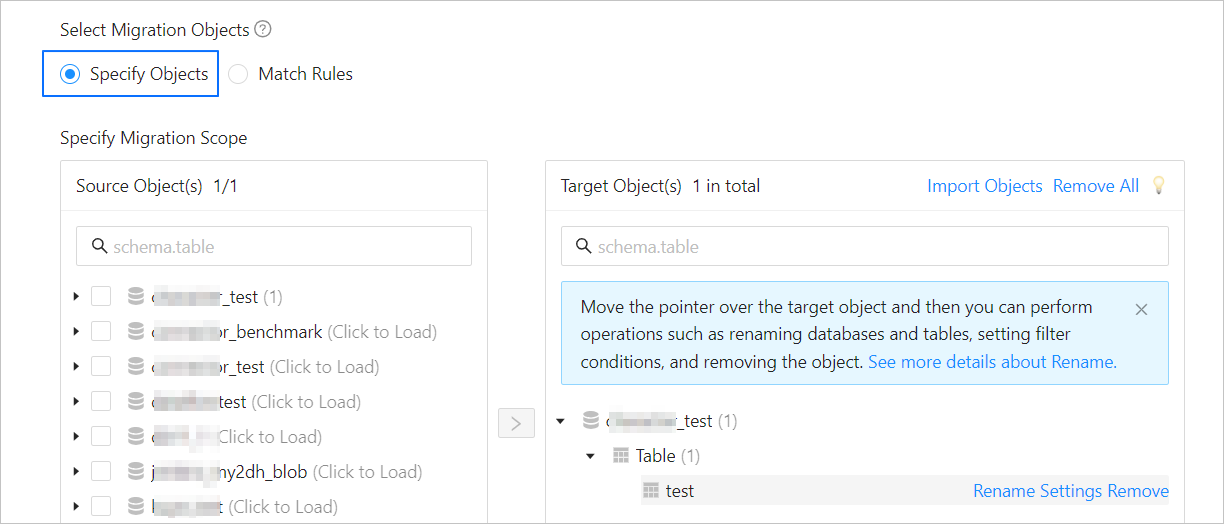
In the Select Migration Objects section, select Specify Objects.
In the Specify Migration Scope section, select the objects to be migrated from the Source Object(s) list. You can select tables and views of one or more databases as the migration objects.
Click > to add the selected objects to the Target Object(s) list.
OMS also allows you to import objects from text, rename objects, set row filters, view column information, and remove a single object or all objects to be migrated.
Note
When you select Match Rules to specify migration objects, object renaming is implemented based on the syntax of the specified matching rules. In the operation area, you can only set filter conditions. For more information, see Configure matching rules.
OperationDescriptionImport objects - In the list on the right of the Specify Migration Scope section, click Import Objects in the upper-right corner.
- In the dialog box that appears, click OK.
Notice
This operation will overwrite previous selections. Proceed with caution. - In the Import Objects dialog box, import the objects to be migrated.
You can import CSV files to rename databases/tables and set row filter conditions. For more information, see Download and import the settings of migration objects. - Click Validate.
- After the validation succeeds, click OK.
Rename objects OMS allows you to rename migration objects. For more information, see Rename a migration or synchronization object. Configure settings OMS allows you to filter rows by using WHEREconditions. For more information, see Use SQL conditions to filter data.
You can also view column information of the migration objects in the View Column section.Remove one or all objects OMS allows you to remove a single object or all objects to be migrated to the target database during data mapping. - To remove a single migration object:
In the list on the right of the Specify Migration Scope section, move the pointer over the target object and click Remove. - To remove all migration objects:
In the list on the right of the Specify Migration Scope section, click Remove All in the upper-right corner. In the dialog box that appears, click OK.
Click Next. On the Migration Options page, configure the following parameters.
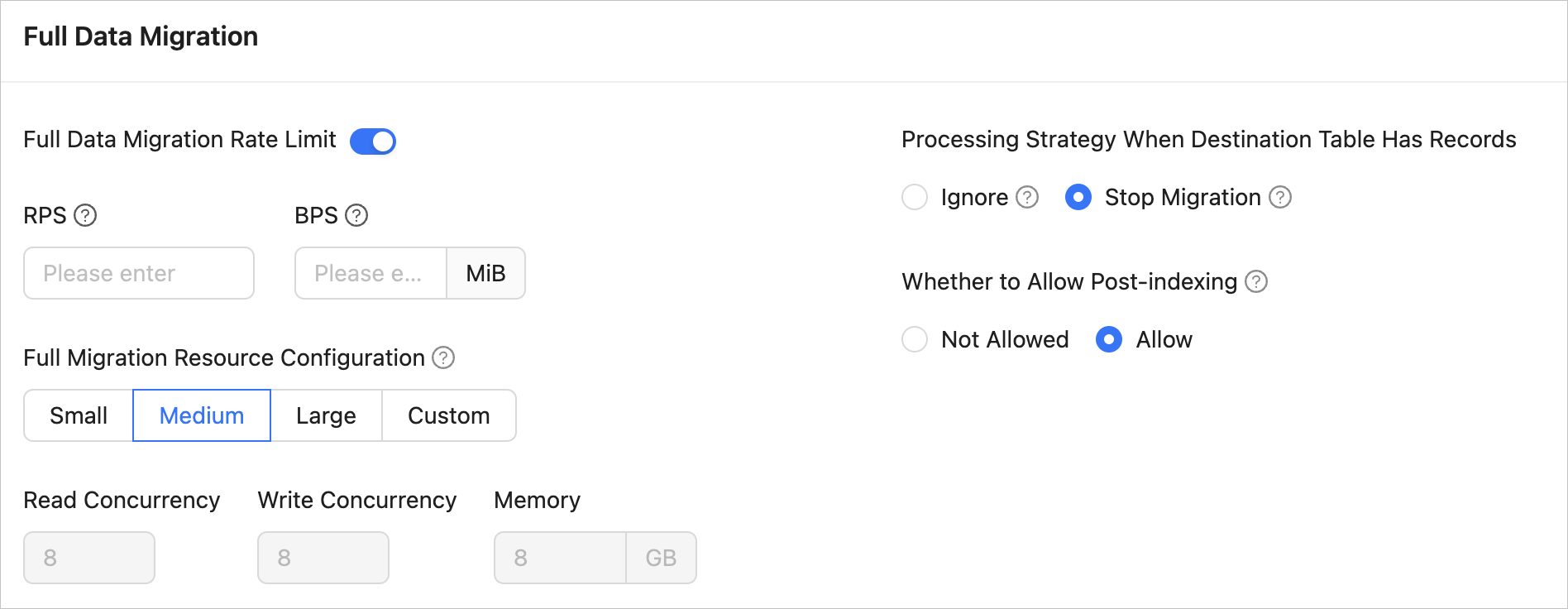
Full migration
The following parameters are displayed only if you have selected Full Migration on the Select Migration Type page.
 ParameterDescription
Full Migration Rate Limit You can choose whether to limit the full migration rate as needed. If you choose to limit the full migration rate, you must specify the records per second (RPS) and bytes per second (BPS). The RPS specifies the maximum number of data rows migrated to the target database per second during full migration, and the BPS specifies the maximum amount of data in bytes migrated to the target database per second during full migration. Note
The RPS and BPS values specified here are only for throttling. The actual full migration performance is subject to factors such as the settings of the source and target databases and the instance specifications.
Full Migration Resource Configuration You can select Small, Medium, or Large to use the corresponding default values of Read Concurrency, Write Concurrency, and Memory. You can also customize the resource configurations for full migration. Through resource configuration for the Full-Import component, you can limit the resource consumption of a task in the full migration phase. Notice
In the case of custom configurations, the minimum value is
1, and only integers are supported.Processing Strategy When Target Table Has Records Valid values are Ignore and Stop Migration. - If you select Ignore, when the data to be inserted conflicts with the existing data of a target table, OMS retains the existing data and records the conflict data.
Notice
If you select Ignore, data is pulled in IN mode for full verification. In this case, the scenario where the target table contains more data than the source table cannot be verified, and the verification efficiency will be decreased.
- If you select Stop Migration and a target table contains data, an error is returned during full migration, indicating that the migration is not allowed. In this case, you must clear the data in the target table before you can continue with the migration.
Notice
After an error is returned, if you click Resume in the dialog box, OMS ignores this error and continues to migrate data. Proceed with caution.
Whether to Allow Post-indexing Specifies whether to create indexes after the full migration is completed. Post-indexing can shorten the time required for full migration. For more information about the considerations on post-indexing, see the description below. Notice
This feature is supported only if you have selected both Schema Migration and Full Migration on the Select Migration Type page.
- Only non-unique key indexes can be created after the migration is completed.
- OceanBase Database V1.x does not support the post-indexing feature.
If post-indexing is allowed, we recommend that you adjust the parameters based on the hardware conditions of your OceanBase Database and the current business traffic.
If you use OceanBase Database V4.x, adjust the following parameters of the
systenant and business tenants by using a CLI client.Adjust the parameters of the
systenant// parallel_servers_target specifies the queuing conditions for parallel queries on each server. // To maximize performance, we recommend that you set this parameter to a value greater than, for example, 1.5 times, the number of physical CPU cores. In addition, make sure that the value does not exceed 64, to prevent database kernels from contending for locks. set global parallel_servers_target = 64;Adjust the parameters of a business tenant
// Specify the limit on the file memory buffer size.
alter system set _temporary_file_io_area_size = '10' tenant = 'xxx';
// Disable throttling in V4.x.
alter system set sys_bkgd_net_percentage = 100;
If you use OceanBase Database V2.x or V3.x, adjust the following parameters of the
systenant by using a CLI client.// parallel_servers_target specifies the queuing conditions for parallel queries on each server. // To maximize performance, we recommend that you set this parameter to a value greater than, for example, 1.5 times, the number of physical CPU cores. In addition, make sure that the value does not exceed 64, to prevent database kernels from contending for locks. set global parallel_servers_target = 64; // data_copy_concurrency specifies the maximum number of concurrent data migration and replication tasks allowed in the system. alter system set data_copy_concurrency = 200;
- If you select Ignore, when the data to be inserted conflicts with the existing data of a target table, OMS retains the existing data and records the conflict data.
Incremental synchronization
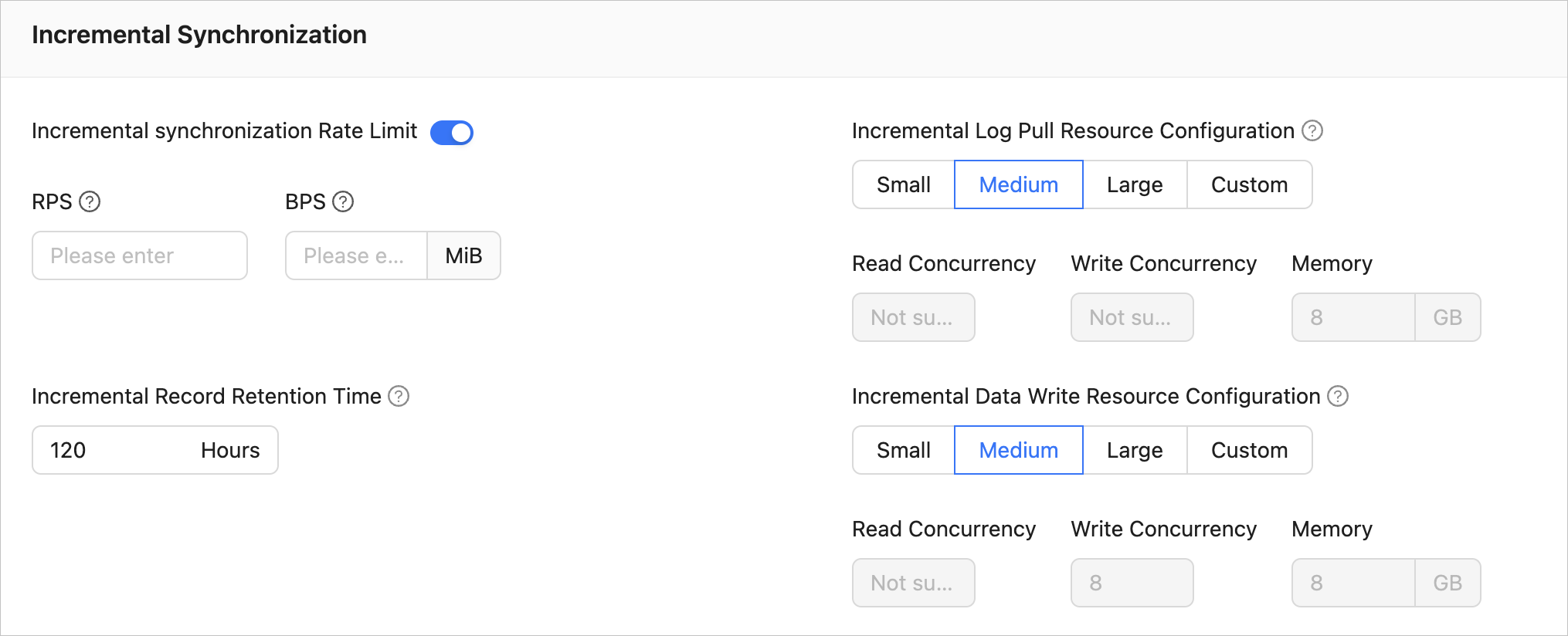
The following parameters are displayed only if you have selected Incremental Synchronization on the Select Migration Type page.
 ParameterDescription
Incremental Synchronization Rate Limit You can choose whether to limit the incremental synchronization rate as needed. If you choose to limit the incremental synchronization rate, you must specify the RPS and BPS. The RPS specifies the maximum number of data rows synchronized to the target database per second during incremental synchronization, and the BPS specifies the maximum amount of data in bytes synchronized to the target database per second during incremental synchronization. Note
The RPS and BPS values specified here are only for throttling. The actual incremental synchronization performance is subject to factors such as the settings of the source and target databases and the instance specifications.
Incremental Log Pull Resource Configuration You can select Small, Medium, or Large to use the corresponding default value of Memory. You can also customize the resource configurations for incremental log pull. Through resource configuration for the Store component, you can limit the resource consumption of a task in log pull in the incremental synchronization phase. Notice
In the case of custom configurations, the minimum value is
1, and only integers are supported.Incremental Data Write Resource Configuration You can select Small, Medium, or Large to use the corresponding default values of Write Concurrency and Memory. You can also customize the resource configurations for incremental data write. Through resource configuration for the Incr-Sync component, you can limit the resource consumption of a task in data writes in the incremental synchronization phase. Notice
In the case of custom configurations, the minimum value is
1, and only integers are supported.Incremental Record Retention Time The duration that incremental parsed files are cached in OMS. A longer retention period results in more disk space occupied by the Store component. Incremental Synchronization Start Timestamp - If you have set the migration type to Full Migration, this parameter is not displayed.
- If you have selected Incremental Synchronization but not Full Migration, specify a point in time after which the data is to be synchronized. The default value is the current system time. For more information, see Set an incremental synchronization timestamp.
Reverse incremental migration
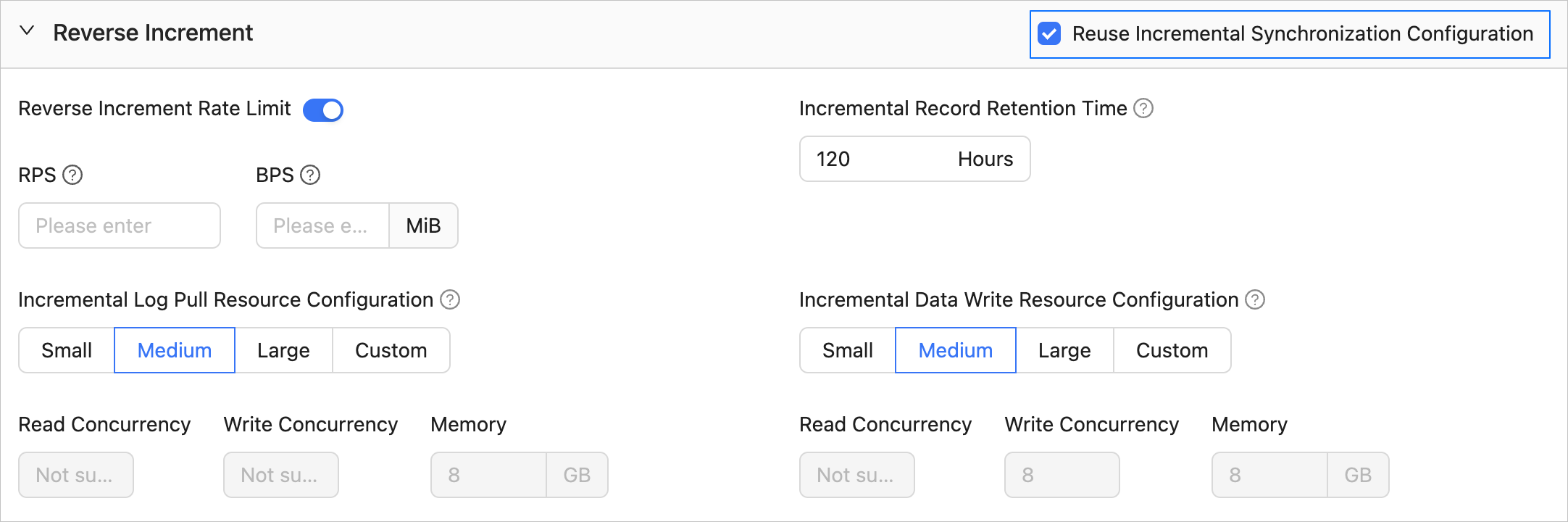
The following parameters are displayed only if you have selected Reverse Increment on the Select Migration Type page. The parameters for reverse incremental migration are consistent with those for incremental synchronization. You can select Reuse Incremental Synchronization Configuration in the upper-right corner.
Full verification
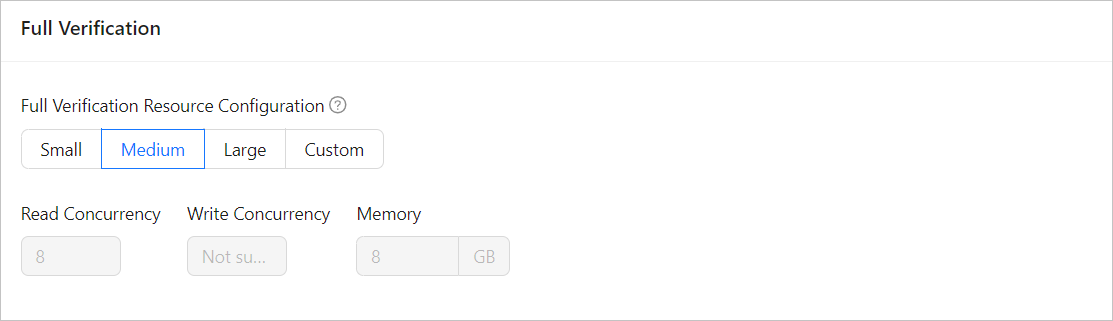
The following parameters are displayed only if you have selected Full Verification on the Select Migration Type page.
 ParameterDescription
Full Verification Resource Configuration You can select Small, Medium, or Large to use the corresponding default values of Read Concurrency and Memory. You can also customize the resource configurations for full verification. Through resource configuration for the Full-Verification component, you can limit the resource consumption of a task in the full verification phase. Notice
In the case of custom configurations, the minimum value is
1, and only integers are supported.Advanced options
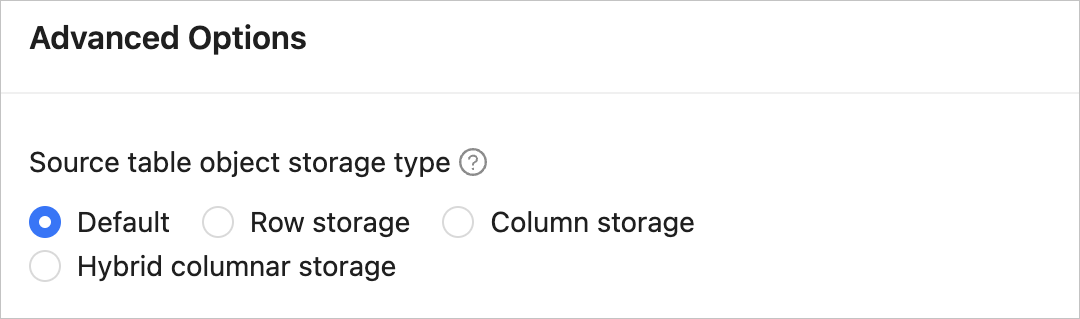
This section is displayed only if the source is an Oracle-compatible tenant of OceanBase Database V4.3.0 or later and you have selected DDL Synchronization for Reverse Increment on the Select Migration Type page.
This parameter specifies the storage type for source table objects during reverse incremental synchronization. The storage types supported for source table objects are Default, Row storage, Column storage, and Hybrid columnar storage. For more information, see default_table_store_format.
Note
The value Default means that other parameters are automatically set based on the parameter configurations of the target database. For new table objects in reverse incremental DDL synchronization, the schemas are subject to the specified storage type.
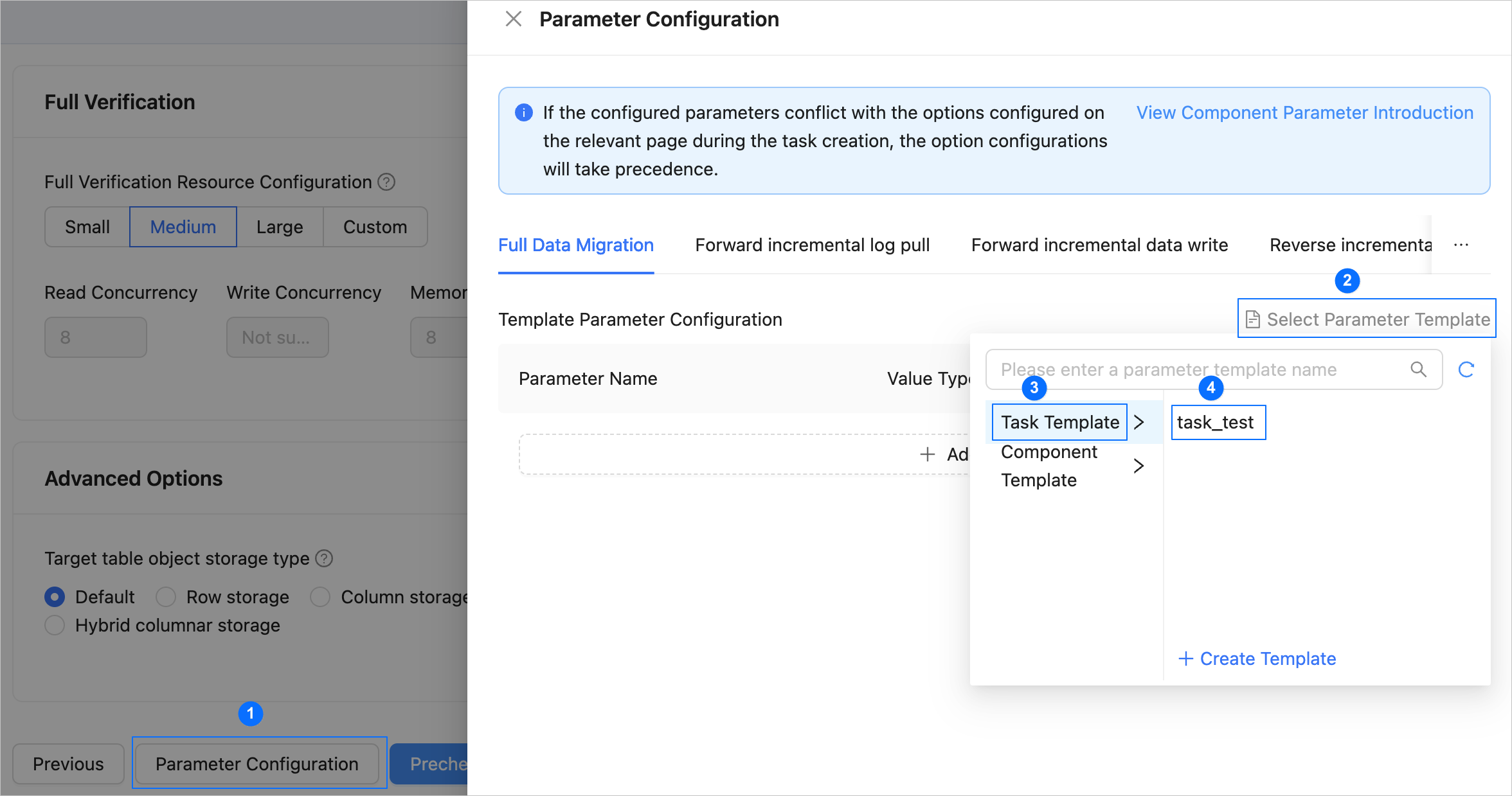
If the parameter settings on the page cannot meet your requirements, you can click Parameter Configuration in the lower part of the page to configure more specific settings. You can also reference an existing task or component template.
Click Precheck to start a precheck on the data migration task.
During the precheck, OMS checks the read and write privileges of the database users and the network connectivity of the databases. A data migration task can be started only after it passes all check items. If an error is returned during the precheck, you can perform the following operations:
Identify and troubleshoot the problem and then perform the precheck again.
Click Skip in the Actions column of a failed precheck item. In the dialog box that prompts the consequences of the operation, click OK.
Click Start Task. If you do not need to start the task now, click Save to go to the details page of the task. You can start the task later as needed.
OMS allows you to modify the migration objects when the data migration task is running. For more information, see View and modify migration objects. After the data migration task is started, it is be executed based on the selected migration types. For more information, see the View migration details section in the View details of a data migration task topic.