OceanBase
English日本語简体中文
ドキュメントホーム
製品
エコシステム
リリース

データベース

OceanBase CloudOceanBaseデータベース

ツール

OceanBase Cloud PlatformOceanBase移行サービス(OMS)OceanBaseデベロッパーセンターOceanBase Admin Tool

データベース

OceanBase CloudOceanBaseデータベース

ツール

OceanBase Cloud PlatformOceanBase移行サービス(OMS)OceanBaseデベロッパーセンターOceanBase Admin Tool
OceanBase CloudOceanBaseデータベース

OceanBase移行サービス(OMS)

V4.3.3Enterprise Edition
  • OMSドキュメント
  • OMSの概要
    • OMSの概要
    • 用語解説
    • OMS高可用性(HA)の紹介
    • Storeの原理
    • Full-Import/Incr-Syncデータ転送の原理
    • データ検証の原理について
    • システムアーキテクチャ
      • アーキテクチャ概要
      • 機能アーキテクチャ
      • コンポーネントの基本原理
    • OMS Oracle 全量移行の設計原理と影響
    • 制限事項
  • クイックスタート
    • データ移行プロセス
    • データ同期プロセス
  • OMSのデプロイ
    • デプロイメントタイプ
    • システムとネットワーク要件
    • メモリとディスク要件
    • 環境の準備
    • シングルノードデプロイ
    • 単一リージョン・マルチノード構成
    • 複数リージョン・複数ノードへのデプロイ
    • スケールアウトデプロイメント
    • スケールインのデプロイ
    • デプロイ状態の確認
    • (オプション)時系列データベースのデプロイ
  • 管理コンソール
    • OMSコンソールへのログイン
    • マネジメントコンソールの紹介
    • 個人設定
      • 個人情報の設定
      • ログインパスワードの変更
      • ログアウト
  • データ移行
    • データ移行の概要
    • MySQLデータベースのデータをOceanBaseデータベースのMySQL互換モードに移行する
    • OceanBaseデータベースのMySQL互換モードのデータをMySQLデータベースに移行する
    • OracleデータベースのデータをOceanBaseデータベースのMySQL互換モードに移行する
    • OceanBaseデータベースのOracle互換モードのデータをOracleデータベースに移行する
    • OracleデータベースのデータをOceanBaseデータベースのOracle互換モードに移行する
    • DB2 LUWデータベースのデータをOceanBaseデータベースのOracle互換モードに移行する
    • OceanBaseデータベースのOracle互換モードのデータをDB2 LUWデータベースに移行する
    • DB2 LUWデータベースのデータをOceanBaseデータベースのMySQL互換モードに移行する
    • OceanBaseデータベースのMySQL互換モードのデータをDB2 LUWデータベースに移行する
    • OceanBaseデータベース間のデータ移行
    • 双方向同期タスクの設定
    • TiDBデータベースのデータをOceanBaseデータベースのMySQL互換モードに移行する
    • PostgreSQLデータベースのデータをOceanBaseデータベースのOracle互換モードに移行する
    • PostgreSQLデータベースのデータをOceanBaseデータベースのMySQL互換モードに移行する
    • PolarDB-X 1.0データベースのデータをOceanBaseデータベースのMySQL互換モードに移行する
    • MilvusデータベースのデータをOceanBaseデータベースのMySQL互換モードに移行する
    • OBShardingデータベースのデータをOceanBaseデータベースのMySQL互換モードに移行する
    • OceanBaseデータベースのOracle互換モードからMySQLデータベースへの増分データ移行
    • データ移行タスクの管理
      • データ移行タスクの詳細を表示する
      • データ移行タスクの名前を変更する
      • 移行対象オブジェクトの表示と変更
      • タグを使用したデータ移行タスクの管理
      • データ移行タスクの一括操作
      • 移行対象オブジェクト設定のダウンロードとインポート
      • 移行パラメータ設定の確認と変更
      • 競合ログファイルのダウンロード
      • データ移行タスクの開始と一時停止
      • データ移行タスクの終了と削除
    • DDL同期のサポート範囲と制限事項
      • MySQLデータベースからOceanBaseデータベースのMySQL互換モードへのDDL同期
        • MySQLデータベースからOceanBaseデータベースのMySQL互換モードへのDDL同期の概要
        • テーブルの作成 CREATE TABLE
          • テーブルの作成
          • 列の作成
          • インデックスまたは制約の作成
          • パーティションの作成
        • データ型の変換
        • テーブルの変更 ALTER TABLE
          • テーブルの変更
          • フィールド操作
          • 制約とインデックスの操作
          • パーティション操作
        • テーブルの全行削除 TRUNCATE TABLE
        • テーブルの名前変更 RENAME TABLE
        • テーブルの削除 DROP TABLE
        • インデックスの作成 CREATE INDEX
        • インデックスの削除 DROP INDEX
        • MySQLデータベースとOceanBaseデータベースのMySQL互換モード間のDDLの非互換点
          • 非互換点の概要
          • CREATE TABLEの非互換点
            • CREATE TABLEの非互換点
            • インデックスまたは制約でサポートされるフィールドタイプ
          • ALTER TABLEの非互換点
            • ALTER TABLEの非互換点
            • 制約のある列の型の変更
            • 制約のない列の型の変更
            • 制約のある列の長さの変更
            • 制約のない列の長さの変更
            • 制約を持つ列の削除
          • インデックスの削除DROP INDEXの非互換点
      • OceanBaseデータベースのMySQL互換モードからMySQLデータベースへのDDL同期
      • OracleデータベースからOceanBaseデータベースのOracle互換モードへのDDL同期
        • OracleデータベースからOceanBaseデータベースのOracle互換モードへのDDL同期の概要
        • テーブルの作成 CREATE TABLE
          • テーブル作成の概要
          • リレーショナルテーブルの作成
            • リレーショナルテーブルの作成
            • リレーショナルテーブルの列定義
          • 仮想列
          • 通常列
          • パーティションの作成
            • パーティションの概要
            • パーティション
            • サブパーティション
            • 複合パーティション
            • カスタムパーティション
            • サブパーティションテンプレート
          • 制約
            • 制約の概要
            • 行内制約
            • 行外制約
        • インデックスの作成 CREATE INDEX
          • インデックス作成の概要
          • 通常のテーブルインデックス
        • テーブルの変更 ALTER TABLE
          • テーブル変更の概要
          • テーブル属性の変更、削除、追加
          • 列属性の管理
            • 列属性の変更、削除、追加
            • 列名の変更
            • 列と列属性の追加
            • 列属性の変更
            • 列の削除操作
          • 制約の変更、削除、追加
          • パーティションの管理
            • パーティションの変更、削除、追加
            • パーティションの削除
            • サブパーティションの削除
            • パーティションとサブパーティションの追加
            • パーティションの変更
            • パーティションデータの削除
        • テーブルの削除 DROP TABLE
        • 名前の変更 RENAME OBJECT
        • テーブルの全行削除 TRUNCATE TABLE
        • インデックスの削除 DROP INDEX
        • OracleデータベースとOceanBaseデータベースのOracle互換モード間のDDLの非互換点
          • 非互換点の概要
          • CREATE TABLEの非互換点
          • ALTER TABLEの非互換点
            • ALTER TABLEの非互換点
            • 制約のある列の型の変更
            • 制約のない列の型の変更
            • 制約のある列の長さの変更
            • 制約のない列の長さの変更
      • OceanBaseデータベースのOracle互換モードからOracleデータベースへのDDL同期
      • DB2 LUWデータベースからOceanBaseデータベースのOracle互換モードへのDDL同期
      • OceanBaseデータベースのOracle互換モードからDB2 LUWデータベースへのDDL同期
      • DB2 LUWデータベースからOceanBaseデータベースのMySQL互換モードへのDDL同期
      • OceanBaseデータベースのMySQL互換モードからDB2 LUWデータベースへのDDL同期
      • OceanBaseデータベースのMySQL互換モード間でのDDL同期
      • OceanBaseデータベースのOracle互換モード間でのDDL同期
      • PostgreSQLデータベースからOceanBaseデータベースのMySQL互換モードへのDDL同期
      • PostgreSQLデータベースからOceanBaseデータベースのOracle互換モードへのDDL同期
      • OBShardingデータベースからOceanBaseデータベースのMySQL互換モードへのDDL同期
  • データ同期
    • データ同期の概要
    • OceanBaseデータベースのデータをKafkaに同期する
    • OceanBaseデータベースのデータをRocketMQに同期する
    • OceanBaseデータベースのデータをDataHubに同期する
    • OceanBaseデータベースのデータをSwiftに同期する
    • ODPの論理テーブルデータをOceanBaseデータベースのMySQL互換モードの物理テーブルに同期する
    • ODPの論理テーブルデータをDataHubに同期する
    • IDBの論理テーブルデータをOceanBaseデータベースのMySQL互換モードに同期する
    • IDBの論理テーブルデータをDataHubに同期する
    • MySQLデータベースのデータをDataHubに同期する
    • OracleデータベースのデータをDataHubに同期する
    • OBShardingデータベースのデータをKafkaに同期する
    • データ同期タスクの管理
      • データ同期タスクの詳細を表示する
      • データ同期タスクの名前を変更する
      • 同期オブジェクトの表示と変更
      • タグを使用したデータ同期タスクの管理
      • データ同期タスクの一括操作
      • 同期対象設定のダウンロードとインポート
      • 同期パラメータ設定の確認と変更
      • データ同期タスクの開始と一時停止
      • データ同期タスクの終了と削除
  • データ検証
    • データ検証の概要
    • データ検証タスクの新規作成
    • データ検証タスクの管理
      • データ検証タスクの詳細を表示する
      • データ検証タスクの名前を変更する
      • 検証オブジェクトの表示と変更
      • 検証パラメータの確認と変更
      • タグを使用したデータ検証タスクの管理
      • 検証オブジェクトのインポート
      • データ検証タスクの開始、一時停止、および再開
      • データ検証タスクのクローン
      • データ検証タスクの削除
  • データソースの作成と管理
    • データソースの作成
      • OceanBaseデータソースの作成
        • OceanBase物理データソースの作成
        • ODPデータソースの作成
        • IDBデータソースの作成
        • OceanBaseパブリッククラウドデータソースの作成
        • OceanBase単一マシンデータソースの作成
      • MySQLデータソースの作成
      • Oracleデータソースの作成
      • TiDBデータソースの新規作成
      • Milvusデータソースの新規作成
      • Kafkaデータソースの作成
      • RocketMQデータソースの作成
      • DataHubデータソースの新規作成
      • Swiftデータソースの作成
      • DB2 LUWデータソースの作成
      • PostgreSQLデータソースの作成
      • PolarDB-X 1.0データソースの新規作成
      • OBShardingデータソースの作成
    • データソースの管理
      • データソース情報の表示
      • データソースのコピー
      • データソースの編集
      • データソースの削除
    • データベースユーザーの作成
    • ユーザー権限の説明
    • MySQLデータベースでBinlogを有効にする
    • ソース側Oracleデータベースの最小権限
  • 運用監視
    • 運用概要
    • 概要ページにアクセスする
    • マシン
      • マシン情報の表示
      • マシンの追加
      • マシンの削除
      • Quotaの更新
      • マシンのログを表示する
      • リソースグループの管理
    • コンポーネント
      • Store
        • Storeの追加
        • Storeコンポーネントの詳細を表示する
        • Storeコンポーネントの更新
        • Storeコンポーネントの起動と一時停止
        • Storeコンポーネントの削除
      • Incr-Sync
        • Incr-Syncコンポーネントの詳細を表示する
        • Incr-Syncコンポーネントの起動と一時停止
        • Incr-Syncコンポーネントの移行
        • Incr-Syncコンポーネントの更新
        • バッチ運用保守
        • Incr-Syncコンポーネントの削除
      • Full-Import
        • Full-Importコンポーネントの詳細を表示する
        • Full-Importコンポーネントの一時停止
        • Full-Importコンポーネントの再実行と再開
        • Full-Importコンポーネントの更新
        • Full-Importコンポーネントの削除
      • Full-Verification
        • Full-Verificationコンポーネントの詳細を表示する
        • Full-Verificationコンポーネントの一時停止
        • Full-Verificationコンポーネントの再実行と再開
        • Full-Verificationコンポーネントの更新
      • Incr-Verification
        • Incr-Verificationコンポーネントの詳細を表示する
        • Incr-Verificationコンポーネントの一時停止
        • Incr-Verificationコンポーネントの再実行と再開
        • Incr-Verificationコンポーネントの更新
      • Row-Verification
        • Row-Verificationコンポーネントの詳細を表示する
    • 運用管理タスク
      • オペレーションタスクの表示
      • タスクまたはサブタスクのスキップ
      • タスクまたはサブタスクの再試行
    • パラメータテンプレート
      • 概要
      • タスクテンプレート
        • タスクテンプレートの作成
        • タスクテンプレートの表示と編集
        • タスクテンプレートのコピーとエクスポート
        • タスクテンプレートの削除
      • コンポーネントテンプレート
        • コンポーネントテンプレートの作成
        • コンポーネントテンプレートの表示と編集
        • コンポーネントテンプレートのコピーとエクスポート
        • コンポーネントテンプレートの削除
      • コンポーネントパラメータの説明
        • Storeコンポーネントのパラメータ説明
        • Incr-Syncコンポーネントのパラメータ説明
        • Full-Importコンポーネントのパラメータ説明
        • Full-Verificationコンポーネントのパラメータ説明
        • Incr-Verificationコンポーネントのパラメータ説明
        • Row-Verificationコンポーネントのパラメータ説明
        • CMコンポーネントパラメータ説明
        • Supervisorコンポーネントのパラメータ説明
  • システム管理
    • 権限管理
      • 権限管理の概要
      • ユーザー管理
      • 部門管理
    • アラート管理
      • タスクのアラート情報を表示する
      • システムアラート情報の表示
      • アラート設定
    • OCPの関連付け
    • システムパラメータ
      • システムパラメータの変更
      • 高可用性機能の設定を変更する
      • oblogproxyパラメータの説明
    • キーの管理
    • 操作監査
  • トラブルシューティングガイド
    • OMSサービスの管理
    • OMSログのトラブルシューティング
    • コンポーネントの運用
      • Supervisorコンポーネントの運用
      • Connectorのコマンドライン操作インターフェース
      • Storeコンポーネントの運用
    • コンポーネントのチューニング
      • Incr-Sync/Full-Importのチューニング
      • Oracle Storeのチューニング
    • スロットリングとレート制限の設定方法
    • Storeコンポーネントのパフォーマンス診断について
  • リファレンスガイド
    • 機能紹介
      • DDL/DMLのカスタム設定
      • DDL同期範囲
      • データベース・テーブルの名前変更
      • SQL条件によるデータのフィルタリング
      • 増分同期の開始タイムスタンプの設定
      • 移行または同期オブジェクトのマッチングルールの設定
      • 検証対象のマッチングルールを設定する
      • ワイルドカード規則の説明
      • データ移行サービスの隠し列メカニズムについて
      • 構造移行操作の説明
      • ハートビートテーブルの作成と更新
      • Topicの変更
      • 列フィルタリングと列マッピング
      • データ形式の説明
    • APIリファレンス
      • 概要
      • タスクの作成
      • タスクの開始
      • タスクの一時停止
      • タスクの再開
      • タスクの解放
      • タスクの削除
      • タスクリストのページ単位の取得
      • タスクの詳細を照会する
      • タスクのステップの詳細を照会する
      • タスクのステップメトリクスの照会
      • タスクの進捗状況を照会する
      • タスクのコンポーネント情報を照会する
      • タスクの全量検証結果を照会する
      • 指定したラベルが付いた開始されていないすべてのタスクを開始する
      • 指定したラベルが付いた実行中のすべてのタスクを一時停止する
      • MySQLデータソースの作成
      • OceanBaseデータソースの作成
      • ODPデータソースの作成
      • PolarDB-X 1.0データソースの作成
      • Milvusデータソースの作成
      • データソースリストの取得
      • ラベルの作成
      • ラベルリストの取得
      • データソースの削除
      • 転送オブジェクトの変更
      • タスクの変更履歴を照会する
      • 変更操作の中止
      • 変更操作の再試行
      • 変更のキャンセル
      • タスクの事前チェック
      • 事前チェック結果の取得
      • タスク設定の更新
      • テーブル構造変換情報のダウンロード
      • 競合ログファイルのダウンロード
      • 競合ログファイルリストの取得
      • 正逆方向の増分同期の同期ポイントを変更する
      • タスクの実行を進める
      • リージョンリストの取得
      • ユーザーの作成
      • ユーザーの削除
      • ユーザー詳細の取得
      • 部門リストの取得
      • Kafka認証ファイルのアップロード
      • Kafkaデータソースの作成
      • DB2 LUWデータソースの作成
    • アラートリファレンス
      • oms_host_down OMSマシンダウンアラート
      • oms_host_down_migrate_resource OMSマシンダウン時の移行アラート
      • oms_host_threshold OMSマシンのしきい値アラート
      • oms_migration_failed 移行タスク失敗
      • oms_migration_delay 移行タスクの遅延
      • oms_sync_failed 同期タスクの失敗
      • oms_sync_status_inconsistent 同期タスクの状態が一致しない
      • oms_sync_delay 同期タスクの遅延
    • シングルサインオン
      • OMSにOIDCプロトコルを接続してシングルサインオンを実現する
      • OMSがSAML 2.0プロトコルに接続してシングルサインオンを実装する
      • OMS SAML 2.0によるMicrosoft Entra IDへのアクセス
    • OMSエラーコード
    • データベースオブジェクトのクエリ
    • トリガーの作成
    • PostgreSQLデータベースインスタンスのログレベルを変更する
    • Online DDLツールへの対応について
    • Oracleデータベースの補足ログに関する説明
    • Milvusトピックの設定
  • アップグレードガイド
    • 概要
    • シングルノードでのアップグレード
    • 複数ノードでのアップグレード
    • よくある質問
  • リリースノート
    • リリースノート
      • バージョン番号ルール
      • V4.3
        • OMS V4.3.3
        • OMS V4.3.2
        • OMS V4.3.1
        • OMS V4.3.0
      • V4.2
        • OMS V4.2.5
        • OMS V4.2.4
        • OMS V4.2.3
        • OMS V4.2.2
        • OMS V4.2.1
        • OMS V4.2.0
      • V4.1
        • OMS V4.1.0
      • V4.0
        • OMS V4.0.2
        • OMS V4.0.1
      • V3.4
        • OMS V3.4.0
      • V3.3
        • OMS V3.3.1
        • OMS V3.3.0
      • V3.2
        • OMS V3.2.2
        • OMS V3.2.1
      • V3.1
        • OMS V3.1.0
      • V2.1
        • OMS V2.1.2
        • OMS V2.1.0

PDF をダウンロード

このページには現在中国語/日本語版がなく、英語版を表示しています。
ドキュメントフィードバック
  1. ドキュメントセンター
  2. OceanBase移行サービス(OMS)
  3. V4.3.3

Migrate incremental data from an Oracle tenant of OceanBase Database to a MySQL database

最終更新:2026-10-09 03:34:20

Prerequisites
Limitations
Considerations
Procedure

This topic describes how to use OceanBase Migration Service (OMS) to migrate incremental data from an Oracle tenant of OceanBase Database, which can be a physical data source or an ApsaraDB for OceanBase data source, to a MySQL database.

Prerequisites

  • You have created dedicated database users for data migration in the Oracle tenant of OceanBase Database and the MySQL database, and granted required privileges to the users. For more information, see Create a database user.

  • You have created data sources for the source and destination. For more information, see Create an OceanBase data source and Create a MySQL data source.

Limitations

  • At present, MySQL 5.5, 5.6, 5.7, and 8.0 are supported.

  • OMS does not support the migration of tables without primary keys from an Oracle tenant of OceanBase Database to a MySQL database.

  • If the destination is a database, OMS does not support triggers in the destination database. If triggers exist in the destination database, the data migration may fail.

  • OMS supports the migration of only objects whose database name, table name, and column name are ASCII-encoded and do not contain special characters. The special characters are spaces, line breaks, and the following characters: . | " ' ` ( ) = ; / & \.

  • OMS does not support a standby OceanBase database as the source.

Considerations

  • If you use OceanBase Database V4.x, we recommend that you enable log archiving. If you enable log archiving, OMS implements incremental synchronization by consuming archive logs after clogs are recycled. For more information about how to enable log archiving, see the Log archive chapter.

  • If the UTF-8 character set is used in the source, we recommend that you use a compatible character set, such as UTF-8 or UTF-16, in the destination to avoid garbled characters.

  • If the clocks between nodes or between the client and the server are out of synchronization, the latency may be inaccurate during incremental synchronization.

    For example, if the clock is earlier than the standard time, the latency can be negative. If the clock is later than the standard time, the latency can be positive.

  • In a project for migrating data from an Oracle tenant of OceanBase Database of a version earlier than V3.2.x to a MySQL database, if the source table is a multi-partition table with a global unique index and you update the values of the partitioning key of the table, data may be lost during migration.

  • If you change the unique index in the destination, you must restart the data migration project to avoid data inconsistency.

  • A difference between the source and destination table schemas may result in data consistency. Some known scenarios are described as follows:

    • When you manually create a table schema at the destination, if the data types of any columns are not supported by OMS, implicit data type conversion may occur at the destination, which causes inconsistent column types between the source and destination.

    • If the length of a column at the destination is shorter than that at the source, the data of this column may be automatically truncated, which causes data inconsistency between the source and destination.

  • If you select only Incremental Synchronization when you create a data migration project, OMS requires that the local incremental logs in the source database be retained for more than 48 hours.

Procedure

  1. Create a data migration project.

    migration-1-en

    1. Log on to the OMS console.

    2. In the left-side navigation pane, click Data Migration.

    3. On the Data Migration page, click Create Migration Project in the upper-right corner.

  2. On the Select Source and Destination page, configure the parameters.

    Parameter
    Description
    Migration Project Name We recommend that you set it to a combination of digits and letters. It must not contain any spaces and cannot exceed 64 characters in length.
    Tag (Optional) Click the field and select a target tag from the drop-down list. You can also click Manage Tags to create, modify, and delete tags. For more information, see Use tags to manage data migration projects.
    Source If you have created a data source for the Oracle tenant of OceanBase Database, which can be a physical data source or an ApsaraDB for OceanBase data source, select it from the drop-down list. If not, click New Data Source in the drop-down list and create one in the dialog box that appears on the right. For more information about the parameters, see Create a physical OceanBase data source or Create a public cloud OceanBase data source.
    Destination If you have created a MySQL data source, select it from the drop-down list. If not, click New Data Source in the drop-down list and create one in the dialog box that appears on the right. For more information about the parameters, see Create a MySQL data source.
  3. Click Next.

  4. On the Select Migration Type page, specify the migration type for the migration project.

    At present, only DML Synchronization is supported for Incremental Synchronization. For more information, see DML filtering.

  5. On the Select Migration Objects page, select the migration objects.

    You can select Specify Objects or Match Rules to specify the migration objects.

    • Select Specify Objects. Then select the objects to be migrated on the left and click > to add them to the list on the right. You can select tables and views of one or more databases as the migration objects.

      Notice

      • The names of tables to be migrated, as well as the names of columns in the tables, must not contain Chinese characters.

      • If the database or table name contains a double dollar sign ($$), you cannot create the migration project.

      • OMS automatically filters out unsupported tables.

      OMS also allows you to import objects from text, rename objects, set row filters, view column information, and remove a single object or all objects to be migrated.
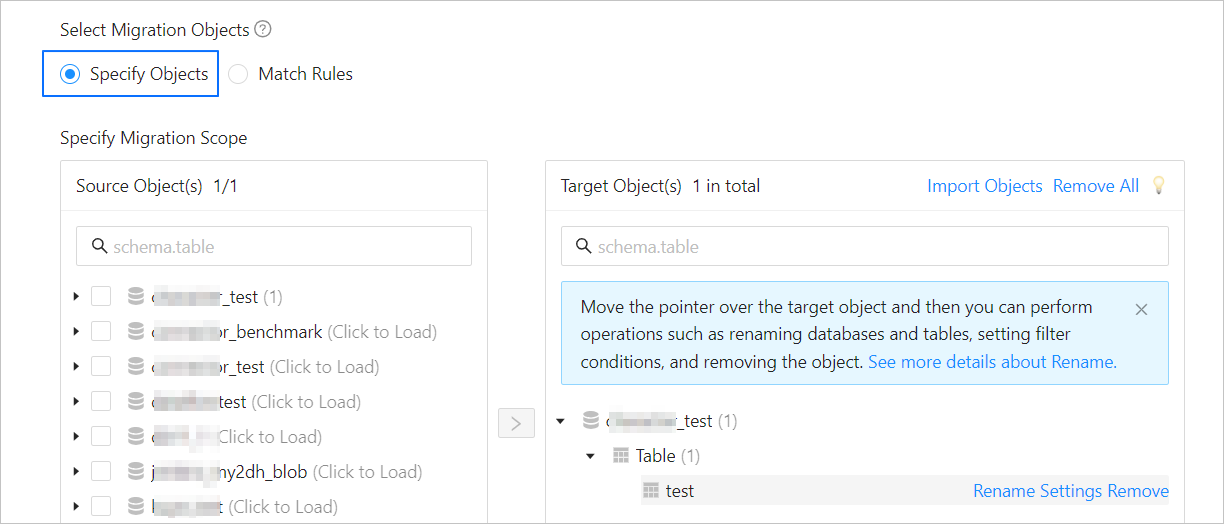
      migration-5-en

      Operation
      Description
      Import objects
      1. In the list on the right of the Specify Migration Scope section, click Import Objects in the upper-right corner.
      2. In the dialog box that appears, click OK.
        Notice
        This operation will overwrite previous selections. Proceed with caution.
      3. In the Import Objects dialog box, import the objects to be migrated.
        You can import CSV files to rename databases/tables and set row filtering conditions. For more information, see Download and import the settings of migration objects.
      4. Click Validate.
      5. After the validation succeeds, click OK.
      Rename objects OMS allows you to rename the migration objects. For more information, see Rename a migration or synchronization object.
      Configure settings OMS allows you to use the WHERE clause to filter rows. For more information, see Use SQL conditions to filter data.
      You can also view column information of the migration object in the View Column section.
      Remove one or all objects During data mapping, OMS allows you to remove one or more selected objects to be migrated or synchronized to the destination.
      • To remove a single migration object:
        In the list on the right of the Specify Migration Scope section, move the pointer over the target object, and click Remove.
      • To remove all migration objects:
        In the list on the right of the Specify Migration Scope section, click Remove All in the upper-right corner. In the dialog box that appears, click OK.
    • Select Match Rules. For more information, see Configure matching rules for migration objects.

  6. Click Next. On the Migration Options page, configure the incremental synchronization parameters.

    Parameter
    Description
    Incremental Log Pull Resource Configuration You can select Small, Medium, or Large to use the corresponding default value of Memory. You can also customize the resource configurations for incremental log pull. Through resource configuration for the Store component, you can limit the resource consumption of a project in log pull in the incremental synchronization phase.

    Notice

    In the case of custom configurations, the minimum value is 1, and only integers are supported.

    Incremental Data Write Resource Configuration You can select Small, Medium, or Large to use the corresponding default values of Write Concurrency and Memory. You can also customize the resource configurations for incremental data write. Through resource configuration for the Incr-Sync component, you can limit the resource consumption of a project in data writes in the incremental synchronization phase.

    Notice

    In the case of custom configurations, the minimum value is 1, and only integers are supported.

    Incremental Record Retention Time The duration that incremental parsed files are cached in OMS. A longer retention period results in more disk space occupied by the Store component.
    Incremental Synchronization Start Timestamp Specify a point in time after which data is to be synchronized. The default value is the current system time. For more information, see Set an incremental synchronization timestamp.
  7. Click Precheck to start a precheck on the data migration project.

    During the precheck, OMS checks the read and write privileges of the database users and the network connections of the databases. The data migration project can be started only after it passes all check items. You can perform one of the following operations if an error is returned during the precheck:

    • Identify and troubleshoot the problem and then perform the precheck again.

    • Click Skip in the Actions column of a failed precheck item. In the dialog box that appears, you can view the prompt for the consequences of the operation and click OK.

  8. Click Start Project. If you do not need to start the project now, click Save to go to the details page of the data migration project. You can start the project later as needed.

    OMS allows you to modify the migration objects when the data migration project is running. For more information, see View and modify migration objects. After a data migration project is started, the migration subtasks will be executed based on the selected migration types. For more information, see the "View migration details" section in the View details of a data migration project topic.

次のトピック

OMSドキュメント
次へ
このページの内容
Prerequisites
Limitations
Considerations
Procedure
