
This topic describes how to use OceanBase Migration Service (OMS) to migrate data from a DB2 LUW database to an Oracle tenant of OceanBase Database, which can be a physical data source or an ApsaraDB for OceanBase data source.
Prerequisites
You have created a corresponding schema in the target Oracle tenant of OceanBase Database.
You must create a corresponding schema in the destination database before migration. OMS will migrate the tables and views to the schema.
You have created dedicated database users in the source DB2 LUW database and the destination Oracle tenant of OceanBase Database for data migration and granted the corresponding privileges to the users. For more information, see Create a database user.
You have enabled archivelog for the DB2 LUW database.
If archivelog is not enabled, perform the following steps:
Connect to the database.
db2 connect to ${db_name}Modify the directory of archived logs.
db2 update db cfg for ${db_name} using LOGARCHMETH1 logpath(${your_logpath})Back up the database.
db2 backup database ${db_name} to dbbackuppath(${your_logpath})Stop the database.
db2stopStart the database.
db2startConnect to the database.
db2 connect to ${db_name}Manually archive logs.
db2 archive log for db ${db_name}View archived logs.
db2 get db cfg|grep LOG
You have enabled Data Changes for the table in the store of the DB2 LUW database.
You can execute the following statement to enable Data Changes:
alter table ${table_name} data capture changesYou have enabled
log_ddl_stmtfor the DB2 LUW database.You can execute the following statement to enable
log_ddl_stmt:db2 update db cfg using LOG_DDL_STMTS YES
Limitations
Limitations on the source database
Do not perform DDL operations that modify database or table schemas during schema migration or full data migration. Otherwise, the data migration project may be interrupted.
DB2 LUW 9.7.x, 10.1, 10.5, 11.1, and 11.5 for Linux and AIX are supported. You can migrate data from DB2 LUW 10.1 to an Oracle tenant of OceanBase Database V2.2.76 and later.
When DB2 LUW 9.7.x serves as the source, DDL synchronization is not supported.
In an ARM CPU architecture, OMS does not support incremental synchronization from a DB2 LUW database to an Oracle tenant of OceanBase Database.
The DB2 LUW database can only parse an object whose name consists of letters, underscores(_), and digits, begins with a letter or underscore, and does not contain a DB2 LUW keyword.
When you migrate data from a DB2 LUW database to an Oracle tenant of OceanBase Database, tables without a UNIQUE constraint cannot be migrated. Only tables with a UNIQUE constraint in the DB2 LUW database can be migrated during full migration and incremental synchronization.
If the destination is a database, OMS does not support triggers in the destination database. If triggers exist in the destination database, the data migration may fail.
A column with a UNIQUE constraint cannot be null. Otherwise, data inconsistency may occur. Multiple null values are allowed in the same column with a UNIQUE constraint in OceanBase Database: null!=null. However, a column with a UNIQUE constraint in the DB2 LUW database cannot be null. A unique index allows null values, but null=null.
For example, the unique (c1, c2) (null, null) index of OceanBase Database can be inserted multiple times, while a UNIQUE constraint of the DB2 LUW database does not allow null values. If a unique index is used, (null, null) can be inserted only once.
Therefore, incompatibility occurs due to null values when OceanBase Database uses unique indexes. Do not use unique keys that allow null columns. Otherwise, errors can occur during schema migration. During incremental synchronization, a NOT NULL constraint is added to the corresponding column, and an error occurs when a null value is written to the column.
In addition, if you create a unique index in OceanBase Database during DDL synchronization, make sure that all columns with unique indexes are not null. Otherwise, the DB2 LUW database returns an error.
The user parsed by the DB2 LUW database must have the
sysadmprivilege on the corresponding schema. Otherwise, the user cannot obtain logs.Data source identifiers and user accounts must be globally unique in OMS.
Considerations
If the UTF-8 character set is used in the source, we recommend that you use a compatible character set, such as UTF-8 or UTF-16, in the destination to avoid garbled characters.
When data of the LOB type in the DB2 LUW database is updated, a large number of row migrations for logs are generated compared with common scenarios. If an unknown combination of row migrations causes an unexpected exit of the store, retain the logs for OceanBase Technical Support.
Do not use the UPDATE operation to change the primary key. Otherwise, data inconsistency may occur during row migration.
The DB2 LUW database is mainly used to pull uncompressed logs for testing. The stability of pulling compressed logs has not been verified. Therefore, pull compressed logs with caution.
Retain logs of the DB2 LUW database and OceanBase Database for at least three days in case of unexpected pullback.
If the clocks between nodes or between the client and the server are out of synchronization, the latency may be inaccurate during incremental synchronization or reverse incremental migration.
For example, if the clock is earlier than the standard time, the latency can be negative. If the clock is later than the standard time, the latency can be positive.
If a NOT NULL constraint is added to the schema of the destination Oracle tenant of OceanBase Database, null strings generated by the source DB2 LUW database cannot be written to the destination.
In a project for reverse incremental migration from a DB2 LUW database to an Oracle tenant of OceanBase Database of a version earlier than V3.2.x, if the source table is a multi-partition table with a global unique index and you update the values of the partitioning key of the table, data may be lost during migration.
If the
renameoperation is performed during DDL synchronization and the source or destination table is not in the synchronization list, therenameoperation is ignored. After therenameoperation is completed, restart full verification. The full verification will fail because the renamed table is not synchronized to the destination database.When DDL synchronization is disabled, if you change the unique index of the destination, you must restart the Incr-Sync component. Otherwise, the data may be inconsistent.
Take note of the following points if you want to perform data merge migration:
We recommend that you configure the mappings between the source and destination databases by specifying matching rules.
We recommend that you manually create schemas at the destination. If you use OMS to create schemas, skip failed objects in the schema migration step.
If you select only Incremental Synchronization when you create a data migration project, OMS requires that the local incremental logs in the source database be retained for more than 48 hours.
If you select Full Data Migration and Incremental Synchronization when you create a data migration project, OMS requires that the local incremental logs in the source database be retained for at least 7 days. Otherwise, the data migration project will fail or the data in the source and destination databases will be inconsistent because OMS cannot obtain incremental logs.
Data type mappings
Conversion rules for schema migration
DB2 LUW database |
Oracle tenant of OceanBase Database |
|---|---|
| TIME | DATE Warning If the default value is not supported, change it manually. |
| TIMESTAMP(n) | TIMESTAMP(n>0) |
| DATE | DATE |
|
|
| CHAR(n) FOR BIT DATA | RAW(n<=255) |
|
|
| VARCHAR(n) FOR BIT DATA | RAW(n<=2000) or BLOB |
| NCHAR(m) | NCHAR(m) |
| NVARCHAR(m) | NVARCHAR2(m) |
| CLOB | CLOB |
| NCLOB | CLOB |
| GRAPHIC(n) | NCHAR(n) |
| VARGRAPHIC(n) | NVARCHAR2(n) |
| LONG VARGRAPHIC | CLOB |
| LONG VARCHAR | VARCHAR2(m BYTE) |
| DBCLOB | CLOB |
| BINARY(m < 256) | RAW |
| VARBINARY(m < 32672) | BLOB |
| BLOB | BLOB |
| BOOLEAN | NUMBER(1) |
| SMALLINT | NUMBER(6, 0) |
| INTEGER | NUMBER(11,0) |
| BIGINT | NUMBER(19, 0) |
| DECIMAL(p,s) | NUMBER(p,s) |
| NUMERIC(p,s) | NUMBER(p,s) |
| DECFLOAT(16|34) | FLOAT(53|113) |
| REAL | BINARY_FLOAT |
| DOUBLE | BINARY_DOUBLE |
| XML | - |
Notice
The CHAR and VARCHAR2 data types in an Oracle tenant of OceanBase Database can store multi-byte encoded data. Therefore, if single-byte encoding units are used in a reverse conversion, the data types may not be long enough.
In a DB2 LUW database, the lengths of data types as well as the OCTETS, CODEUNITS16, and CODEUNITS32 encoding units must be considered for data storage.
Only DB2 LUW 10.5 and later support the OCTETS and CODEUNITS32 encoding units.Data of the CLOB and BLOB types must be less than 48 MB in size.
Data of the LONG, ROWID, BFILE, LONG RAW, XMLType, and UDT types cannot be migrated.
The problem of full data inconsistency exists in tables with the FLOAT, DOUBLE, or REAL type as the primary key.
Limitations
The maximum timestamp precision of a DB2 LUW database is 12, while that of an Oracle tenant of OceanBase Database is 9. Therefore, the data is truncated when it is migrated from a DB2 LUW database to an Oracle tenant of OceanBase Database. The data that will be truncated cannot be used as the primary key or unique key.
Length limits
The data of the CHAR or BINARY type cannot exceed 255 bytes in length in a DB2 LUW database. If the data written to the Oracle tenant of OceanBase Database exceeds 255 bytes in length, an error is returned for the data migration project.
The data of the VARCHAR or BINARY type cannot exceed 32 KB in length in a DB2 LUW database. If the data written to the Oracle tenant of OceanBase Database exceeds 32 KB in length, an error is returned for the data migration project.
The Decimal(dp, ds) in a DB2 LUW database is equivalent to the NUMBER of an Oracle tenant of OceanBase Database. The length of dp cannot exceed 31 and must be greater than or equal to that of ds.
The number written to an Oracle tenant of OceanBase Database cannot exceed the maximum allowed number. By default, the data of the NUMBER, INT, SMALLINT, and NUMBER(*, s) types is 38 bytes in length in an Oracle tenant of OceanBase Database. You need to explicitly define the NUMBER(p,s) to the length that is compatible with the business application and the source and destination databases.
Data type limitations
Note that when a data type in a DB2 LUW database is converted to the LOB type in an Oracle tenant of OceanBase Database, the data of the LOB type cannot exceed 48 MB in size.
The data of the TIME type in a DB2 LUW database cannot be migrated as the partitioning key.
The data of the XML type is not supported.
We do not recommend that you use CODEUNITS16 or CODEUNITS32 to define or store multi-byte data of the NCHAR, GRAPHIC, or other types.
The default value of the BLOB-type data cannot be modified.
Procedure
Create a data migration project.

Log on to the OMS console.
In the left-side navigation pane, click Data Migration.
On the Data Migration page, click Create Migration Project in the upper-right corner.
On the Select Source and Destination page, configure the parameters.
ParameterDescriptionMigration Project Name We recommend that you set it to a combination of digits and letters. It must not contain any spaces and cannot exceed 64 characters in length. Tag (Optional) Click the field and select a target tag from the drop-down list. You can also click Manage Tags to create, modify, and delete tags. For more information, see Use tags to manage data migration projects. Source If you have created a DB2 LUW data source, select it from the drop-down list. Only tables with primary keys or unique keys are displayed. If not, click New Data Source in the drop-down list and create one in the dialog box that appears on the right. For more information, see Create a DB2 LUW data source.
Notice
The column specified as the unique key in a DB2 LUW database must have the NOT NULL constraint.Destination If you have created a data source for the Oracle tenant of OceanBase Database, which can be a physical data source or an ApsaraDB for OceanBase data source, select it from the drop-down list. If not, click New Data Source in the drop-down list and create one in the dialog box that appears on the right. For more information about the parameters, see Create a physical OceanBase data source or Create a public cloud OceanBase data source. Click Next. In the dialog box that appears, click OK.
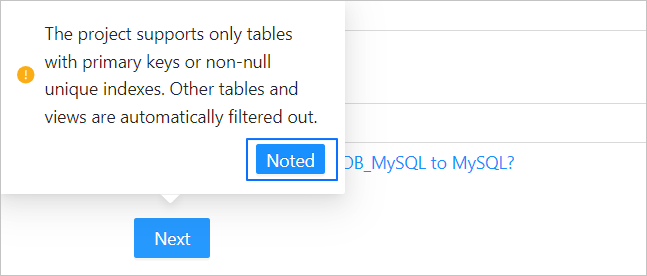
Note that this project supports only tables and views with a primary key or a non-null unique index and those without are automatically filtered out.
On the Select Migration Type page, configure the parameters.
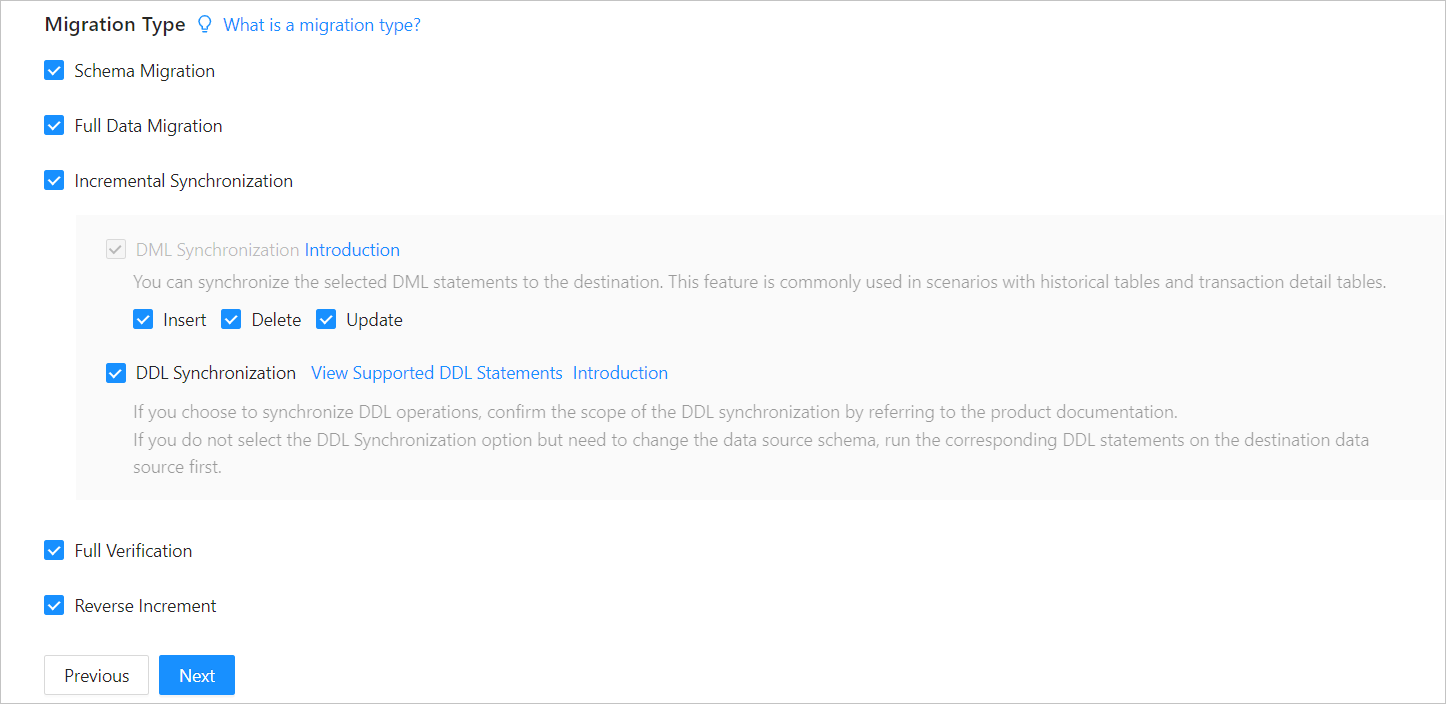
Options for Migration Type are Schema Migration, Full Data Migration, Incremental Synchronization, Full Verification, and Reverse Increment.
Migration typeDescriptionSchema migration When a schema migration task starts, OMS migrates the definitions of data objects, such as tables, indexes, constraints, comments, and views, from the source database to the destination database. Temporary tables are automatically filtered out. Full migration When a full migration task starts, OMS migrates the existing data from tables in the source database to the corresponding tables in the destination database. If you select Full Migration, we recommend that you use the RUNSTATSstatement to collect the statistics of the DB2 LUW database before data migration.Incremental synchronization When an incremental synchronization task starts, OMS synchronizes changed data in the source database to the corresponding tables in the destination database. Data changes are data addition, modification, and deletion.
Options for Incremental Synchronization are DML Synchronization and DDL Synchronization. You can select the options as needed. For more information about DDL synchronization, see Synchronize DDL operations from an Oracle tenant of OceanBase Database to a DB2 LUW database. Incremental Synchronization has the following limitations:- If OMS for ARM is used, Incremental Synchronization is not supported.
- If you select DDL Synchronization, when you perform a DDL operation that cannot be synchronized by OMS in the source database, data migration may be interrupted.
- If the DDL operation creates a new column, we recommend that you set the attribute of the column to NULL. Otherwise, data migration may be interrupted.
Full verification After the full data migration and incremental data synchronization are completed, OMS automatically initiates a full data verification task to verify the data tables in the source and destination databases. - If you select Full Verification, we recommend that you collect the statistics of the DB2 LUW database and the Oracle tenant of OceanBase Database before full verification. For more information about how to collect statistics of an Oracle tenant of OceanBase Database, see Manually collect statistics.
- If you have selected Incremental Synchronization but did not select all DML statements in the DML Synchronization section, OMS does not support full verification.
Reverse incremental migration When a reverse incremental migration task starts, OMS migrates the data changed in the destination database after the business switchover back to the source database in real time. You cannot select Reverse Increment in the following cases: - Data merge migration that involves multiple tables is enabled.
- Multiple source schemas map to the same destination schema.
(Optional) Click Next.
If you have selected Reverse Increment but the related parameters are not configured for the destination Oracle tenant of OceanBase Database, the More About Data Sources dialog box appears, prompting you to configure related parameters. For more information about the parameters, see Create a physical OceanBase data source or Create a public cloud OceanBase data source.
After you configure the parameters, click Test Connection. After the test succeeds, click OK.
Click Next. On the Select Migration Objects page, specify the migration objects and migration scope.
You can select Specify Objects or Match Rules to specify the migration objects.
Select Specify Objects. Then select the objects to be migrated on the left and click > to add them to the list on the right. You can select tables and views of one or more databases as the migration objects.
Notice
The names of tables to be migrated, as well as the names of columns in the tables, must not contain Chinese characters.
If the database or table name contains a double dollar sign ($$), you cannot create the migration project.
After you select migration objects by using the Specify Objects option, the DDL operations take effect only for selected objects, and table creation is not supported.
OMS automatically filters out unsupported tables.
OMS also allows you to import objects from text, rename objects, set row filters, view column information, and remove a single object or all objects to be migrated.
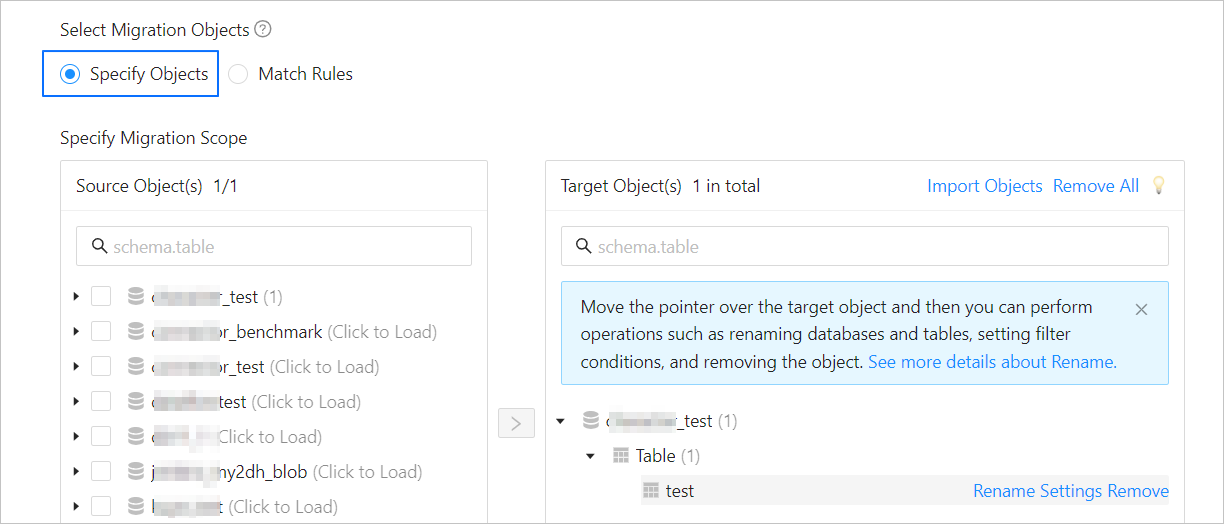 OperationDescription
Import objects - In the list on the right of the Specify Migration Scope section, click Import Objects in the upper-right corner.
- In the dialog box that appears, click OK.
Notice
This operation will overwrite previous selections. Proceed with caution. - In the Import Objects dialog box, import the objects to be migrated.
You can import CSV files to rename databases/tables and set row filtering conditions. For more information, see Download and import the settings of migration objects. - Click Validate.
- After the validation succeeds, click OK.
Rename objects OMS allows you to rename the migration objects. For more information, see Rename a migration or synchronization object. Configure settings OMS allows you to use the WHEREclause to filter rows. For more information, see Use SQL conditions to filter data.
You can also view column information of the migration object in the View Column section.Remove one or all objects During data mapping, OMS allows you to remove one or more selected objects to be migrated or synchronized to the destination. - To remove a single migration object:
In the list on the right of the Specify Migration Scope section, move the pointer over the target object, and click Remove. - To remove all migration objects:
In the list on the right of the Specify Migration Scope section, click Remove All in the upper-right corner. In the dialog box that appears, click OK.
Select Match Rules. For more information, see Configure matching rules for migration objects.
Click Next. On the Migration Options page, configure the following parameters.
Full migration
The following parameters are displayed only if you have selected Full Data Migration on the Select Migration Type page.
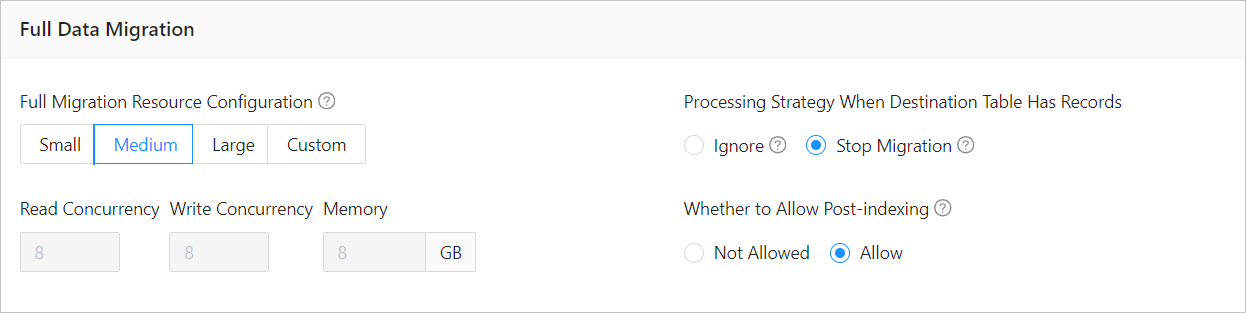 ParameterDescription
Full Migration Resource Configuration You can select Small, Medium, or Large to use the corresponding default values of Read Concurrency, Write Concurrency, and Memory. You can also customize the resource configurations for full migration. Through resource configuration for the Full-Import component, you can limit the resource consumption of a project in the full migration phase. Notice
In the case of custom configurations, the minimum value is 1, and only integers are supported.
Processing Strategy When Destination Table Has Records Valid values: Ignore and Stop Migration. - If you select Ignore, when the data to be written conflicts with the existing data of a destination table, OMS logs the conflicting data while retaining the existing data.
Notice
If you select Ignore, data is pulled in IN mode for full verification. In this case, the scenario where the destination contains more data than the source cannot be verified, and the verification efficiency will be decreased.
- If you select Stop Migration and a destination table contains records, an error is returned during full migration, indicating that the migration is not allowed. In this case, you must clear the data in the destination table before you can continue with the migration.
Notice
After an error is returned, if you click Resume in the dialog box, OMS ignores this error and continues to migrate data. Proceed with caution.
Whether to Allow Post-indexing Specifies whether to create indexes after the full migration is completed. Post-indexing can shorten the time required for full migration. For more information about the considerations on post-indexing, see the description below. Notice
This feature is supported only if you have selected both Schema Migration and Full Data Migration on the Select Migration Type page.
- Only non-unique key indexes can be created after the migration is completed.
- OceanBase Database V1.x does not support the post-indexing feature.
If post-indexing is allowed, we recommend that you adjust the parameters based on the hardware conditions of your OceanBase database and the current business traffic.
If you use OceanBase Database V4.x, adjust the following parameters of the
systenant and business tenants by using a CLI client.Adjust the parameters of the
systenant// parallel_servers_target specifies the queuing conditions for parallel queries on each server. // To maximize performance, we recommend that you set this parameter to a value greater than, for example, 1.5 times, the number of physical CPU cores. In addition, make sure that the value does not exceed 64, to prevent database kernels from contending for locks. set global parallel_servers_target = 64;Adjust the parameters of a business tenant
// Specify the limit on the file memory buffer size.
alter system set _temporary_file_io_area_size = '10' tenant = 'xxx';
// Disable throttling in V4.x.
alter system set sys_bkgd_net_percentage = 100;
If you use OceanBase Database V2.x or V3.x, adjust the following parameters of the
systenant by using a CLI client.// parallel_servers_target specifies the queuing conditions for parallel queries on each server. // To maximize performance, we recommend that you set this parameter to a value greater than, for example, 1.5 times, the number of physical CPU cores. In addition, make sure that the value does not exceed 64, to prevent database kernels from contending for locks. set global parallel_servers_target = 64; // data_copy_concurrency specifies the maximum number of concurrent data migration and replication tasks allowed in the system. alter system set data_copy_concurrency = 200;
- If you select Ignore, when the data to be written conflicts with the existing data of a destination table, OMS logs the conflicting data while retaining the existing data.
Incremental synchronization
The following parameters are displayed only if you have selected Incremental Synchronization on the Select Migration Type page.
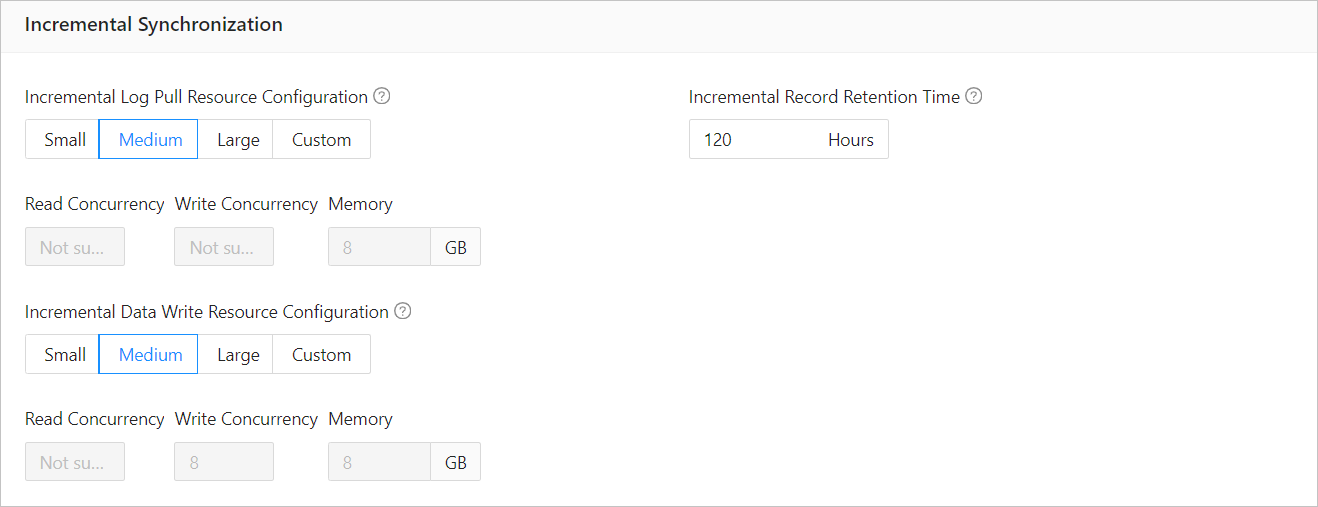 ParameterDescription
Incremental Log Pull Resource Configuration You can select Small, Medium, or Large to use the corresponding default value of Memory. You can also customize the resource configurations for incremental log pull. Through resource configuration for the Store component, you can limit the resource consumption of a project in log pull in the incremental synchronization phase. Notice
In the case of custom configurations, the minimum value is 1, and only integers are supported.
Incremental Data Write Resource Configuration You can select Small, Medium, or Large to use the corresponding default values of Write Concurrency and Memory. You can also customize the resource configurations for incremental data write. Through resource configuration for the Incr-Sync component, you can limit the resource consumption of a project in data writes in the incremental synchronization phase. Notice
In the case of custom configurations, the minimum value is 1, and only integers are supported.
Incremental Record Retention Time The duration that incremental parsed files are cached in OMS. A longer retention period results in more disk space occupied by the Store component. Incremental Synchronization Start Timestamp - If you have set the migration type to Full Data Migration, this parameter is not displayed.
- If you have selected Incremental Synchronization but not Full Data Migration, specify a point in time after which the data is to be synchronized. The default value is the current system time. For more information, see Set an incremental synchronization timestamp.
Reverse incremental migration
The following parameters are displayed only if you have selected Reverse Increment on the Select Migration Type page. The parameters for reverse incremental migration are consistent with those for incremental synchronization. You can select Reuse Incremental Synchronization Configuration in the upper-right corner.
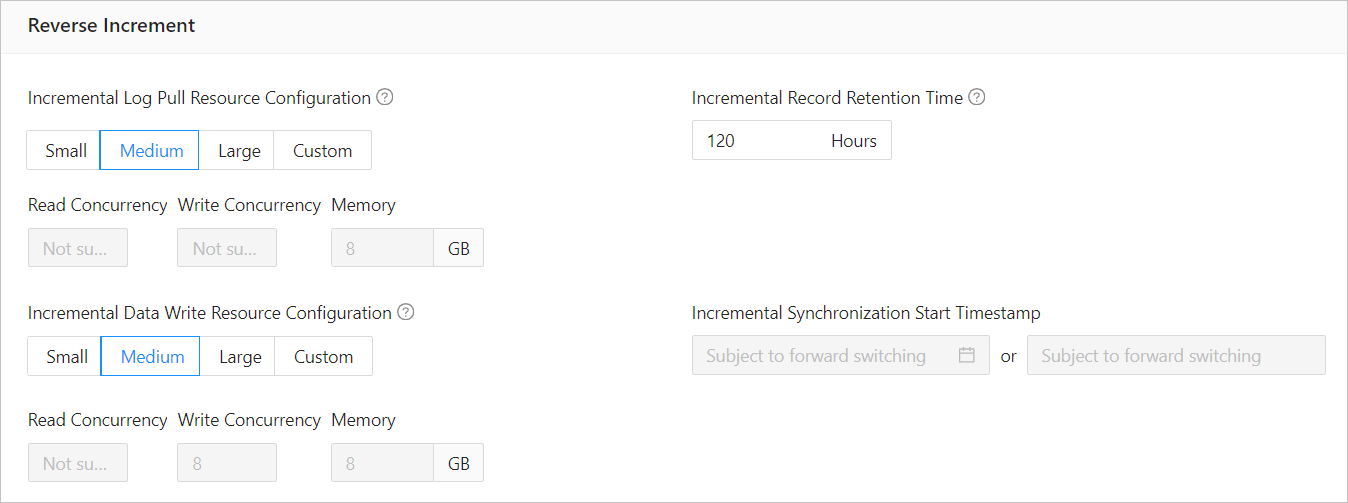
Full verification
The following parameters are displayed only if you have selected Full Verification on the Select Migration Type page.
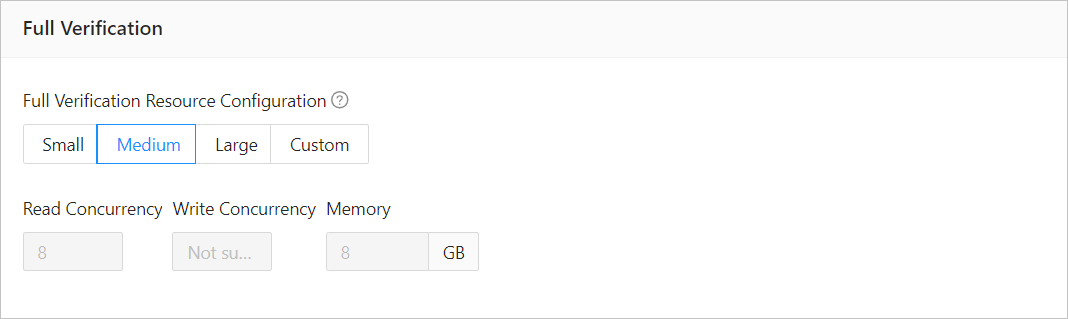 ParameterDescription
Full Verification Resource Configuration You can select Small, Medium, or Large to use the corresponding default values of Read Concurrency and Memory. You can also customize the resource configurations for full verification. Through resource configuration for the Full-Verification component, you can limit the resource consumption of a project in the full verification phase. Notice
In the case of custom configurations, the minimum value is 1, and only integers are supported.
If the parameter settings on the page cannot meet your requirements, you can click Parameter Configuration in the lower part of the page to configure more specific settings. You can also reference an existing project or component template.
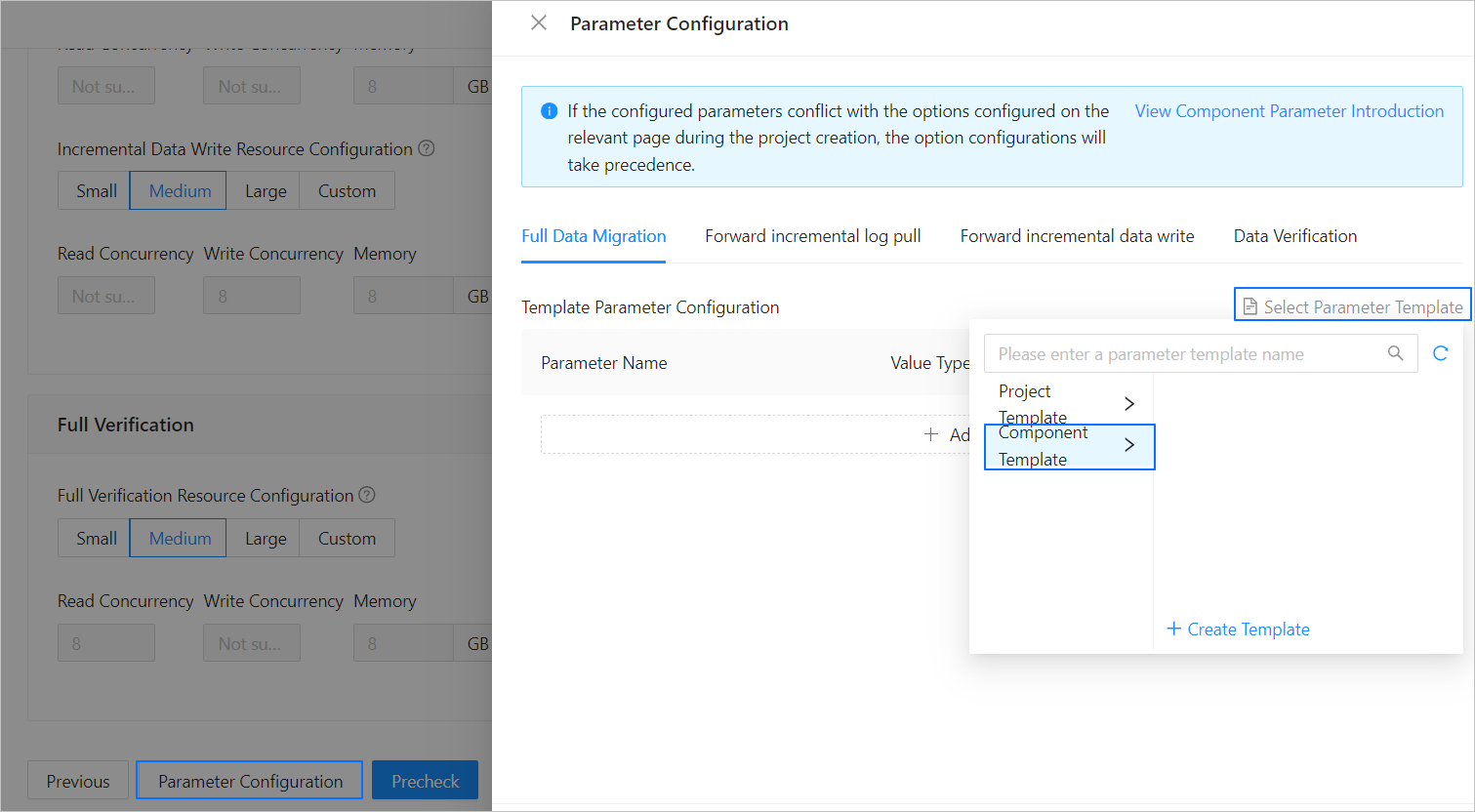
Click Precheck to start a precheck on the data migration project.
During the precheck, OMS checks the read and write privileges of the database users and the network connections of the databases. The data migration project can be started only after it passes all check items. You can perform one of the following operations if an error is returned during the precheck:
Identify and troubleshoot the problem and then perform the precheck again.
Click Skip in the Actions column of a failed precheck item. In the dialog box that appears, you can view the prompt for the consequences of the operation and click OK.
- Click Start Project. If you do not need to start the project now, click Save to go to the details page of the data migration project. You can start the project later as needed.
OMS allows you to modify the migration objects when the data migration project is running. For more information, see View and modify migration objects. After a data migration project is started, the migration subtasks will be executed based on the selected migration types. For more information, see the "View migration details" section in the View details of a data migration project topic.